
Share this @internewscast.com
In recent days, one clear lesson has emerged: Bitcoin may not be the reliable store of value that some proponents suggest. Contrary to claims of it being akin to digital gold, its performance tells a different story.
For those who invested in Bitcoin over the last 15 months, the experience has been financially draining. At one point on Thursday, its value had plummeted to less than half of its all-time high of $122,200 from October of the previous year. The Bitcoin bubble appears to have burst.
Nevertheless, another truth became apparent. There will always be those ready to chase a dream, at least until that dream collapses.
Despite recent downturns, the world’s leading cryptocurrency showed signs of life with a robust rebound on Friday, thanks to investors eager to “buy on the dips.”
There might still be enough optimism to sustain this rebound, yet we must seriously consider the possibility that Bitcoin and other cryptocurrencies might ultimately hold no intrinsic value, and ponder the implications of such a scenario.
Could they truly be worthless? Richard Farr, the chief market strategist at Pivotus Partners, a US-based market research firm, certainly thinks so. He has boldly set a target price of zero for Bitcoin and has not hesitated to share this view publicly.

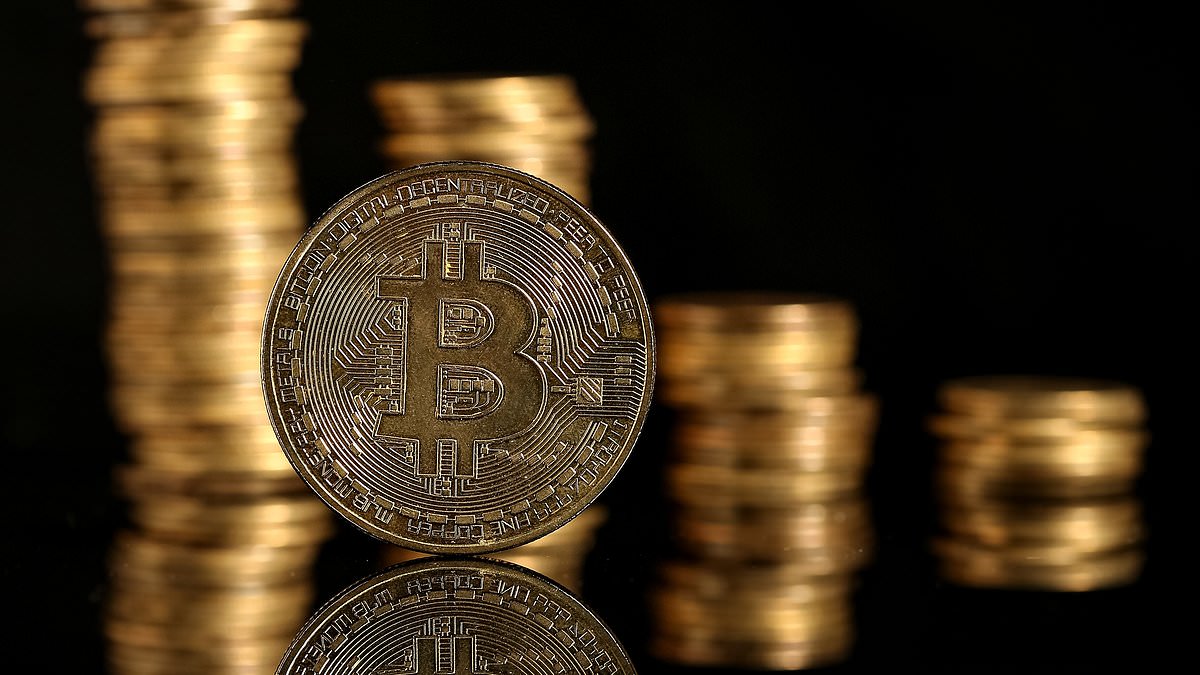
Sinking feeling: If you have the misfortune of holding any Bitcoin bought in the past 15 months you have lost money
As you might imagine that has caused quite a stir, but I think he is right. There’s no intrinsic value to any of these so-called currencies. There’s no income, no assets. All that’s behind them is the belief of people who hold them.
I can’t give a date but I’m confident that, in the fullness of time, Bitcoin will indeed be worth zero.
What’s more, I am confident that this would bring huge benefits to our shaky financial system, and the world economy as a whole.
Here’s why. The function of our market economy is to generate wealth by taking savings of ordinary people and parcelling them into a form that generates investment and hence drives growth.
The mechanisms vary. If you put money in a bank or a building society it goes into mortgages or loans for firms – or most of it does. If you own shares in a firm you directly or indirectly support the activities of that enterprise.
We should cheer if Bitcoin and the rest of them bite the dust. They are socially useless
You can even argue that if you buy government securities, gilts here in the UK, you are paying for the investments that the Government is making on our behalf, even if too many of those investments are poor ones, such as HS2.
Now, it’s true that the mechanics of our capitalist system are imperfect. In 2009, as the financial crash unfolded, Lord Adair Turner caused a stir by saying the financial sector had become too big, and that much of what went on in it was socially useless.
He had taken over as chairman of the Financial Services Authority watchdog, having been head of the Confederation of British Industry and vice-chairman of Merrill Lynch Europe.
Some felt he was rather biting the hand that had fed him. But he was courageous and he was right. The financial system had become overly complex, and it was duly punished for its excesses.
It is easy to see imperfections now. But mainstream finance is doing its basic job of financing investment, notably by supplying the wall of money going into the high-tech enterprises building and deploying artificial intelligence, and even more controversially, into Government spending.
But at least there is something there. With Bitcoin there isn’t.
That’s why we should cheer if Bitcoin and the rest of them bite the dust. They are socially useless. Inevitably some people would be hurt, there would be knock-ons, and that is not nice.
But it is hard to see the financial system as a whole being threatened as it was in 2008-9. Bitcoin isn’t big enough to do so. Its market capitalisation is $1.4 trillion (£1 trillion), and that of the entire crypto-currency world less than $3 trillion. For context, US equities are worth $70 trillion.
There’s danger, of course. But there won’t be an overall market meltdown. The central banks know how to pile in and stop that.
Most important of all, would be the positive impact of the end of cryptocurrencies on the financial system as a whole. It needs risk-takers, but now and again their enthusiasm fuels excess.
Cryptocurrencies are not the only manifestation of that excess, but they are part of it. We need the socially useless parts of finance to be beaten down to keep the vital elements of it sweet.
DIY INVESTING PLATFORMS
AJ Bell

AJ Bell
Easy investing and ready-made portfolios
Hargreaves Lansdown

Hargreaves Lansdown
Free fund dealing and investment ideas
interactive investor

interactive investor
Flat-fee investing from £4.99 per month
Freetrade

Freetrade
Investing Isa now free on basic plan
Trading 212

Trading 212
Free share dealing and no account fee
Affiliate links: If you take out a product This is Money may earn a commission. These deals are chosen by our editorial team, as we think they are worth highlighting. This does not affect our editorial independence.
Compare the best investing account for you