
Share this @internewscast.com
Historically, stock market crashes have often been precipitated by conflicts between the United States and Europe, especially following periods marked by excessive market enthusiasm.
During the 1930s, the implementation of tariffs under the Smoot-Hawley Act led to retaliatory measures from U.S. trading partners, significantly contributing to the onset of the Great Depression.
In 1987, a critical decision by the Bundesbank to raise interest rates played a pivotal role in triggering a market collapse.
Currently, a potential crisis looms as tensions rise from former President Donald Trump’s attempts to pressure NATO allies into agreeing to his plans to exert influence over Greenland.
Monday’s relatively subdued reaction in equity and bond markets can be attributed to the closure of Wall Street in observance of the Martin Luther King Jr. holiday.
With the dominant Dow Jones and tech-centric Nasdaq markets inactive, trading in the Pacific and European markets occurred in a vacuum.

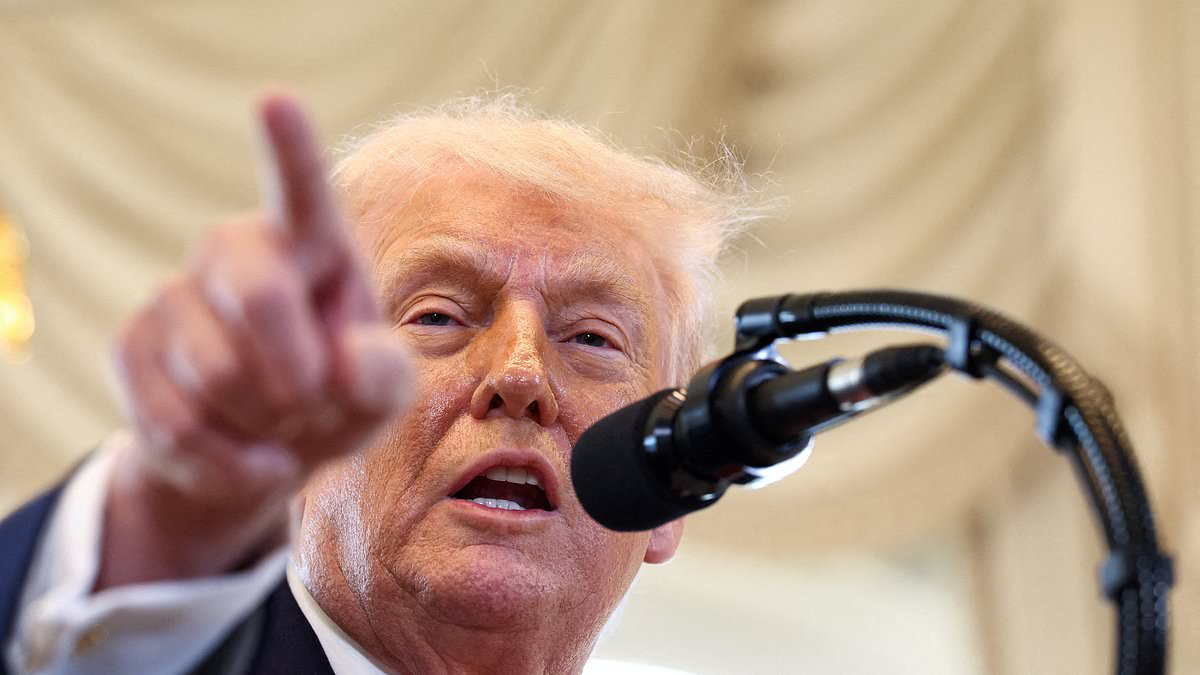
Demands: US President Donald Trump (pictured) is hitting nations which oppose his push to acquire Greenland, which includes the UK, with 10% tariffs set to rise to 25%
One understands why the European Union, in defence of Nato members, is threatening to counter Trump’s proposed tariff with £81billion of tit-for-tat trade sanctions. In this case, Keir Starmer’s jaw-jaw rather than war-war looks more sensible.
The Liberation Day tariffs of April 2025 caused a 10 per cent drop in global equity prices. Even though they recovered, fuelled by the AI investment drama, the productivity revolution may still be years away.
The IMF’s latest World Economic Outlook looks dated before the ink has dried. The Fund economists credit easing trade tensions and higher fiscal stimulus as reasons why world growth this year will be robust at 3.3 per cent.
Rachel Reeves hailed the relatively upbeat UK forecast of 1.3 per cent this year and 1.5 per cent next as an unalloyed triumph.
But if big UK exporters such as JLR, Diageo et al find themselves locked out of the vast US market because of elevated tariffs, it could be an unalloyed disaster.
As always with Trump, there is speculation that the 10 per cent Greenland tariff, scheduled to eventually rise to 25 per cent, is chimera which can be negotiated away.
There is also a quaint belief that the Supreme Court will declare the President’s use of the trade weapon, without Congressional approval, to be illegal.
But no one should underestimate the ability of a wily and ruthless White House team to find a workaround.
The ultimate fear is that the bullying Greenland tariff becomes the straw which wrecks market confidence already stressed by uncertainty over leadership at the Federal Reserve and an AI bubble.
Nerve-racking days lie ahead and investors in those ultimate defensive assets, gold and silver, are taking no chances by going on a spree.
Mighty Quinn
Leo Quinn is the kind of unassuming executive needed in hard times. When he took on the role of chief executive at Balfour Beatty, the whole infrastructure sector was in dire straits after the implosion at Carillion.
Under his leadership, the group’s fortunes were transformed. The value of the group’s unfashionable stock almost doubled during his stewardship.
His move to troubled WH Smith, up to its neck in an accounting mess, will come as an enormous lift. The 11 per cent rise in its stock demonstrated this.
As executive chairman, with the possibility of passing ‘Go’ and collecting a £24.5million fee, Quinn is testing the patience of
governance mavens. But all-powerful chairmen, even if backed by a chief executive, are the rage at present, following Archie Norman’s revival of M&S and a belief in Albert Manifold at BP.
Retail requires a peculiar set of skills. Quinn’s career in engineering has been very different. A smarter government would have enlisted him to bring the Northern Powerhouse railway to fruition, or discipline to HS2.
Grasping Gnomes
Despite the FTSE 100 scaling new heights, the London discount has not been wiped out.
Zurich’s £7.7billion opportunistic swoop on Lloyd’s broker Beazley sent the shares rocketing 42 per cent.
It follows several efforts by Zurich to persuade Beazley to submit to its charms.
The valuation looks light and speaks volumes for the way the London insurance market is prospering, with innovation including cyber.
One fears that the pioneering, entrepreneurial City spirit would only be eroded by another overseas swoop.
DIY INVESTING PLATFORMS
AJ Bell

AJ Bell
Easy investing and ready-made portfolios
Hargreaves Lansdown

Hargreaves Lansdown
Free fund dealing and investment ideas
interactive investor

interactive investor
Flat-fee investing from £4.99 per month
Freetrade

Freetrade
Investing Isa now free on basic plan
Trading 212

Trading 212
Free share dealing and no account fee
Affiliate links: If you take out a product This is Money may earn a commission. These deals are chosen by our editorial team, as we think they are worth highlighting. This does not affect our editorial independence.
Compare the best investing account for you