Share this @internewscast.com
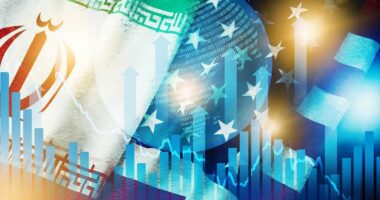
In the aftermath of US President Donald Trump’s announcement of military action against Iran, the financial world’s barometer of fear, the VIX index, soared to a striking intra-day peak of 35.3.
This significant spike is noteworthy even for the VIX, a term commonly used to refer to the Chicago Board Options Exchange’s CBOE Volatility Index.
For those who might find the VIX to be a complex concept, it’s actually a crucial metric for investors and analysts. It measures market expectations for trading futures and options on the S&P 500, a key indicator that influences the global stock market’s overall sentiment.
Typically, a VIX reading in the realm of 15 is considered normal and stable. However, when the index exceeds 30, it signals an environment of extreme volatility, akin to financial Armageddon.
This level of turbulence has driven investors worldwide to offload equities at a rapid pace, as if there were no tomorrow.
Even seasoned professionals have not been immune. Reports from some of Wall Street’s leading banks indicate that hedge funds experienced one of their most challenging months in March.

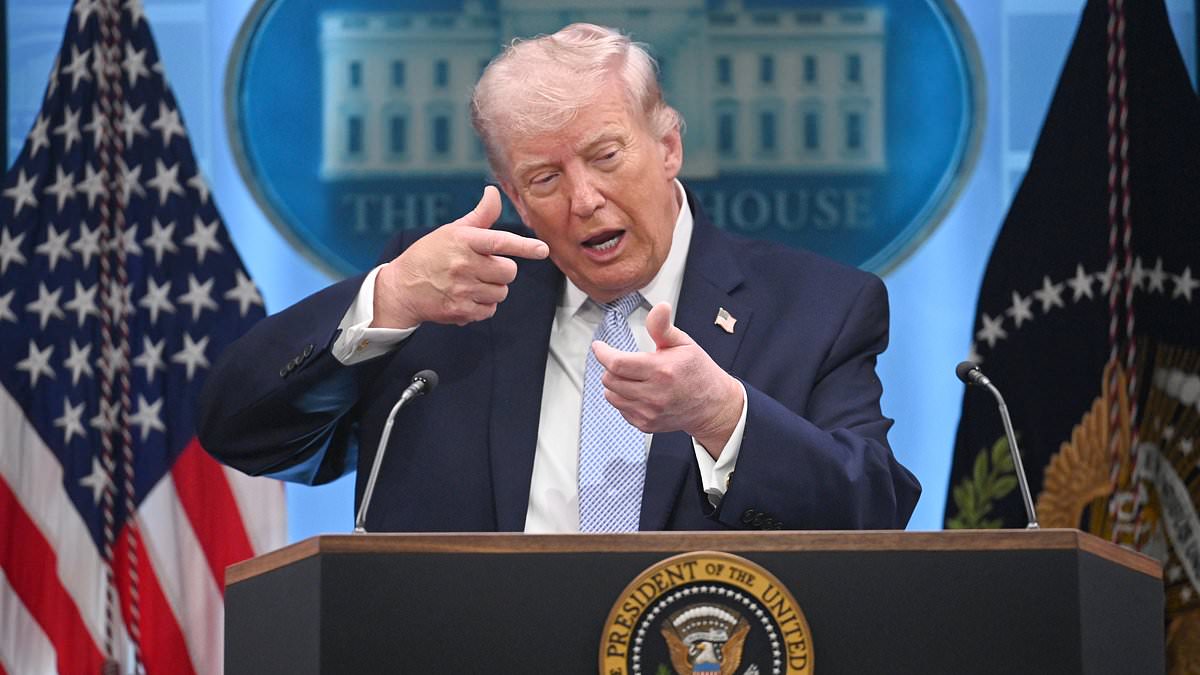
Economic threat: President Trump, pictured, has announced a 50% tariff on countries supplying Iran with arms, a threat aimed mainly at Russia
Here in the UK, fund withdrawals soared by 55 per cent in March to £1.44billion on fears that the US-Iran war would trigger a catastrophic economic crisis that could put the financial crash of 2008 into the shade.
So it’s no surprise that within hours of Trump and Tehran announcing their last-minute ceasefire, the VIX index fell sharply to around 20, indicating that the market mood is on the turn.
And so it is, for now at least. The S&P 500 opened up more than 2 per cent after the news, with the Dow Jones and the Nasdaq indices rising by similar amounts.
The FTSE 100 was up 2.5 per cent and the FTSE 250 rose more than 4 per cent. Bond yields dropped, a rare bit of good news for Chancellor Rachel Reeves as the likelihood of higher interest rates recedes.
Even so, the UK remains more vulnerable than any of its European peers to further geopolitical shocks because of its exorbitant energy costs and higher than average borrowing costs.
Oil and gas prices fell, but are still a quarter to a half higher than they were before the conflict.
What’s more, costs are likely to stay high, particularly for jet fuel, because of the hit to oil production facilities in the Gulf.
And so will prices of key industrial ingredients such as fertiliser and helium, still stuck on ships waiting to leave the Strait of Hormuz’s chokehold.
While Trump may have got his off-ramp, it’s by no means clear how the Iranians will charge toll fees on the ships trying to pass through the strait, which has already been nicknamed the Tehran Toll Booth. (Oman is saying it won’t charge ships passing through.)
Predictably, Trump fired back with his favourite weapon – announcing a 50pc tariff on countries supplying Iran with arms, a threat aimed mainly at Russia.
For now, it seems as though Iran has Trump over a barrel, a rather fat, pricey oil barrel at that. Neither side is speaking the language of a ceasefire, more of a stalemate, a dangerous tit-for-tat.
Keep an eye on that VIX index.
Brighter than the sun
On A brighter note, the Artemis II space mission shows mankind at its most enlightened.
The engineering skills involved are sensational, while the mental strength and agility of the astronauts is truly mind-boggling.
What’s even more extraordinary is that NASA hopes to have fully operational space stations, with humans working there, on the moon within two years.
Much of the work supporting this mission and future Artemis lunar landings is being carried out by the UK Space Agency, the European Space Agency (ESA) as well as private companies, based at the Harwell Space Cluster, near Oxford.
Harwell, which I have visited, is Europe’s biggest space cluster, with more than 100 space organisations which employ over 1,600 people on a myriad of projects and it’s big business.
Thales Alenia Space is working on the critical propulsion subsystem for the ESA’s Argonaut programme, while Nammo Space is creating an engine allowing safe landings on the Moon’s surface.
Harwell is the most fascinating place, well worth a visit, especially the Diamond Light Source, where you can see star dust particles from a comet some 242m miles away because of the light beamed from the synchrotron – some 10bn times brighter than the sun.
Alex Brummer is away
DIY INVESTING PLATFORMS
AJ Bell
AJ Bell
Easy investing and ready-made portfolios
Hargreaves Lansdown
Hargreaves Lansdown
Free fund dealing and investment ideas
interactive investor

interactive investor
Flat-fee investing from £4.99 per month
Freetrade

Freetrade
Investing Isa now free on basic plan
Trading 212

Trading 212
Free share dealing and no account fee
Affiliate links: If you take out a product This is Money may earn a commission. These deals are chosen by our editorial team, as we think they are worth highlighting. This does not affect our editorial independence.
Compare the best investing account for you