Share this @internewscast.com
Subscribe to the White House Watch newsletter at no cost.
Donald Trump, despite abstaining from alcohol, is described by his chief of staff, Susie Wiles, as having an “alcoholic’s personality.” Such personalities often exhibit compulsive and risk-taking behaviors, finding solace in actions that momentarily relieve discomfort or pain.
For Trump, this discomfort is increasingly rooted in domestic challenges. His approval ratings are stagnant, showing no signs of improvement, which drives him to seek distractions and achievements on the international stage. When troubles brew at home, the allure of making bold moves abroad becomes irresistible.
While many U.S. presidents turn to foreign policy as their terms progress, Trump’s approach is distinct. He has come to realize that bypassing international norms is often simpler than navigating U.S. legal proceedings. For instance, he justified the recent abduction of Venezuela’s Nicolás Maduro by citing a U.S. warrant, deploying American forces to capture a fugitive in the jungle. The strategy proved effective, as long as the opposition was outmatched.
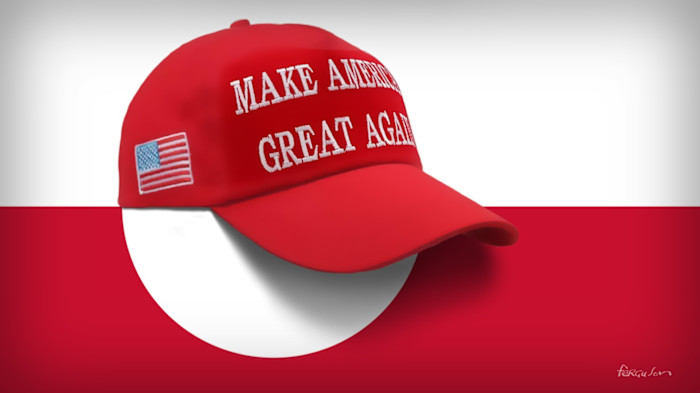
Trump’s growing confidence in wielding America’s military might unchecked has raised concerns among other nations. Denmark, for instance, has expressed unease following his unsolicited remarks about Greenland during a press appearance post-Maduro. Trump has repeatedly asserted the strategic necessity of Greenland, stating, “we need” the territory for U.S. security. However, Denmark’s Prime Minister, Mette Frederiksen, countered by dismissing the notion as senseless. In response, Trump reiterated Greenland’s importance, questioning Denmark’s recent security efforts by quipping about their addition of a single dog sled.
“You know what Denmark did recently to boost up security in Greenland?” he asked. “They added one more dog sled.”
Such is Trump’s fixation that he appointed a Greenland envoy — the Republican governor of Louisiana, Jeff Landry — just before Christmas. “It’s an honour to serve you in this volunteer position to make Greenland a part of the US,” Landry said. Last year Trump dispatched his vice-president, JD Vance, uninvited to Greenland to survey the territory. Anyone who is confident that Trump is merely trolling should book a holiday in Caracas.
But why Greenland? First, because it would be easy. Much like “Operation Absolute Resolve” in Venezuela, Trump could annex Greenland from the performative comfort of the situation room (he created a look-alike in Mar-a-Lago). It would take an hour or two and risk no US casualties. That way Trump can keep emulating Barack Obama, those iconic pictures of whom watching the 2011 killing of Osama bin Laden he so envies. Though Danes are no pacifists, resisting the superpower would be suicidal.
Second, adding Greenland to his column would be lucrative. Trump’s libertarian friends have been eyeing it for some time. Peter Thiel, who wants to set up crypto-empowered “network states” on undeveloped territory, has invested in Praxis, a start-up that aims to do just that and which has scouted Greenland. Trump’s ambassador to Denmark, Ken Howery, was a co-founder with Thiel and Elon Musk of PayPal. Silicon Valley is awash with billionaires invested in one kind of networked venture or another. Greenland is high on most lists. Unlike Mars, occupying Greenland is doable.
On top of pleasing the libertarians, taking Greenland would go down well with Maga ideologues, since it would kill Nato in one swoop. Denmark could invoke article V in which an attack on one is an attack on all. Since America leads Nato, the treaty would be void. No ally would come to Denmark’s defence. Were Denmark to accept the fait accompli, the result would be the same. Either way, geography, not law, would do Trump’s explaining. Though a slice of Greenland sits in the eastern hemisphere, most of it lies in the western.
It is plausible that developments in Venezuela could keep Trump’s focus on the Caribbean rather than the Arctic. A strike on a Colombian coca plantation, or a Mexican fentanyl site, would not be a shock. Cuba, likewise, should watch its back. Though Trump also covets Canada as America’s 51st state, he has largely stopped airing that ambition since Mark Carney replaced Justin Trudeau as prime minister last year. On the spectrum of Trump’s public musings, Canada is at the trolling end. The stars and stripes, on the other hand, could rise over Greenland at any time.
The betting among Trump’s domestic opponents is that he will risk more as his fortunes decline. Trump’s lawlessness is inversely related to his political woes. Democrats are expected to retake the House of Representatives in November. The pressure to release the unredacted Jeffrey Epstein files will not abate until Trump has done so, which he has made clear he never will. No good publicity can come from the impression that he is hell-bent on suppressing what he is legally obliged to make public.
Even the normally pliant US Supreme Court could deliver bad news soon if it strikes down the bulk of Trump’s tariffs. Lower courts regularly block his deployment of the US military in American cities. So far Trump has largely complied with judicial rulings. By contrast, there is no court that can realistically check his use of the US military overseas. Nor, as in his first term, are there any voices around him counselling restraint.
As a source of shock value, mission accomplished and moneymaking, Trump always has Greenland. His temptation is only likely to grow.
edward.luce@ft.com