
Share this @internewscast.com
As Thanksgiving approaches, many people might find themselves curious about why turkey eggs rarely make an appearance on the holiday table.
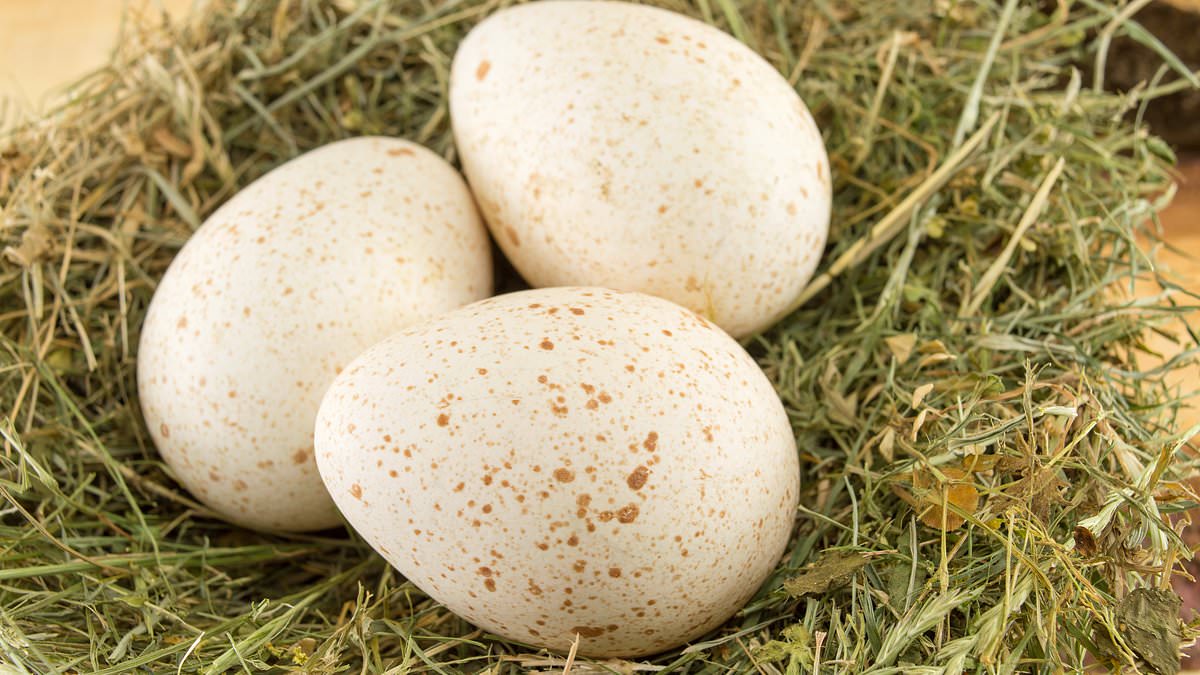
Turkey eggs are a rarity both in grocery stores and in holiday recipes.
According to experts, the explanation involves a combination of biological, economic, and practical factors.
In contrast to chickens, which typically lay an egg every day, turkeys only manage to lay one or two eggs each week.
Kimmon Williams from the National Turkey Federation shared with Modern Farmer that turkeys have a lengthier life cycle, requiring about seven months to start laying eggs.
Chickens, however, begin laying eggs much sooner, at around five months of age.
Raising turkeys is also more expensive, as they require significantly more feed and larger housing, both of which drive up production costs.
As a result, farmers would need to charge at least $3 per turkey egg, meaning a dozen would cost around $36.

Farmers would have to sell each turkey egg for at least $3, making a full dozen $36
Some cooking professionals have said that turkey eggs are better for sauces because their yolks are creamier and richer, Slate reported.
But the recommendations are not enough to get them on menus.
Turkeys are indigenous to North America, making them a staple among Native American tribes, and chickens did not arrive in the US until the 1500s.
Native Americans introduced turkeys to early European settlers in the 1600s.
The large, wild birds were exotic animals to Europeans who became instant fans.
Early Spanish explorers to the New World even returned home with turkeys, but rumors quickly spread that the eggs were linked to outbreaks of leprosy.
The suspicions were largely among the French, who were wary about the birds’ foreign origins.
In medieval Europe, diseases like leprosy were often seen as divine punishment or the result of moral failings.

Today, turkey eggs are a rarity, sought mainly by food enthusiasts or farmers looking to meet the demand for Thanksgiving
And new foods from a land deemed dangerous did not align with the established norms of the time.
But back in the US, the new settlers viewed the eggs as a luxury.
By the 18th century, their popularity in the US had grown so much that the domestication of turkeys became widespread.
New York’s iconic Delmonico’s restaurant, for instance, served turkey eggs scrambled or poached, as well as in frittatas and omelets.
However, the rise of industrial poultry farming during the 20th century changed the landscape of American food.
Technological advancements allowed farmers to specialize in chickens for egg production or meat, making chicken eggs more cost-efficient and readily available.
As a result, turkey eggs began to lose favor, and even Delmonico’s eventually removed them from their menu.
Today, turkey eggs are a rarity, sought mainly by food enthusiasts or farmers looking to meet America’s demand for Thanksgiving.
In October, the American Farm Bureau Federation, a leading agricultural trade group, warned of a possible turkey shortage after more than 600,000 birds were infected with Highly Pathogenic Avian Influenza (HPAI).
According to the Farm Bureau, HPAI has severely impacted the US turkey industry, affecting roughly 18.7 million turkeys since 2022.
So far in 2025 alone, about 2.2 million turkeys have been infected, representing a significant portion of the nation’s poultry losses.
The US Department of Agriculture estimated the average wholesale price for a frozen whole turkey at about $1.32 per pound.
This marks an increase of four cents per pound from last month and a rise of 38 cents compared with the same period in 2024, reflecting a roughly 40 percent jump in wholesale turkey prices over the past year.