
Share this @internewscast.com
Unlock the Editor’s Digest without charge
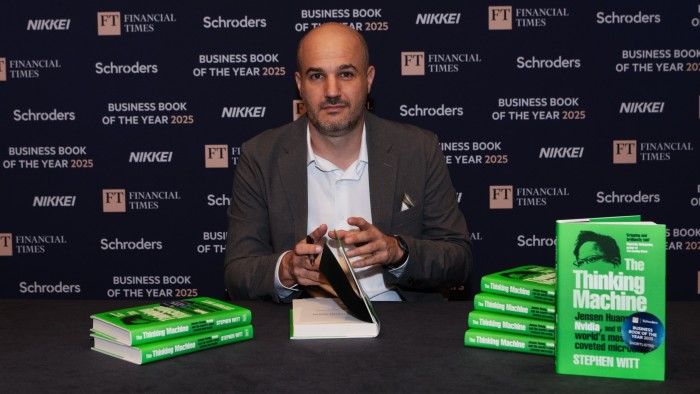
Stephen Witt’s book, The Thinking Machine, which chronicles the ascent of Nvidia and its dynamic leader, Jensen Huang, has clinched the 2025 Financial Times and Schroders Business Book of the Year Award.
This marks the second consecutive year the £30,000 prize has been awarded to a book exploring the rapid expansion of generative artificial intelligence. Last year, Parmy Olson’s Supremacy, which delved into the fierce competition between OpenAI and DeepMind, took home the honor.
During a ceremony in London on Wednesday, Richard Oldfield, CEO of the asset management company Schroders, presented Witt with the award. He highlighted the judges’ admiration for The Thinking Machine, praising its “unique insights” into the triumphs of Huang and Nvidia. Notably, in October, Nvidia became the first company to exceed a market capitalization of $5 trillion.
Roula Khalaf, editor of the Financial Times and chair of the judging panel, described the book as “a fascinating account of the making of one of the most consequential companies of our times.”
Witt, who is also a television producer and investigative journalist, was previously shortlisted for the FT award in 2015 with his book How Music Got Free, which explored how piracy and peer-to-peer sharing revolutionized the recorded music industry.
The judges also praised the five other shortlisted titles, each of which is awarded £10,000, for the way in which they summed up critical issues facing business and the world, including US-China rivalry and the quest for growth and prosperity.
The award, which is also supported by FT owner Nikkei, is now in its 21st year. Previous winners include Amy Edmondson in 2023 for Right Kind of Wrong, about how to learn from failure and take better risks, and Chris Miller’s Chip War in 2022, about the global battle for semiconductor supremacy.
The other 2025 finalists were: House of Huawei by Eva Dou, which investigates the rise of the Chinese technology company and its founder; Chokepoints by Edward Fishman, about the use of economic sanctions; How Progress Ends by Carl Benedikt Frey, on what decides the destiny of civilisations; Abundance by Ezra Klein and Derek Thompson, about the growth dilemma facing the US; and Breakneck by Dan Wang, contrasting the US and its arch-rival China.
The other judges of this year’s award were Mimi Alemayehou, founder and managing partner, Semai Ventures; Daisuke Arakawa, senior managing director for global business, Nikkei; Mitchell Baker, founder, former CEO and executive chair, Mozilla; entrepreneur, angel investor and board leader Sherry Coutu; Mohamed El-Erian, professor of practice at the Wharton School, University of Pennsylvania, chief economic adviser, Allianz, and chair, Gramercy Funds Management; James Kondo, chair, International House of Japan; Adam Osborn, head of research, Asia ex Japan equities, Schroders; Randall Kroszner, economics professor at University of Chicago’s Booth School of Business; Nicolai Tangen, CEO, Norges Bank Investment Management; and Shriti Vadera, chair of Prudential and the Royal Shakespeare Company.
For more on this year’s award and previous winners, visit www.ft.com/bookaward