
Share this @internewscast.com
Upcoming financial meetings in Washington next week were destined to be anything but straightforward.
Even before the United States and Israel launched their offensive against Iran and its allies in Lebanon, the global environment was already challenging.
Economic stagnation among the majority of the G7’s wealthiest nations, with the exception of the US, meant that hopes of controlling fiscal deficits—alarmingly high in several Western countries, including the UK—were slim.
In Britain and the US, inflation remains a persistent issue, exacerbated by the energy crisis that followed Russia’s invasion of Ukraine.
Financial markets have been particularly volatile, with disruptions in private credit markets causing several funds, such as those managed by industry giant Morgan Stanley, to restrict withdrawals.
Additionally, there is growing apprehension that the rapid pursuit of artificial intelligence has resulted in excessive financial leverage, overshadowing prudent decision-making.

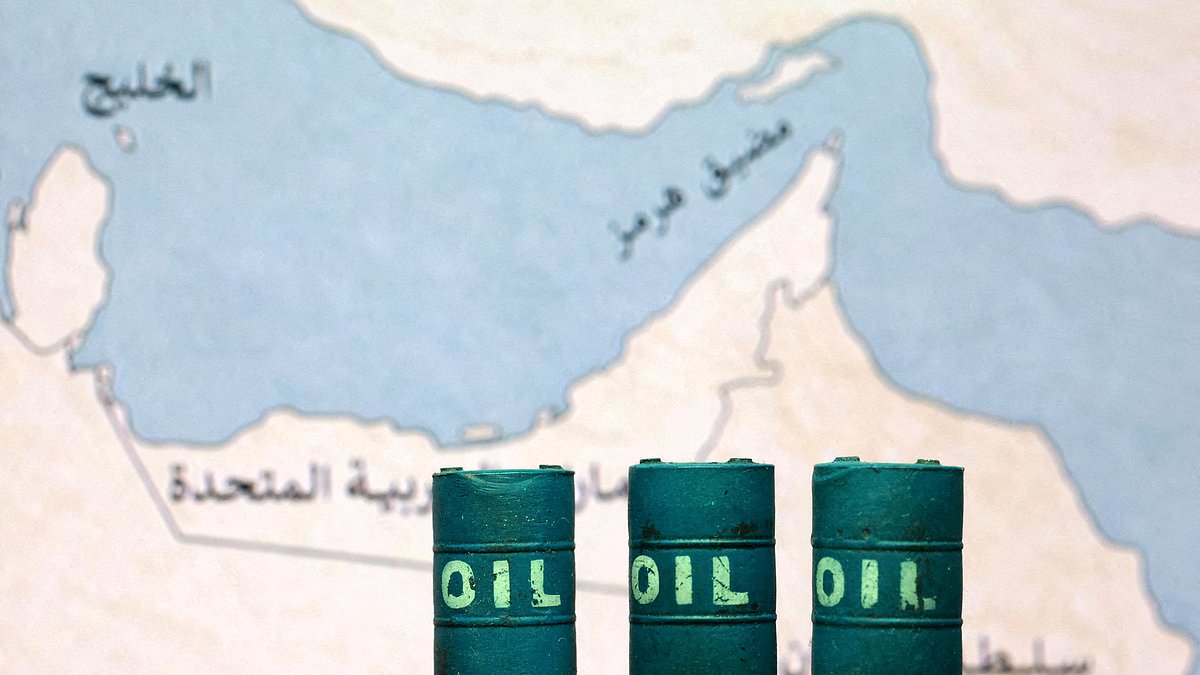
Stranglehold: The IMF says that since the start of the Iran war the world’s daily oil flow has been reduced by 13% and liquified natural gas, much of it coming from Qatar, is down by 20%
On top of this we must overlay the impact of the closure of the Strait of Hormuz. As the International Monetary Fund’s (IMF) managing director Kristalina Georgieva notes, even if the ceasefire announced by President Trump holds, terrible damage has been done.
Investors would be foolish to take comfort from a retreat in Brent crude oil prices from $120 to below $100 a barrel. They are still sharply up on the $70 mark ahead of the war.
The damage inflicted on energy infrastructure in the Gulf states has been as serious as restrictions on Hormuz traffic.
The IMF says the world’s daily oil flow has been reduced by 13 per cent and liquefied natural gas, much of it coming from Qatar, is down by 20 per cent. The consequences, ceasefire or not, are devastating.
There are global shortages of jet fuel and an extra 45m people will be suffering from food insecurity because of transport disruptions and fertiliser shortages.
The IMF’s advice to the G7 and the world is clear. Western budgets are already overwrought so countries should avoid costly bailouts to consumers. Monetary policy should take the strain.
Georgieva dismisses the arguments of those who say that monetary policy is ineffectual in a catastrophe caused by supply problems.
She says it is the job of central banks to step in and prevent inflationary expectations from getting out of hand.
Britain’s Chancellor Rachel Reeves may be able to wave away downgraded growth forecasts and higher inflation as global, and beyond Britain’s control.
Nevertheless, the fallout in terms of climbing interest rates looks disastrous for home-owners and house-buyers.
The cost of two-year fixes has climbed to 4.9 per cent and five-year fixes are 5.5 per cent for those with substantial equity.
Anyone looking for a 90 per cent mortgage will have to pay 6 per cent upwards. Higher rates come on top of harm caused by stamp duty and just-inaugurated mansion taxes.
Military retreat
The Government has sought to embrace greater defence spending as an industrial opportunity for Britain.
It hasn’t helped much that our neighbours in the EU seem determined to bar our defence champions from the spoils.
We are also engaged in an act of domestic self-harm. Blackstone’s deal for engineer Senior is the latest of a series of takeovers of the UK’s second-line defence suppliers.
Investment firm KKR bought Spectris, Keysight Technologies swallowed Spirent and Dauch won control of Dowlais (a spin-out from the old GKN).
This is on top of previous sales of Cobham, Ultra Electronics, Inmarsat et al.
Global lawyers White & Case note this sell-out is taking place as military spending is ramped up.
Yet no one in the Government seems prepared to wave a red flag and invoke the National Security and Investment Act – designed to prevent the erosion of Britain’s strategic edge.
Green revolt
Action-man chairman Albert Manifold has garnered praise since taking the helm at BP for refocusing it on fossil fuels.
But the retreat from a green agenda could mean he gets a bloody nose at the group’s annual meeting this month.
Voting adviser Glass Lewis has joined up with critics including Dutch green outfit Follow This, UK local authority pension funds and Legal & General.
They fear the climate retreat and lack of transparency has gone too far. No one is saying bring back displaced chief executive Bernard Looney just yet.
DIY INVESTING PLATFORMS
AJ Bell

AJ Bell
Easy investing and ready-made portfolios
Hargreaves Lansdown
Hargreaves Lansdown
Free fund dealing and investment ideas
interactive investor

interactive investor
Flat-fee investing from £4.99 per month
Freetrade

Freetrade
Investing Isa now free on basic plan
Trading 212

Trading 212
Free share dealing and no account fee
Affiliate links: If you take out a product This is Money may earn a commission. These deals are chosen by our editorial team, as we think they are worth highlighting. This does not affect our editorial independence.
Compare the best investing account for you