
Share this @internewscast.com
The NHS Highland health board, already grappling with financial challenges, is faced with an anticipated expense exceeding £1.3 million for establishing a new asylum seeker center. This budget covers essential services like monthly sexual health clinics, vaccination programs, and mental health support.
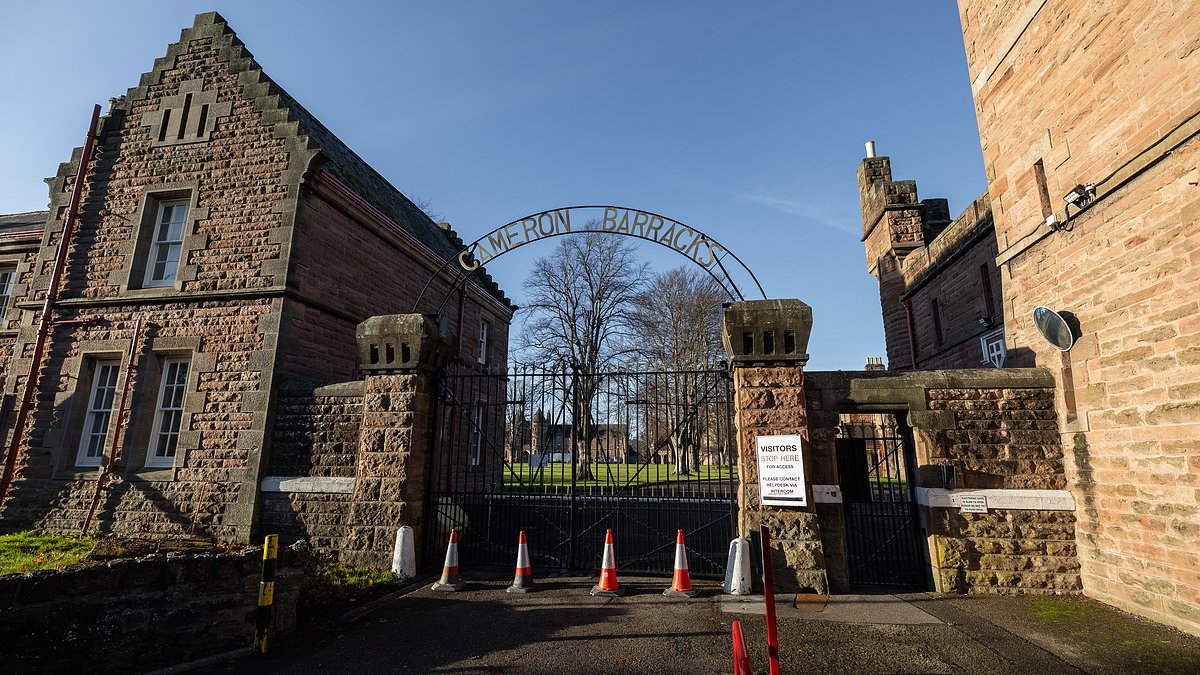
These substantial costs arise from the Home Office’s initiative to house approximately 300 asylum seekers at the Cameron Barracks military facility in Inverness.
A draft report, disclosed to the Mail, details the significant financial requirements for the proposed healthcare services at this location.
Among the expenses, £25,665 is allocated for monthly sexual health clinics, which will provide blood-borne virus screenings during weekends and offer on-site condoms.
An additional £269,899 is earmarked for vaccination clinics, which will operate two days a week with a team of two, administering vaccines for diseases like diphtheria, tetanus, and polio. Mental health services will require £87,067 for continuous ‘distress brief intervention’ support available year-round. Moreover, £115,740 will be needed to expand translation services to accommodate the diverse linguistic needs of the residents.
The report outlines the most significant expenditure as the staffing costs, estimated at £629,298. This has sparked concerns regarding its impact on NHS Highland, a health board already under financial strain.
Edward Mountain, Tory MSP for the Highlands, said: ‘This extra pressure on a cash-strapped rural health board would be intolerable. What’s more, there is a hidden burden on GPs. There is just no way practices in an around Inverness can absorb this additional load.
‘To make matters worse, the Home Office don’t appear to have made any attempt to consult the GPs who are expected to carry out so much additional work.

The Home Office plans to accommodate around 300 asylum seekers at the Cameron Barracks military base in Inverness

An anti immigration protest in Inverness after the plans were announced
‘No-one expects such a movement of people to come at no cost, but I really cannot see why taxpayers need to spend thousands on sexual health provision.
‘People are already angry at this plan, and ridiculous add-ons like that will only make the situation worse. The overall eye-watering cost underlines yet again how inappropriate and unsustainable this whole idea is.’
The Home Office originally wanted to move asylum seekers in by early December and use the site for 12 months, but the plans were delayed.
Earlier this month, it was revealed planning rules could create a further delay as Highland Council may need to approve a change of use from barracks to hostel if it is to be used as asylum seeker accommodation for more than six months.
The leaked draft NHS Highland ‘costing proposal’ for the Barracks written in December, assumes there will be around 250 people on site at one time, staying for 70-90 days each, and that the site will be occupied for 12 months.
It states that ‘NHS Highland acute health system is under considerable strain. It is therefore imperative we develop a Core Site Team to ensure people are signposted to the appropriate service avoiding A&E wherever possible’.
The report proposes this consists of two nurses and an admin assistant while there will also be a social worker to address ‘support and protection issues’.
Every new resident will receive a health assessment upon arrival, and those requiring a GP or other services will be given support.
A UK Government spokesman said: ‘We work closely with health partners to minimise the impact on the local community, GP practices and existing NHS resources.’
A health board spokesman said: ‘NHS Highland can confirm we have established an operational group to undertake a detailed review of our costing proposal for the Home Office.’
The Home Office said it is assessing the feasability of the Cameron Barracks site, working closely with local health partners to minimise the impact on the local community, and ensuring people get access to the healthcare they need while protecting protecting local services.
A UK Government spokesman said: ‘We are furious at the level of illegal migrants and asylum hotels. This government will close every asylum hotel. Work is well underway, with more suitable sites, such as military bases, being brought forward to ease pressure on communities.
‘We work closely with health partners to minimise the impact on the local community, reducing reliance on local GP practices and minimising pressure on existing NHS resources.’
An NHS Highland spokesman said: ‘NHS Highland can confirm that we have established an Operational Group to undertake a detailed review of our costing proposal for the Home Office.
‘We will continue to work closely with the Scottish Government, Scottish Refugee Council, Home Office, Highland Council and other key partners to ensure that high-quality, coordinated core services are delivered in a sustainable way.
‘Our priority remains meeting the needs of people seeking asylum and delivering high-quality support and services across all core services.’