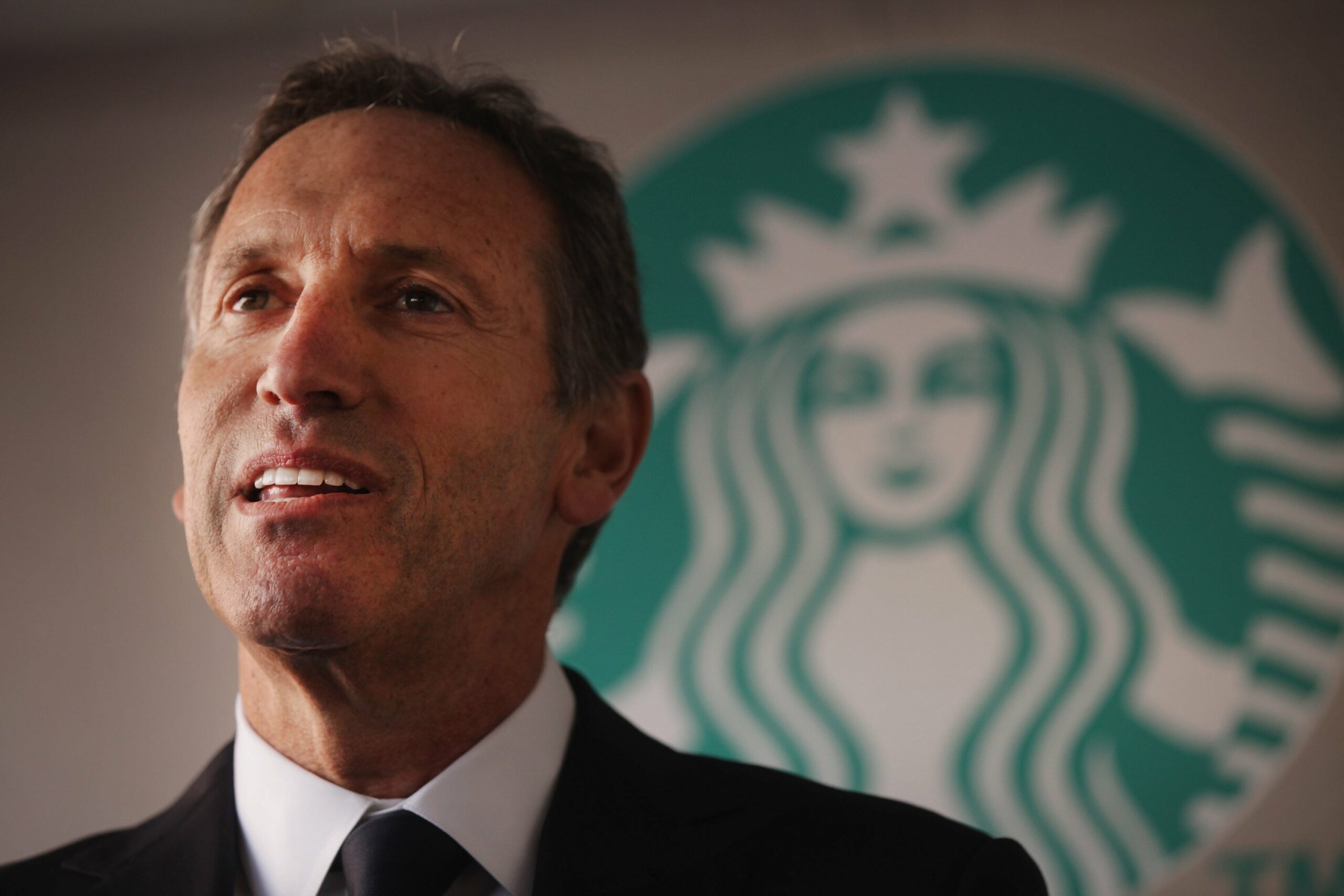

Share this @internewscast.com
It all began with the allure of a simple cup of coffee.
In 1981, Howard Schultz, then a young sales executive, stepped into a quaint coffee shop nestled in Seattle’s Pike Place Market, known as Starbucks. At the time, Starbucks was a modest enterprise, with only four stores focusing on selling roasted coffee beans and equipment, rather than serving prepared drinks. Yet, Schultz was immediately captivated by the establishment. The inviting aroma of freshly roasted beans, the evident passion of the staff, and the unique atmosphere of camaraderie among patrons were unlike anything he had encountered before.
Schultz soon realized that coffee could transcend its role as a mere beverage. It had the potential to become a social hub, a daily ritual, and a unifying force that could bring people together.
This revelation would eventually propel Starbucks from a small regional player into a global powerhouse, renowned as one of the most iconic consumer brands worldwide. Today, Starbucks boasts tens of thousands of locations across the globe and holds a market valuation near $115 billion. The monumental success of the company elevated Schultz to the ranks of America’s wealthiest entrepreneurs, with his personal fortune estimated at approximately $3.5 billion.
The story of Starbucks is a testament to how one insightful moment over a cup of coffee can spark the creation of a global empire.
Growing Up Poor in Brooklyn
Howard Schultz was born on July 19, 1952, in Brooklyn, New York. Raised in a working-class environment, he grew up alongside his sister, Ronnie, and brother, Michael. His father, Fred Schultz, a former U.S. Army trooper, held various blue-collar jobs, including truck driving and diaper delivery, while his mother, Elaine, worked as a receptionist.
The family lived in the Canarsie Bayview Houses, a public housing complex in Brooklyn. Money was often tight, and Schultz later described his childhood as defined by financial instability. His father had no health insurance, job security, or meaningful benefits, experiences that would later influence Schultz’s approach to building a company.
Sports became Schultz’s escape. He excelled in football, baseball, and basketball at Canarsie High School. His athletic ability eventually earned him a football scholarship to Northern Michigan University, making him the first person in his family to attend college.
Schultz graduated in 1975 with a bachelor’s degree in communications.
Early Career and the Starbucks Discovery
After college, Schultz worked briefly as a salesman for Xerox, where he developed skills in marketing and customer relationships. He later joined Hammarplast, a Swedish company that manufactured drip coffee makers, and eventually became the firm’s manager of U.S. operations.
While reviewing sales data, Schultz noticed that a small Seattle retailer called Starbucks was ordering an unusually large number of Hammarplast coffeemakers. Curious, he flew to Seattle in 1981 to meet the company’s founders.
The visit would change his life.
At the time, Starbucks was run by Jerry Baldwin, Gordon Bowker, and Zev Siegl. Baldwin had been an English teacher before entering the coffee business. Bowker was a writer and advertising professional who had worked as a copywriter and creative director, while Siegl was a history teacher. The three friends were inspired by Alfred Peet, the Dutch-born founder of Peet’s Coffee in Berkeley, who introduced them to the idea that coffee could be treated with the same care and craftsmanship as wine.
When they launched Starbucks in Seattle in 1971, their goal was simple: sell the highest-quality roasted coffee beans and brewing equipment to customers who wanted to make better coffee at home. The original Starbucks store in Seattle’s Pike Place Market didn’t serve prepared drinks. Instead, it focused on educating customers about coffee beans, roasting techniques, and brewing methods. By the early 1980s, the company had expanded modestly to a handful of locations around Seattle and had built a loyal following among serious coffee enthusiasts.
Schultz was captivated by their passion for coffee. But he also saw something bigger. He believed the brand had the potential to become something far larger than a specialty bean retailer.
It took nearly a year of persuasion, but in 1982, Schultz joined Starbucks as its director of marketing and operations. At that time, the company had just four stores.
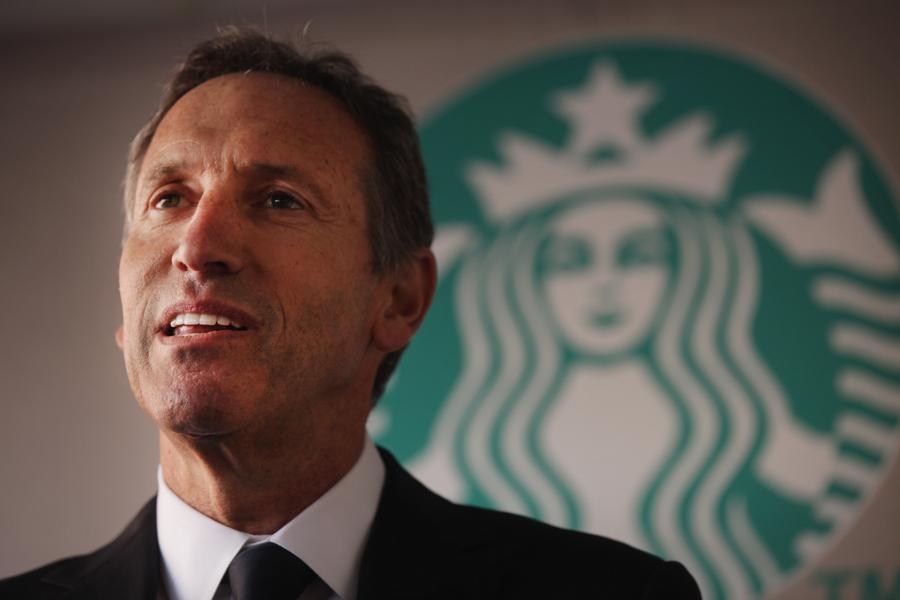
Spencer Platt/Getty Images
The Italian Coffeehouse Inspiration
In 1983, Schultz traveled to Italy on a business trip. While there, he became fascinated by the country’s coffee culture.
Italian cities were filled with espresso bars where people gathered throughout the day. Customers would stop in for a quick espresso, chat with friends, read the newspaper, or simply enjoy a moment of community. These cafes served as neighborhood meeting places.
Schultz became convinced that the United States lacked a similar “third place,” somewhere between home and work, where people could gather. He returned to Seattle determined to recreate that experience.
In 1984 Schultz convinced the founders to let him test his idea by opening a Starbucks café that served espresso drinks. The location was an instant hit with customers. But despite the success, the founders still had no interest in turning Starbucks into a coffeehouse chain.
However, Starbucks’ original owners were skeptical. Their vision was to remain focused on selling coffee beans and equipment rather than prepared drinks.
Unable to convince them to adopt his concept, Schultz decided to leave the company.
Launching Il Giornale
In 1986, Schultz launched his own coffee company called Il Giornale. The venture introduced the Italian-style coffee bar experience he had seen overseas, serving espresso drinks and creating a social gathering space around coffee.
The concept proved successful almost immediately.
Then an opportunity appeared that would change everything.
Buying Starbucks
In 1987, the original Starbucks owners decided to sell the company. At the time, Starbucks had six locations. Schultz assembled a group of prominent Seattle businessmen, including Bill Gates and Bill Gates Sr., and purchased the company for $3.8 million, roughly equivalent to around $10 million today when adjusted for inflation. He merged Il Giornale into Starbucks and began executing his vision.
In addition to Bill Gates and Bill Gates Sr., one of Howard’s buyout partners was a Seattle entrepreneur named Harold Gorlick. Harold made his fortune as the co-founder of a chain of thrift stores called Thrifty Supply Co. He co-founded Thrifty Supply with his brother, Morris. Morris would bring a little bit of celebrity power into Starbucks’ early days…
Quirky Celebrity Investors
A few years before investing in Starbucks, Harold Gorlick’s nephew, a saxophonist named Kenneth, signed a record deal with Clive Davis’ Arista Records. His 1982 debut album went gold. His next two albums both went platinum. In 1986, a year before his uncle became one of Starbucks’ four buyout partners, Kenneth released an album titled “Duotones.” Thanks to the lead single “Songbird,” Duotones went 5X Platinum. Kenneth, who you know better as Kenny G, would go on to sell 75 million albums worldwide and is the most successful instrumentalist in music history.
Kenny became friendly with Howard and even performed at several store openings in those early years. He even used some of his newfound music wealth to acquire a block of pre-IPO shares. In various interviews over the years, Kenny G has claimed that he has made as much money off his early investment in Starbucks as he has selling albums. One sign of Kenny’s surprisingly large fortune was revealed during his 2023 divorce. In a spousal support filing made in April 2023, Kenny disclosed that every month he earns around $600,000 just from passive rental income on his real estate portfolio!!!
And Kenny isn’t the only musician who apparently got rich off a Starbucks investment. In 1994, Guns N’ Roses bass player and Seattle native Duff McKagan was in rehab for alcohol abuse and began studying the stock market as a distraction. On somewhat of a whim, he decided to invest $100,000 ($300,000 total) into three local companies. Those companies were:
- Amazon
- Microsoft
- Starbucks
Duff is probably exaggerating somewhat because Amazon wasn’t even founded by Jeff Bezos until July 1994 and didn’t go public until 1997. Had he really been an investor in Amazon in 1994, he would have literally been one of the very first venture capital investors and would be worth billions today. Amazon’s early VC backers are well known, and Duff is not one of them 🙂
However, let’s say he wasn’t exaggerating about his Microsoft and Starbucks investments. And just for fun, let’s pretend he never sold a share. Here’s what those investments would be worth today (without dividend reinvestment):
- Microsoft – $14 million
- Starbucks – $15 million
But back to Howard and Starbucks…
Building the Starbucks Empire
Under Schultz’s leadership, Starbucks expanded rapidly through the late 1980s and 1990s. Stores began appearing in major cities across the United States, often on prominent street corners.
But Schultz insisted that the company remain focused on quality and experience. Starbucks locations were designed to be comfortable gathering spaces where customers could linger.
In 1992, Starbucks went public. At the time of the IPO, the company operated 165 stores.
The growth that followed was extraordinary.
Over the next three decades, Starbucks expanded across North America, Europe, Asia, and the Middle East. The brand helped popularize espresso drinks like lattes, cappuccinos, and Frappuccinos across the United States.
Today, Starbucks operates more than 38,000 locations worldwide and is one of the most recognizable consumer brands on the planet. Its market capitalization now stands around $115 billion.
- 1987: 6 stores
- 1992 IPO: 165 stores
- Today: 38,000
A Different Kind of Corporate Culture
One of Schultz’s most distinctive decisions was to prioritize employee benefits long before it became common in the retail industry.
He insisted that Starbucks employees, whom the company calls “partners,” receive healthcare benefits even if they worked as little as 20 hours per week. The company also extended benefits to unmarried partners, a policy that was considered unusually progressive at the time.
Starbucks also introduced a broad employee stock-option program called Bean Stock, allowing workers at all levels to own shares in the company.
Schultz often said these policies were influenced by his father’s experiences working low-paying jobs without benefits or dignity.
He wanted Starbucks to be the type of company his father never had the chance to work for.
Education and Philanthropy Initiatives
Schultz continued expanding employee-focused initiatives throughout his career.
In 2014, Starbucks announced a partnership with Arizona State University that allowed employees to earn college degrees through the university’s online program with substantial financial support from the company.
Schultz and his wife, Sheri, have also been heavily involved in philanthropy through the Schultz Family Foundation. Their charitable work has focused on supporting veterans, addressing youth unemployment, and expanding economic opportunity.
Leadership Transitions and Later Years
Schultz served multiple stints as Starbucks’ chief executive over the decades as the company navigated periods of rapid growth and economic challenges.
He first stepped down as CEO in 2000, though he remained chairman. During the financial crisis of 2008, Schultz returned as CEO to lead a major turnaround that included store closures, operational reforms, and renewed focus on customer experience.
He stepped away again in 2017 before briefly returning in 2022 as interim CEO during another leadership transition.
Schultz ultimately left Starbucks’ board in 2023 after more than four decades shaping the company.
The Fortune Built From Coffee
Today, Howard Schultz’s net worth is $3.5 billion.
While Starbucks has grown into a $115 billion global corporation, Schultz’s legacy extends beyond the company’s financial success. His vision helped reshape how Americans consume coffee and transformed a simple beverage into a global lifestyle brand.
And it all traces back to a single moment in 1981, when a young salesman walked into a small coffee shop in Seattle and saw something that others had missed.
He didn’t just see coffee.
He saw a community waiting to be built.
What Happened to Jerry, Gordon, and Zev?
After selling Starbucks to Howard Schultz and a group of investors for $3.8 million in 1987, the company’s three original founders largely stepped away from the brand they had created.
Before the sale even happened, Jerry Baldwin and a group of investors had already bought rival Peet’s Coffee & Tea. He spent the next 30 years on the board of directors while also launching a wine business in California’s Sonoma Valley called J. Baldwin Wines. He’s done well enough to own a 15-acre property in Glen Ellen, California, which he sold in June 2021 for $8.6 million.
After the Starbucks sale, Gordon Bowker and a partner co-founded Redhook Ale Brewery, one of the early pioneers of the American craft brewery movement. Gordon died in August of last year. According to his Wall Street Journal obituary, while he may not have become a billionaire from his creations, selling the two companies made him “rich enough.” He traveled the world with his family, visiting Rome annually.
Zev Siegl, who exited Starbucks in 1980, founded Quartermarine Coffee Roasters in Rockville, Maryland, while also working as a mentor and keynote speaker.
(function() {
var _fbq = window._fbq || (window._fbq = []);
if (!_fbq.loaded) {
var fbds = document.createElement(‘script’);
fbds.async = true;
fbds.src=”
var s = document.getElementsByTagName(‘script’)[0];
s.parentNode.insertBefore(fbds, s);
_fbq.loaded = true;
}
_fbq.push([‘addPixelId’, ‘1471602713096627’]);
})();
window._fbq = window._fbq || [];
window._fbq.push([‘track’, ‘PixelInitialized’, {}]);