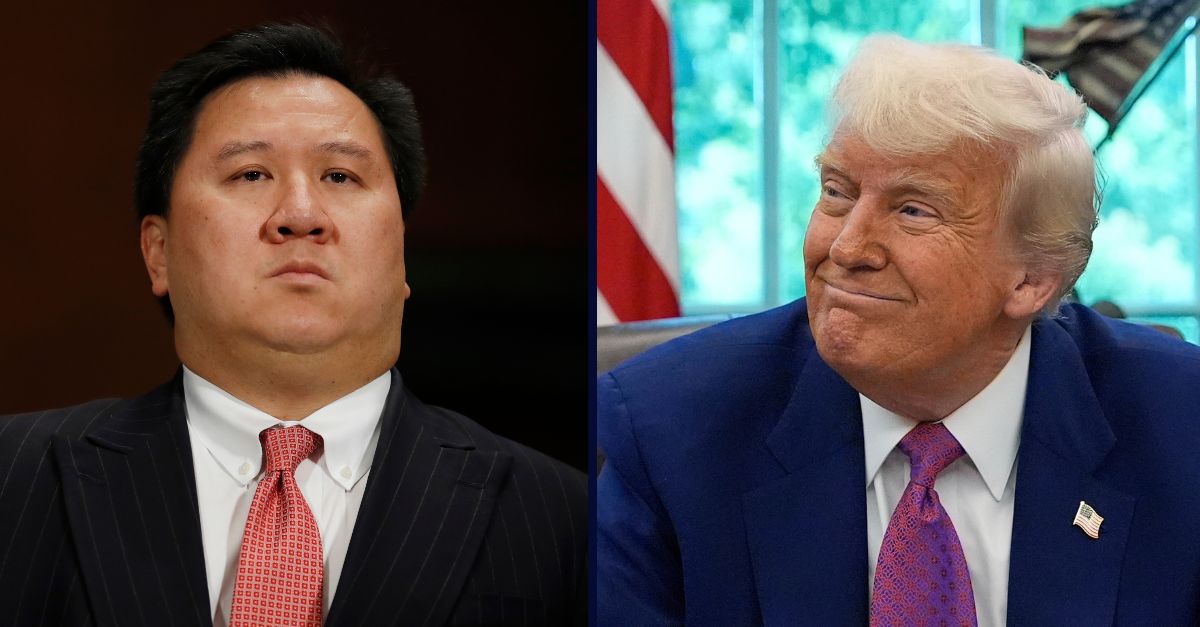

Left: James Ho takes the oath during a Senate Judiciary Committee hearing on Capitol Hill, Washington, on November 15, 2017. (AP Photo/Carolyn Kaster). Right: President Donald Trump smiles while speaking in the Oval Office at the White House on May 20, 2025, in Washington (AP Photo/Alex Brandon).
A member of the U.S. Court of Appeals for the Fifth Circuit volubly complained about the U.S. Supreme Court in a concurrence this week.
On Tuesday, Circuit Judge James C. Ho, appointed by President Donald Trump during his initial term, criticized his superiors in an extraordinary statement linked to an unusual directive reinstating an Alien Enemies Act (AEA) case on the appellate court’s schedule.
“This appeal should be concluded,” Ho complained. “Petitioners bypassed the district court’s chance to address their emergency motion initially. That should be sufficient to end this appeal. However, the Supreme Court has overturned our unanimous decision. Thus, this appeal must continue. Therefore, I concur.”
The underlying case was filed in the U.S. District Court for the Northern District of Texas and has had a tumultuous — and somewhat contested — ride through the court system. In his concurrence, Ho spends considerable effort recalling the order of events.
Love true crime? Sign up for our newsletter, The Law&Crime Docket, to get the latest real-life crime stories delivered right to your inbox.
The plaintiffs are Venezuelan immigrants facing summary deportation under the 18th-century wartime law. Hoping to avoid having their clients flown to a notorious El Salvador prison, attorneys with the American Civil Liberties Union (ACLU) quickly, albeit controversially, skipped up the judicial ladder — and they did so twice.
On April 19, essentially using an interlocutory appeal to the Supreme Court, the ACLU stopped the Trump administration from carrying out AEA deportations in the sprawling Northern District of Texas. In barring such actions, the justices issued their only Saturday order of the current session — an exceedingly rare bit of weekend work.
The same issue in the case, which is variously stylized as A.A.R.P. v. Trump and W.M.M. v. Trump due to class certification issues, was technically pending before the 5th Circuit when the ACLU filed with the Supreme Court in late April. Meanwhile, the appellate court actually dismissed the appeal hours before the high court ruled by citing a lack of jurisdiction. But the plaintiffs were undeterred.
They revived the appeal by immediately filing a petition for a writ of certiorari. On Monday, the nation’s high court once again dealt the 45th and 47th president a loss by finding that the form of notice granted to would-be deportees “surely does not pass muster.”
And, in continuing to bar deportations in the district, the justices, in a 7-2 per curiam ruling, sent the matter back to the Fifth Circuit.
Ho, in his concurrence, clearly takes some umbrage for himself and his immediate colleagues over the remand, but largely seeks to defend the honor of U.S. District Judge James Hendrix, also appointed by Trump during his first term, over his work on the case so far.
In the original leap to the Supreme Court, the ACLU rejected assurances from Department of Justice attorneys that none of the plaintiffs faced “imminent risk of summary removal.” Hendrix, however, did accept those overtures as valid. Ultimately, a majority of high court justices sided with the ACLU and implicitly suggested the Trump administration was not credible when discussing who it planned to deport, or how, even in legal filings or during in-court proceedings.
Nesting within the trust discrepancy is the matter of time.
The detainees aimed to move expeditiously. Meanwhile, many would argue the government has, at least in the past, only moved expeditiously when flying planes full of other immigrants to El Salvador in violation of court orders.
In the order temporarily blocking removals under the AEA, the Supreme Court chides Hendrix for not acting fast enough and faults the Fifth Circuit for misstating the degree of the judge’s delay.
“Here the District Court’s inaction — not for 42 minutes but for 14 hours and 28 minutes — had the practical effect of refusing an injunction to detainees facing an imminent threat of severe, irreparable harm,” the unsigned order reads. “Accordingly, we vacate the judgment of the Court of Appeals.”
Ho has two problems with this timeline.
First, he says, this starts the clock when the plaintiffs originally filed their district court motion for emergency relief, half past midnight.
Only in a later motion — filed the next afternoon — did the plaintiffs say they would file an intervening appeal if Hendrix did not act with speed. Ho, disputing the justices, says Hendrix was right not to act immediately, because he needed to give the government a chance to respond.
The Supreme Court, of course, rejected this understanding, clearly not crediting the initial statements from the government and seemingly not concerned with having them opine further while the clock ticked down. But that’s not Ho’s only complaint.
The late-night filing itself sticks in his craw.
“[S]tarting the clock at 12:34 a.m. not only ignores the court’s express instructions respecting the Government’s right to respond,” Ho continues. “It also ignores the fact that the Court is starting the clock at — 12:34 a.m. We seem to have forgotten that this is a district court — not a Denny’s. This is the first time I’ve ever heard anyone suggest that district judges have a duty to check their dockets at all hours of the night, just in case a party decides to file a motion.”
The concurrence goes on like this, at length:
If this is going to become the norm, then we should say so: District judges are hereby expected to be available 24 hours a day — and the Judicial Conference of the United States and the Administrative Office of the U.S. Courts should secure from Congress the resources and staffing necessary to ensure 24-hour operations in every district court across the country.
If this is not to become the norm, then we should admit that this is special treatment being afforded to certain favored litigants like members of Tren de Aragua — and we should stop pretending that Lady Justice is blindfolded.
The circuit judge later speaks up for Hendrix directly. Quoting and paraphrasing Justice Samuel Alito, Ho suggests the Supreme Court unfairly maligned Hendrix’s work as inaction.
“All inferior court judges expect to be reversed on appeal from time to time,” Ho continues. “But I’d wager that this judge never imagined he’d be reversed on grounds of laziness.”
Yet Hendrix is not the only person Ho believes the majority of the high court’s justices disrespected with their order.
“The [district] court firmly believed that the Government should have the right to express its views before any ruling is issued,” the concurrence goes on. “And rightly so.”
Ho opines about the “adversarial” nature of the U.S. legal system and, again citing Alito, says judges should consider both sides before issuing a ruling in any given dispute.
“It should go without saying that the President and his fellow Executive Branch officials deserve the same respect that courts regularly afford every other litigant — including other Presidents and officials,” the concurrence continues.
The judge then launches into a series of citations reflecting the last three Democratic Party presidents either disagreeing with or otherwise running into trouble with the U.S. Supreme Court on issues both public and private.
“Yet I doubt that any court would deny any of those Presidents the right to express their views in any pending case to which they are a party, before issuing any ruling,” Ho muses. “Our current President deserves the same respect.”
At another point in his concurrence, Ho elucidates his pointed disagreement with the Supreme Court.
“I write to state my sincere concerns about how the district judge as well as the President and other officials have been treated in this case,” the judge muses. “I worry that the disrespect they have been shown will not inspire continued respect for the judiciary, without which we cannot long function.”


