
Share this @internewscast.com
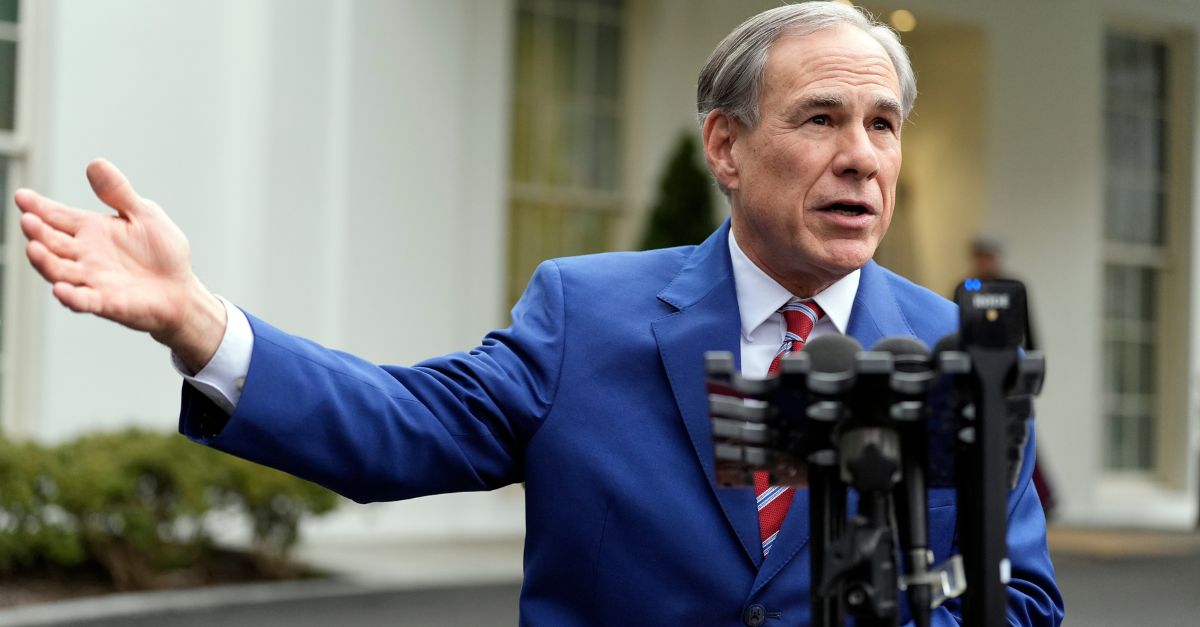
FILE – Texas Gov. Greg Abbott speaks to reporters outside the West Wing of the White House, Feb. 5, 2025, in Washington (AP Photo/Alex Brandon, File).
In a significant legal development, Texas and the Republican Party achieved a crucial victory in an appellate court regarding longstanding restrictions on how voting rights advocates can engage with voters.
Following the COVID-19 pandemic, Texas enacted SB1, a comprehensive set of election law reforms. Among these is a measure criminalizing what is known as “vote harvesting services” or “ballot harvesting.” This law characterizes ballot harvesting as any “in-person interaction with one or more voters, in the physical presence of an official ballot or a ballot voted by mail, intended to deliver votes for a specific candidate or measure.”
A coalition of civil rights and voting rights advocacy groups challenged this provision, securing an injunction at the district court level. They argued that the ballot harvesting restrictions breached federal laws designed to protect individuals with disabilities.
However, on Thursday, the U.S. Court of Appeals for the 5th Circuit, through a three-judge panel, reversed this decision. The panel concluded that the district court “erred in facially striking down this provision,” thus lifting the injunction.
The roots of this legal battle stretch back to September 2021, when the lawsuit was filed shortly after the law’s enactment. In Texas, new laws passed during a legislative session typically take effect the following September.
In their ruling, the 5th Circuit panel praised the broader legislative package by referencing “The Federalist Papers,” incorporating insights from both James Madison and Alexander Hamilton to underline their decision.
“Deeply concerned about “the vicious arts by which elections are too often carried,’ the Framers of the Constitution supported election provisions, such as the Electoral College, that aimed to erect ‘every practicable obstacle . . . to cabal, intrigue, and corruption,’” the unanimous opinion begins. “In accordance with a constitutional design that aspires to maintain free and secure elections, Texas enacted S.B. 1 in 2021. The statute curtails various activities that incentivize vote fraud and intimidation.”
With that characterization of the law in hand, U.S. Circuit Judge Edith Jones, a Ronald Reagan appointee, marvels that SB1 is being “serially litigated” at the district court level “for reasons that are not obvious.”
The court goes on to describe the relevant portion of SB1 as an effort to “prevent mail ballot fraud” and spends some time pointing out what the panel views as the dangers of voting by mail.
“Mail ballots are more susceptible to fraud because they render election workers incapable of knowing what happens to the ballot once it is mailed out. Due to the inherent vulnerability of mail ballots, ‘[f]raud is a real risk that accompanies mail-in voting,’” the opinion goes on, citing the U.S. Supreme Court. “In particular, ‘[v]ote buying schemes are far more difficult to detect when citizens vote by mail.’”
And whereas the court favorably views SB1, the court oppositely scorns the process of third-party ballot collection as a form of fraud.
From the opinion, at length:
One particularly common form of “mail ballot fraud” is known as “vote harvesting.” Vote harvesting describes a process whereby paid election operatives “generate applications for mail ballots in . . . targeted precincts.” Operatives often go door-to-door, talk to voters, and get them to sign up to vote by mail. More nefariously, vote harvesting can also be accomplished by paid operatives forging applications for voters without the voters’ knowledge or consent. Later, once the voters receive the mail ballots that were requested by canvassing or by forgery, the same partisan operatives return to collect the voters’ completed mail ballots. As part of the ballot collection process, the partisan operatives ensure that the ballots were cast for a particular candidate.
The 5th Circuit’s description of ballot harvesting goes back and forth between describing both above-board and untoward practices — and ultimately includes various practices as part and parcel of partisan schemes to direct unsuspecting votes to preferred candidates.
The groups opposing SB1, however, insist such efforts are “lawful voter assistance by community-based nonpartisan organizations.”
To hear the plaintiffs tell it, they are engaged in voter registration drives, voter education efforts, early voting awareness campaigns, and distribution of mail ballot applications. These activities, according to their 74-page complaint, are not aimed at electing particular candidates, but at generally increasing voter turnout in elections.
At the district court level, U.S. District Judge Xavier Rodriguez, a George W. Bush appointee, said the statute is impermissibly vague and encompasses so wide an array of behavior that it should “more accurately and impartially” be referred to as a “canvassing restriction.”
The 5th Circuit rubbishes the lower court for a series of hypothetical examples used to determine the statute is vague.
Rodriguez, for his part, said it was unclear whether providing volunteers with “a glass of water as a pick-me-up during a hot afternoon of door-knocking” or “providing volunteers food, water, swag, letters of recommendation, academic credit, gas cards, bus fare, free parking, or even the use of its offices for their advocacy work” might run afoul of prohibitions against providing “compensation” and “benefit.”
The panel says the real-world application of the law — in a court of law — will speak for itself and clear up any confusion.
“In contrast to this judicial myopia, ordinary citizens serving on a jury ‘should be capable of understanding’ this statute’s ‘common-sense core of meaning,’” the opinion continues. “Limiting the statute’s scope to ‘compensation or other benefit’ protects campaign volunteers who are presumably less trained than seasoned, salaried political operatives and who have no incentive to harangue voters for pay.”
Other examples used by Rodriguez are similarly rejected, at length:
The district court also erred in holding that the statute’s term “physical presence” is vague because it does not indicate how much physical proximity between a canvasser and a ballot is required to establish criminal liability. The district court makes much of hypothetical interactions, such as a ballot harvester’s talking with a voter while a ballot is in another room or a campaign worker’s speaking to an assembly of voters while some of them have ballots hidden in their bags. These speculative scenarios are inconsistent with a reasonable interpretation of the statute.
The panel also rejected a First Amendment justification for the permanent injunction.
“For mail-in balloting, Texas’s vote harvesting statute is the least restrictive means to accomplish the same objectives permitted in the in-person voting context,” the appellate court ruled.