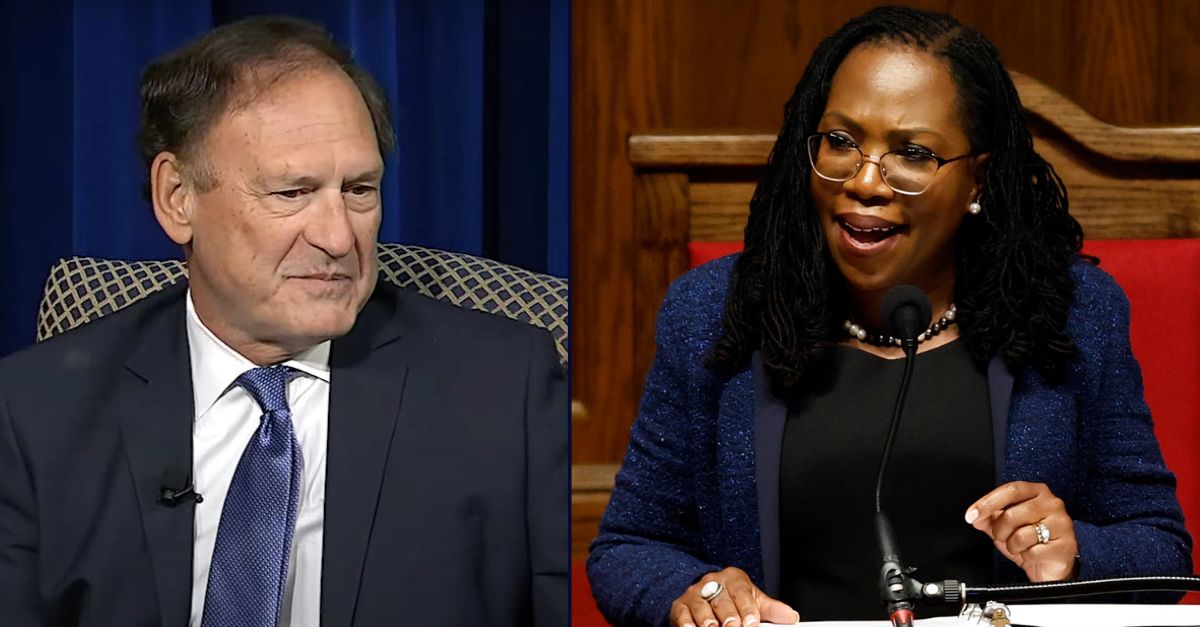

Left: Justice Samuel Alito during a Heritage Foundation event in October 2022 (YouTube/The Heritage Foundation). Right: Supreme Court Justice Ketanji Brown Jackson, the first Black woman to serve, speaks at the 60th Commemoration of the 16th Street Baptist Church bombing on September 15, 2023, in Birmingham, Alabama (AP Photo/Butch Dill).
The U.S. Supreme Court delivered a decision on Thursday concerning the fate of first-time offenders and bank robbers who utilized firearms in their crimes and faced lengthy sentences due to the “stacking” of mandatory minimum penalties prior to the First Step Act. These sentences were overturned following a significant legal amendment.
With the introduction of the First Step Act—an important criminal justice reform law enacted by President Donald Trump in 2018—first-time offenders sentenced under federal mandatory minimum statutes for firearm-related offenses became eligible for reduced sentences, though only in cases that were still pending. This left unresolved what should occur for individuals whose sentences, issued before the First Step Act, were annulled after the act became law, and whether they can benefit from the sentencing leniency provided by the act.
A section of the First Step Act — specifically, section 403 — amended the federal law that required an additional 25-year mandatory minimum sentence for certain firearm offenses.
Love true crime? Sign up for our newsletter, The Law&Crime Docket, to get the latest real-life crime stories delivered right to your inbox
The question before the court — stemming from the cases of Hewitt v. United States and Duffey v. United States — was whether the First Step Act’s “sentencing reduction provisions apply to a defendant originally sentenced before the First Step Act’s enactment when that original sentence is judicially vacated and the defendant is resentenced to a new term of imprisonment after the First Step Act’s enactment.”
Justice Ketanji Brown Jackson wrote the opinion in five parts, but was only joined by four other justices — Chief Justice John Roberts and Justices Sonia Sotomayor, Elena Kagan, and Neil Gorsuch — in the first three parts. Sotomayor and Kagan joined the opinion in full.
For Jackson and the slim SCOTUS majority, petitioners Corey Duffey, Jarvis Ross and Tony Hewitt were persuasive in arguing that post-First Step Act vacating of a sentence essentially means that the sentence wasn’t imposed pre-First Step Act.
“We hold that, under that circumstance, a sentence ‘has not been imposed’ for purposes of §403(b),” Jackson wrote. “Thus, the First Step Act’s more lenient penalties apply.”
Justice Samuel Alito, on the other hand, led the dissent and was joined by Justices Clarence Thomas, Brett Kavanaugh, and Amy Coney Barrett.
In Alito’s view, it remains true that Duffey’s, Hewitt’s, and Ross’ sentences were actually imposed in 2010, well before the First Step Act was enacted. He wrote that Jackson’s majority “disfigures the Act in order to reach a different result,” and he suggested that activism was a driving factor.
“The Court’s interpretation thus unspools the Act’s carefully wound retroactivity command to mean that any defendant whose sentence is vacated at any time and for any reason may claim the benefit of the Act’s reduced mandatory minimum,” he wrote. “But nothing in the text or broader context supports such a boundless interpretation.”
Alito next emphasized that there were portions of Jackson’s opinion that only the liberal wing of the court joined.
“Indeed, the portions of today’s decision that command the votes of only three Justices give the game away. Animating the Court’s atextual interpretation is a thinly veiled desire to march in the parade of sentencing reform. But our role is to interpret the statute before us, not overhaul criminal sentencing,” he added.
Notably, Jackson directly responded in a footnote to Alito’s “march in the parade” remark, disputing that characterization and stating that the majority “merely” supported Congress’ intent.
“The dissent agrees that our job is to ‘interpret what Congress meant’ by the words in §403(b). Here, Congress’s desire to change the derided, draconian sentencing stacking scheme” created by Supreme Court precedent “could not be clearer,” she wrote. “Thus, far from ‘march[ing] in the parade of sentencing reform,’ we are merely observing the events and circumstances that led Congress to take up the banner of sentencing reform itself.”