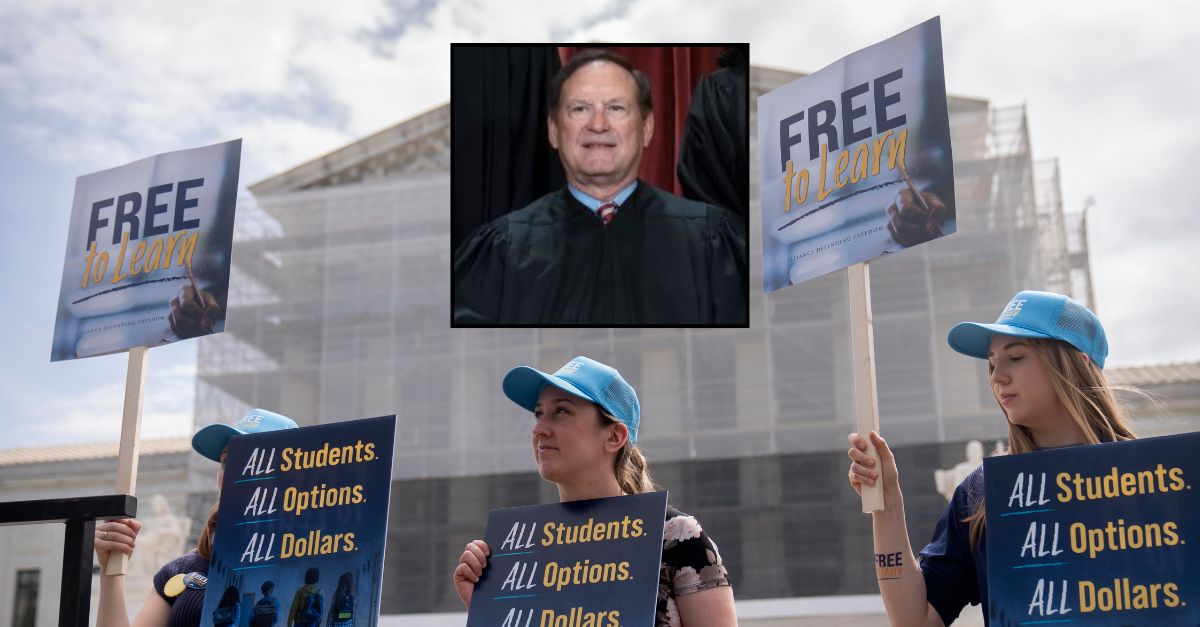

Main: Supporters of charter schools rally outside of the Supreme Court on Wednesday, April 30, 2025, in Washington. (AP Photo/Mark Schiefelbein); Inset: Associate Justice of the Supreme Court Samuel Alito. (Alex Wong/Getty Images.)
The Supreme Court may be headed for a 4-4 split in a case that tests the constitutional legalities of religious charter schools.
The high court heard several hours of oral arguments Wednesday in the case of Oklahoma Statewide Charter School Board v. Drummond, and each participating justice, except for Chief Justice John Roberts, gave clear indications of how they will vote in the case.
The school
St. Isidore of Seville — named for an unofficial patron saint of the internet — is a virtual Catholic charter school operating in Oklahoma that was established by the diocese of Tulsa and the Archdiocese of Oklahoma City. Under state law, charter schools must be nonreligious “in their programs, admissions policies, and other operations.” The school projects an initial enrollment of 500 students with the expectation of reaching 1,500 students by 2028, half from lower-income families.
Per the school’s handbook, it provides a “robust Catholic education” to all attendees and is open to both Catholic and non-Catholic students.
In 2023, the charter school board approved St. Isidore’s application for the following school year, but Oklahoma’s Republican attorney general and current gubernatorial candidate, Gentner Drummond, sought and obtained a court order from the Oklahoma Supreme Court directing the board to invalidate its contract with the school. The court reasoned that as a public school, St. Isidore is required to be nonsectarian under Oklahoma’s charter school law, and that the rule comports with both the Oklahoma Constitution and the establishment clause of the U.S. Constitution, both of which prohibit the use of public funds for religious institutions.
Love true crime? Sign up for our newsletter, The Law&Crime Docket, to get the latest real-life crime stories delivered right to your inbox.
St. Isidore appealed the decision and argues that the school provides a “much-needed opportunity for many Oklahoma children who lack robust educational choices or find traditional schooling difficult due to learning differences.”
The justices face important questions of law
The justices now consider two questions. First, whether the actions of St. Isidore’s, a free, privately-run school, constitute “state action” simply because of its charter school contract. And second, whether the First Amendment’s free exercise clause is violated by Oklahoma’s exclusion of St. Isidore’s from its charter school program.
The ruling has far-reaching potential to affect charter schools across the nation. Further, because it sets up something of a contest between the establishment clause — the section of the Constitution that ensures separation of church and state via a prohibition of government endorsement of a religion — and the free exercise clause — the section that prohibits the government from making laws that impede the free exercise of religion — the consequences threaten to reach even beyond schoolhouse walls.
A split court
During the marathon oral arguments, the Court’s most conservative justices signaled an overt willingness to rule in favor of St. Isidore’s and against Oklahoma. Meanwhile, the Court’s liberal flank predictably pushed back on the legality of permitting government funding for a religious school.
Justice Elena Kagan framed the issue as a court-sanctioned power for a charter school to simply ignore rules with which it disagrees.
“These are state-run institutions,” Kagan said, and argued that allowing this Catholic school to receive a charter despite Oklahoma’s rule against it would amount to giving St. Isidore’s — and by extension, other schools — to simply “strike” portions of state law with which they disagree.
Likewise, Justice Sonia Sotomayor was highly skeptical of the idea of allowing government-funded religious charter schools.
“I think the essence of the establishment clause was, ‘We’re not going to pay religious leaders to teach their religion,’” said Sotomayor to attorney James Campbell for the state’s charter school boards. “Really, what you’re saying is the free exercise clause trumps the establishment clause.”
In colloquy with attorney Campbell, Sotomayor pushed back on the argument that history favors St. Isidore’s position.
“Using history in this case is crazy,” the justice snapped, “because during early history, no one thought there was an obligation of the government to provide funding [for schools] at all.”
“We don’t use the history of segregation to interpret the equal protection clause now,” she continued. “I doubt very much we would use that history of the federal government funding the churches to teach Indian children and convert them as proving anything about the free exercise or establishment clause now.”
Justice Ketanji Brown Jackson similarly argued that Oklahoma’s wish was to set up secular private schools, and that it is allowed to do so, despite the fact that St. Isidore’s disagrees.
“So it’s not being denied a benefit that everyone else gets,” said Jackson.
But several times over the course of the proceedings, Justice Brett Kavanaugh signaled that he sees it differently.
“All the religious school is saying is don’t exclude us on account of our religion,” remarked Kavanaugh, who elaborated at length that religious institutions should not be excluded from doing what secular institutions can do.
Justice Neil Gorsuch appeared to be convinced that the charter school is not a government entity, given the lack of supervision by a local school board, thereby circumventing any constitutional issues relevant to government action.
Justice Samuel Alito left little doubt as to where he stands on the case. While questioning Gregory Garre, who argued the case on behalf of Drummond, Alito said that the Oklahoma attorney general’s office was “motivated by hostility toward particular religions.” To underscore his point, Alito pointed to Drummond’s statements that many Oklahomans would support Christian charter schools, but would be less likely to approve similar applications from schools of other faiths.
“We have statement after statement by the attorney general that reeks of hostility toward Islam,” Alito said to Garre.
“That’s entirely incorrect, your Honor,” responded Garre, arguing that Drummond’s statements merely warned of tensions to come if a Catholic charter school was allowed to operate.
Alito also commented on Oklahoma’s “unsavory discriminatory history,” and Garre expressed doubt that Oklahoma’s constitution showcased animus against Catholic immigrants.
Rather, Garre offered, Oklahoma’s separation of church and state was likely motivated by the government’s “Christianization” of Native American children.
Alito, who has often spoken of religion being “under attack,” doubled down and asked, “Do you think that anti-Catholic bigotry had disappeared from Oklahoma by 1907?”
With Justice Amy Coney Barrett, a Trump appointee, recused from the case, due to a friendship with a professor who advised St. Isidore, the outcome could come down to Chief Justice John Roberts, who did not show his hand clearly. He said early in the arguments that the Supreme Court’s previous rulings dealt with a less significant mixture between state governments and schools than the current Oklahoma cases involve. Should the Supreme Court split 4-4, it means the Oklahoma Supreme Court’s ruling against St. Isidore’s would stand, and for the immediate future, religious charter schools would be disallowed.
The post ‘Reeks of hostility’: Alito accuses Oklahoma of ‘unsavory discrimination history’ in fight over allowing first Catholic charter school first appeared on Law & Crime.


