
Share this @internewscast.com
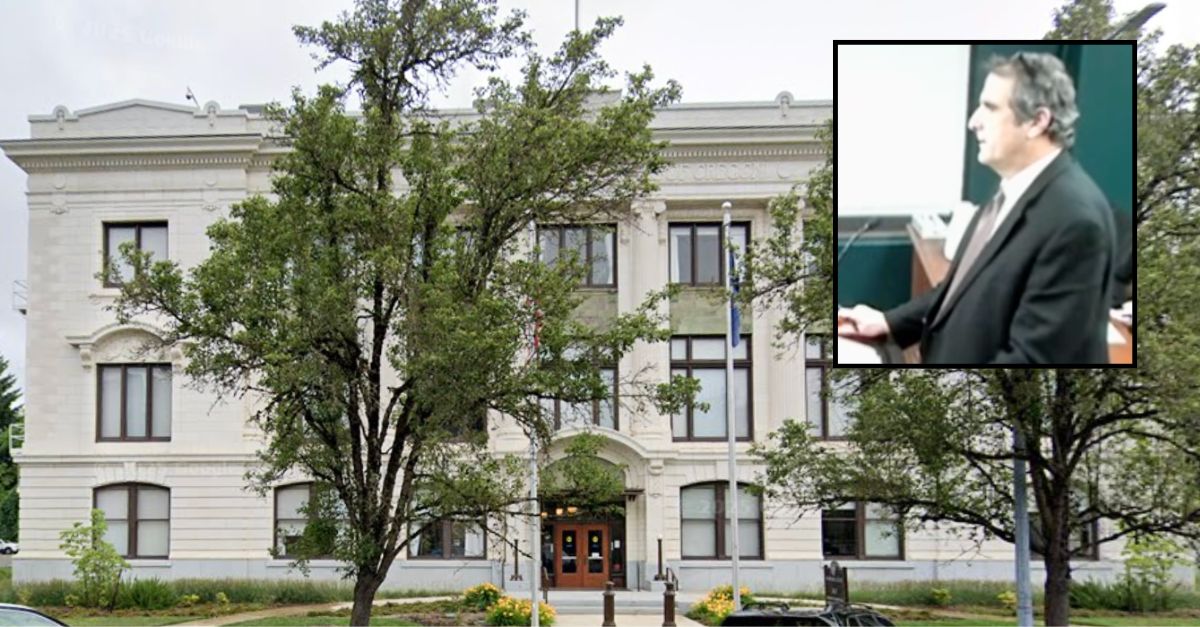
Background: The Oregon Supreme Court building in Salem, Oregon, home to the Oregon Court of Appeals (Google Maps). Inset: Bill Ghiorso (Oregon Judicial Department/KGW/YouTube).
In a landmark ruling, the Oregon Court of Appeals has imposed a significant fine on an attorney who submitted a legal brief riddled with fictitious case law generated by artificial intelligence.
Attorney Bill Ghiorso has been ordered to pay $10,000 to the Oregon Judicial Department’s Appellate Court Services Division. The penalty follows his admission that his filing was “unchecked and ultimately fabricated,” and did not meet professional standards. The brief, produced by the Salem-based lawyer, reportedly included “at least 15” false citations and “at least nine” non-existent quotations, as detailed in the court’s order.
“My law clerk was using a search engine that we’ve now completely discarded,” Ghiorso told three appeals court judges in video shared by Portland NBC affiliate KGW. The judges, however, did not appear to be convinced by his explanation.
Presiding Judge Scott Shorr remarked, “It couldn’t just be a search engine; something produced and wrote the brief that your name is on.”
The case in question, Doiban v. OLCC, emerged after the Oregon Liquor and Cannabis Commission (OLCC) revoked a marijuana production license from Henry Doiban. Doiban failed to attend a crucial 15-minute online hearing to contest this decision, citing technical issues, as reported by The Oregonian.
Doiban enlisted Ghiorso to challenge the OLCC’s decision. The attorney submitted his brief in November 2024, during a period he described as marked by “serious health issues.” Having “exhausted the available extensions” for filing, Ghiorso delegated the task to his staff, who used search engines like Google and Safari, mistakenly considering their findings as “legitimate legal analysis.”
The appeals court noted that OLCC attorneys alerted Ghiorso to the fictitious citations in April 2025, prior to filing their response. Ghiorso reportedly failed to address the issue.
Ghiorso then “did not address the nonexistent citations and quotations in any manner for seven months until in-person questioning by the court,” the the Oregon Court of Appeals stated, “despite having been made aware of them.”
In November 2025, the Oregon Court of Appeals ordered Ghiorso to defend his brief and show why it shouldn’t be thrown out, and why the court should not “impose monetary sanctions for submitting a brief to this court that contains nonexistent caselaw and nonexistent quotations.”
The appeals court adds that “when given the opportunity to explain, counsel did not provide any explanation for the lack of correction during that lengthy time period.”
The judges suggested that this illustrated Ghiorso “minimized the gravity of the situation.”
“Whether an attorney relies on a partner or associate for an initial draft of a brief or, instead, overly relies on a computer, which may be risky but perhaps not improper on its own, prior to filing, the attorney signing the final filed brief is certifying that the citations therein are accurate and not contrived from thin air,” the order states.
In considering whether — and then how much — to sanction the attorney, the judges considered recent examples. In December 2025, in a different case, the appeals court concluded that “‘monetary sanctions, payable by [the] respondents’ counsel, in the amount of $500 for each false citation, and $1,000 for each false quotation or statement of law’ were appropriate.”
Such penalties would have added up to a minimum of $16,500 for Ghiorso, but the judges decided to “cap the sanctions” at $10,000, which is still a record fine for this sort of error, per KGW. They say they did so in part because Ghiorso “has acknowledged the need for and reportedly implemented new office procedures to prevent another occurrence in the future.”
The appeals court also said it will allow the attorney to file a proposed replacement brief, making edits as necessary but without raising any new arguments.