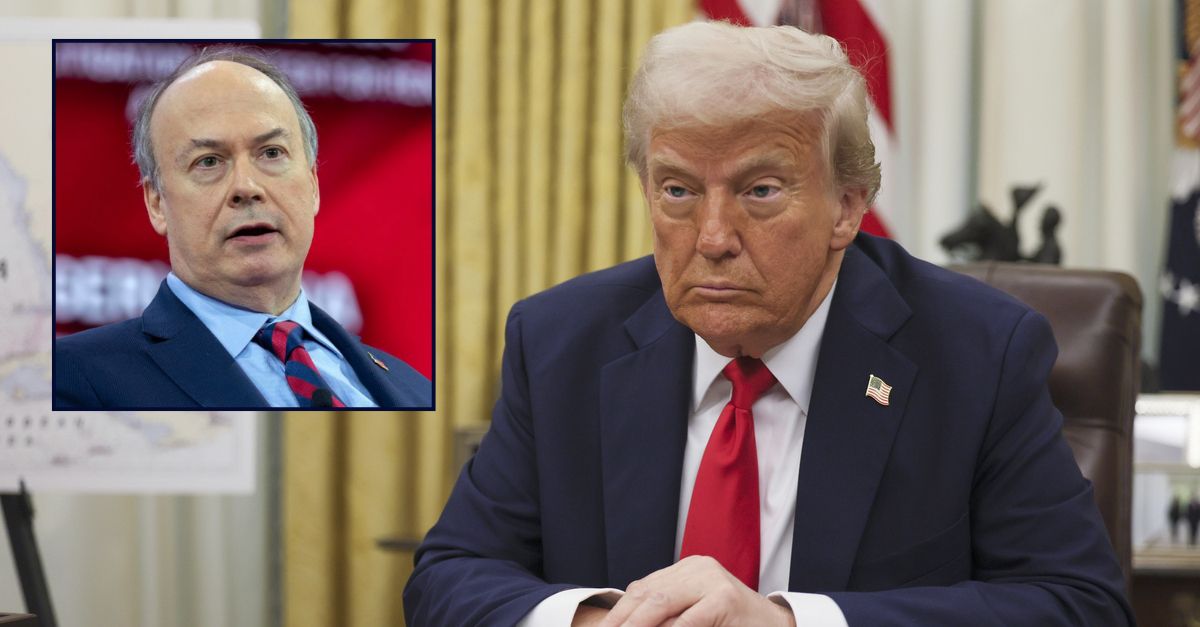

Inset: Former Justice Department official Jeffrey Clark addresses the crowd during the Conservative Political Action Conference, CPAC 2024, held at National Harbor in Oxon Hill, Maryland, on Friday, February 23, 2024 (AP Photo/Jose Luis Magana). Background: President Donald Trump responds to a question from a reporter prior to signing an executive order in the Oval Office at the White House in Washington, Monday, March 31, 2025 (Pool via AP).
The Washington, D.C., legal discipline authority for lawyers has advised that former U.S. Department of Justice lawyer Jeffrey Clark should be stripped of his ability to practice law due to his participation in attempts to overturn the 2020 presidential election results in favor of President Donald Trump.
On Thursday, the Board on Professional Responsibility for the District of Columbia Court of Appeals delivered a decision on requests made by Clark and the D.C. Bar Office of Disciplinary Counsel. These requests involved the review of an April 2024 decision that suggested he should lose his law license.
The board, effectively a court of appeal in the federal district”s lawyer discipline system, declined to disturb the earlier committee’s ruling.
“After reviewing all the facts provided by the Disciplinary Counsel, we have determined that the Respondent should no longer practice law because of his blatant attempt at dishonesty,” summarizes the 111-page report.
The recommendation, while highly critical of Clark’s actions, makes clear that the recommendation is not a final order of discipline.
The bar complaint against Clark centered on an unsent draft letter that wrongly asserted the DOJ had “identified significant concerns that might have affected the election results in multiple states, including Georgia.”
The charge details stated that Clark breached D.C. Rules of Professional Conduct 8.4(a) and (c) (“by trying to partake in dishonest actions by drafting a letter with false claims”) as well as Rules 8.4(a) and (d) (“by attempting to engage in actions that would significantly disrupt the administration of justice”).
The so-called “proof of concept letter” is the draft Clark compiled that also would have urged legislatures in states where Trump lost to “send an unauthorized slate of electors to Congress,” according to the charges.
On the whole, the board endorsed the disciplinary counsel’s findings.
“[T]he charges against [Clark] focus on the truthfulness of the factual assertions contained in the Proof of Concept letter that he authored,” the report reads. “On the merits, we conclude that Disciplinary Counsel proved by clear and convincing evidence that Respondent attempted to make intentionally false statements when he continued to advocate that the Justice Department issue a letter containing falsehoods.”
Clark, for his part, argued he had personal misgivings concerning the integrity of the presidential election won by Joe Biden.
The board rejected those arguments – largely crediting testimony from former DOJ officials, including then-acting assistant attorney general Jeffrey Rosen and Rosen’s deputy Richard Donoghue.
During their testimony, those DOJ witnesses testified Clark tried to weaponize the department, advanced clearly debunked claims about electoral fraud, and even threatened to replace them should they not bend to the will of the then-president.
“Although the hearing witnesses agreed that [Clark] had sincere personal concerns about the integrity of the 2020 election, they also agreed that the Justice Department had not identified potentially outcome-determinative issues in Georgia or other states,” the report goes on. “[Clark] knew that because Messrs. Rosen and Donoghue told him so. Thus, [Clark’s] conduct constituted an attempt to make intentionally false statements about the results of the Justice Department’s investigation.”
In supporting the hearing committee’s initial findings, the board goes quite a bit further in terms of prospective punishment. The originally proposed sanction was a two-year suspension.
From the report, at length:
A majority of the Board recommends that Respondent be disbarred. We recognize that there are no factually comparable prior disciplinary cases. But that is not surprising given the underlying facts. In making this recommendation, we are mindful of the need to maintain the integrity of the legal profession and deter the respondent and other attorneys from engaging in similar misconduct. Lawyers must observe the highest standard of professional conduct. At a minimum, they must be honest. While dishonesty is always intolerable, the facts here are significantly aggravating to warrant disbarment: Respondent was prepared to cause the Justice Department to tell a lie about the status of its investigation of an important national issue (the integrity of the 2020 Presidential election). Lawyers cannot advocate for any outcome based on false statements and they certainly cannot urge others to do so. Respondent persistently and energetically sought to do just that on an important national issue. He should be disbarred as a consequence and to send a message to the rest of the Bar and to the public that this behavior will not be tolerated.
Clark, in his own motions, pushed for a slap on the wrist in the form of a “private admonition,” which is not a form of discipline for lawyers that is countenanced by the D.C. Court of Appeals.
The board’s decision in favor of disbarment was not, however, unanimous.
Two members suggested Clark be suspended for three years – pending the outcome of a “fitness requirement” which is “intended to be an appropriate response to serious concerns about whether the attorney will act ethically and competently in the future, after the period of suspension has run.”
Even in the minority, those two members strongly upbraided Clark.
“Respondent sought to have the Justice Department lie about a ‘pressing matter of overriding national importance,’ despite being told in no uncertain terms that it was a lie, and he does not appreciate the significance of his misconduct,” the minority report reads. “Those considerations ‘cast a serious doubt upon the attorney’s continuing fitness to practice law.’ A fitness requirement would appropriately protect the public.”