
Share this @internewscast.com
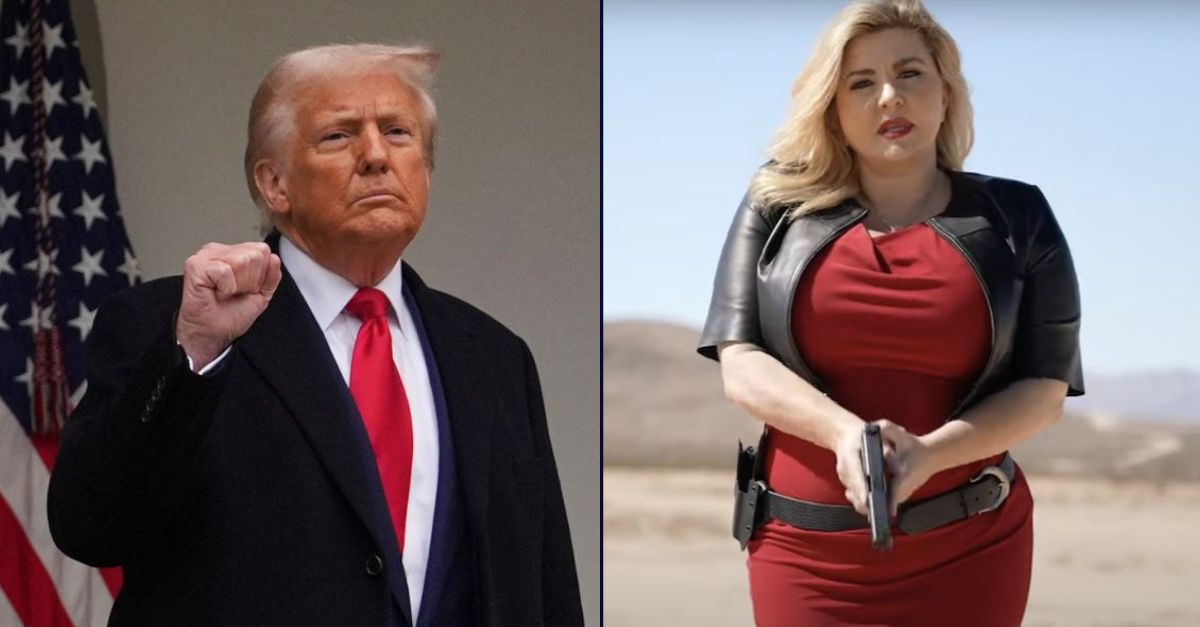
Left: President Donald Trump departs after signing an executive order at an event to announce new tariffs in the Rose Garden of the White House, Wednesday, April 2, 2025, in Washington (AP Photo/Evan Vucci). Right: Michele Fiore campaign ad (Youtube).
A Nevada justice of the peace, whose federal fraud convictions were pardoned by former President Donald Trump, is petitioning the state’s Supreme Court to restore her position, arguing that her suspension was unlawful.
Michele Fiore, known for her outspoken support of Trump and her nickname “Lady Trump,” appeared before the high court on Thursday to contest her suspension. She contends that the decision was improper because it was based on actions that occurred before she assumed office.
Fiore, a former Las Vegas councilwoman, maintains that the Nevada Commission on Judicial Discipline exceeded its authority in suspending her, as she currently campaigns for reelection to her justice of the peace role in Pahrump County.
Her legal troubles stem from convictions related to a scheme where she allegedly misappropriated approximately $70,000 from donors meant for a charity supporting a slain police officer’s family. Instead, she reportedly used the funds for personal expenses, including rent, cosmetic procedures, and her daughter’s wedding.
While actively serving as a justice of the peace, Fiore was federally indicted on six counts of wire fraud and one count of conspiracy to commit wire fraud. This indictment led to her suspension from the bench without pay.
Following an eight-day trial in October 2024, the former GOP gubernatorial candidate was found guilty of all seven charges. Before sentencing could occur, Trump issued her a “full and unconditional pardon,” which spared her from facing up to 20 years in federal prison for each charge.
Following the pardon, the seven-member judicial commission issued a ruling suspending Fiore with pay pending an investigation of “additional complaints” levied against her.
The conduct that led to her fraud convictions took place before she was elected a justice of the peace.
During Thursday’s hearing, Therese Shanks, an attorney with the commission, argued that Fiore being suspended with pay is merely a mechanism of the body’s investigation into Fiore’s conduct while she was a justice of the peace, the Las Vegas Review-Journal reported. She reportedly told the justices, in part:
This is only an investigation phase. There is no discipline happening. There are no formal statements of charges that have been filed. Judge Fiore conceded in her opening argument that the fact that she was found guilty by a jury of seven felonies while she was sitting as a justice of the peace is a basis for discipline. She conceded that, but now she argues that the Commission cannot investigate that fact, and she does so on the premise that the judicial discipline code only allows investigation of a violation of the law if there is, quote, unquote, a conviction. Judge Fiore wants the pardon to block out any consideration of the fact that this happened.
Shanks further asserted that the suspension is required to protect the public perception of the judiciary.
“The continuing deceit of charitable donors and unjust enrichment at the expense of the slain police officer statue harms the public’s perception of the judicial system and its confidence in the system’s legitimacy, creates the appearance of impropriety, reflects adversely on respondent’s honesty and character, and undermines her ability to impose justice and to apply the law fairly,” Shanks said.
Fiore was represented by attorney Paola Armeni, who argued that the commission was basing its investigation on the same conduct from before she became a judge that resulted in Fiore’s criminal convictions, Courthouse News reported. Armeni also shrugged off the commission’s claims that it had received multiple complaints about Fiore’s conduct as a justice of the peace, reportedly telling the justices, “They’re just upset about her getting a pardon.”
The Nevada Supreme Court did not immediately issue a ruling on the matter.