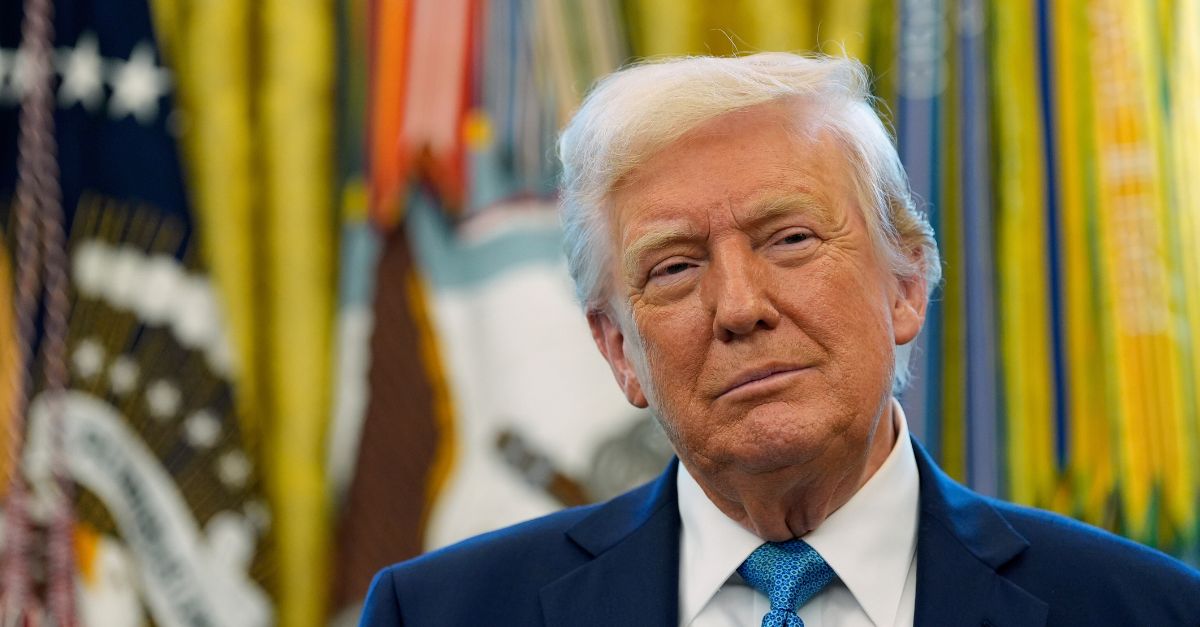
President Donald Trump looks on as Treasury Secretary Scott Bessent takes part in a ceremonial swearing-in of Paul Atkins as chairman of the Securities and Exchange Commission, held in the Oval Office of the White House, Tuesday, April 22, 2025, in Washington (AP Photo/Alex Brandon).
A federal judge in Washington, D.C., provided a win for the Trump administration on Tuesday by dismissing a lawsuit from a Democratic Party campaign committee. The lawsuit accused President Donald Trump of attempting to wield “unprecedented” control over the Federal Election Commission (FEC).
In a 14-page memorandum opinion, U.S. District Judge Amir H. Ali, a Joe Biden appointee, rejected those claims as too speculative.
“Given this record — which lacks any specific claims that the contested section has been or will be applied to the FEC or its Commissioners, consistent with counsel’s statements — the Court approves the defendants’ motions to dismiss for a lack of tangible and immediate harm required to establish standing and ripeness,” Ali concluded.
The plaintiffs, led by the Democratic National Committee, sued Trump and other members of his administration in February over Executive Order 14215, entitled “Ensuring Accountability For All Agencies.”
Love true crime? Sign up for our newsletter, The Law&Crime Docket, to get the latest real-life crime stories delivered right to your inbox.
The order, among other things, provides that “the President and the Attorney General’s opinions on questions of law are controlling on all employees in the conduct of their official duties” and says no executive branch employee “may advance an interpretation of the law as the position of the United States that contravenes the President.”
In their 23-page lawsuit, the plaintiffs claimed the executive order violated U.S. Supreme Court precedent regarding administrative agencies that are “led by a multimember, bipartisan board that performs quasi-judicial and quasi-legislative functions.” Specifically, the FEC.
“As the Supreme Court has held for 90 years, it ‘cannot well be doubted’ that Congress possesses the authority to insulate from presidential micromanagement [such] agencies,” the lawsuit reads. “Congress’s authority is especially true in this context, where the credibility of the entire regulatory enterprise would be fatally undermined if the party controlling the White House can unilaterally structure campaign rules and adjudicate disputes to disadvantage its electoral competitors.”
Ali, for his part, found that Trump’s executive order, on its own, does not actually intrude into the scheme developed by Congress — because it does not actually bind the FEC at all.
“Here, the executive order does not ‘presently or prospectively subject’ the committees to any ‘regulations, proscriptions, or compulsions,”” the court explains. “And although the committees emphasize [one section’s] compulsory nature in that it requires executive employees to comply with the President and Attorney General’s legal opinions, the section does not require the President or the Attorney General to issue any opinions in the first place.”
In dismissing the Democratic Party’s case, the court relies on an analytical framework widely understood by legal scholars as “conservative standing doctrine.”
This judicial theory was created in two cases from the 1920s by conservative judges who sought to restrain the use and limits of constitutional redress. In other words, standing doctrine was created — and has over time been honed and sustained — to limit lawsuits against the government. While technically procedural in nature, as opposed to relying on the underlying merits arguments in a dispute, standing arguments tend to be fact-intensive.
In the parlance of the federal court system, cases often hit a brick wall when they lack what is referred to as a “cognizable injury” under Article III of the U.S. Constitution. As shorthand, courts often simply refer to the presence or lack of an “Article III injury.”
Ali helpfully summarizes the law:
[T]he Supreme Court has explicitly rejected the notion that a plaintiff can show cognizable injury by claiming “that they experienced a ‘chilling effect’ that resulted from a governmental policy that does not regulate, constrain, or compel any action on their part.” In cases where activity is chilled, the Supreme Court has limited Article III injury to where “the challenged exercise of governmental power was regulatory, proscriptive, or compulsory in nature, and the complainant was either presently or prospectively subject to the regulations, proscriptions, or compulsions that he was challenging.”
Then, the court applies the law to the facts in order to show why the Democrats fail here — an exercise which, again, is not entirely unlike an analysis based on the merits, but which is technically procedural.
“At bottom, the committees’ claim and stated basis for an injunction is that their dealings with the FEC have changed or will change, and governing precedent requires them to point to a concrete basis for this conclusion,” the opinion goes on. “They have not done so here. The committees point to the executive order, but they have not alleged any concrete basis to infer that the FEC is targeted by [the challenged section of the order], which does not single out the FEC and applies broadly to all executive employees.”
In their lawsuit, the plaintiffs said they had been forced to account for potential changes at the FEC “in their strategic and day-to-day decisionmaking,” according to the court. This, the Democrats said, amounted to “present harm” from the executive order.
“The committees allege that they are taking costly precautions to limit their interactions with the FEC to minimize the risk that the FEC will take adverse actions against them based on a legal position dictated by the President or the Attorney General,” Ali again summarizes. “In short, the committees are chilled from engaging in political activity and interacting with the agency as they normally would because of the serious potential consequences of doing business as usual with an FEC whose legal positions are decided by a political opponent.”
But, in rejecting the lawsuit, the court relied upon assurances by the Trump administration broadly — and the FEC in particular — that the executive order does not, in fact, do what the Democrats claim.
The court, again, at length:
In response to the committees’ lawsuit, the President and Attorney General affirmatively disclaim a challenge to FECA’s constitutionality. Counsel for the President and Attorney General also offer affirmative representations to the Court that they have not attempted to apply — and they are aware of no indication there ever will be an attempt to apply — the executive order to dictate or influence the FEC’s interpretations of FECA. Counsel for the FEC represents to the Court further that the agency and its Commissioners would not understand directives received from the President or Attorney General to interfere with the Commissioners’ independent judgment or how they vote.
“While by no means dispositive, it is meaningful that the FEC and its bipartisan Commissioners — the very agency and offices Congress created to safeguard the vital issues that the committees fear is under threat — have made representations that the executive order has and will have no effect on their operations or decisionmaking,” the judge muses. “This Court’s doors are open to the parties if changed circumstances show concrete action or impact on the FEC’s or its Commissioners’ independence. Absent such allegations, however, the Court must dismiss the case for lack of jurisdiction and therefore does so.”