Share this @internewscast.com
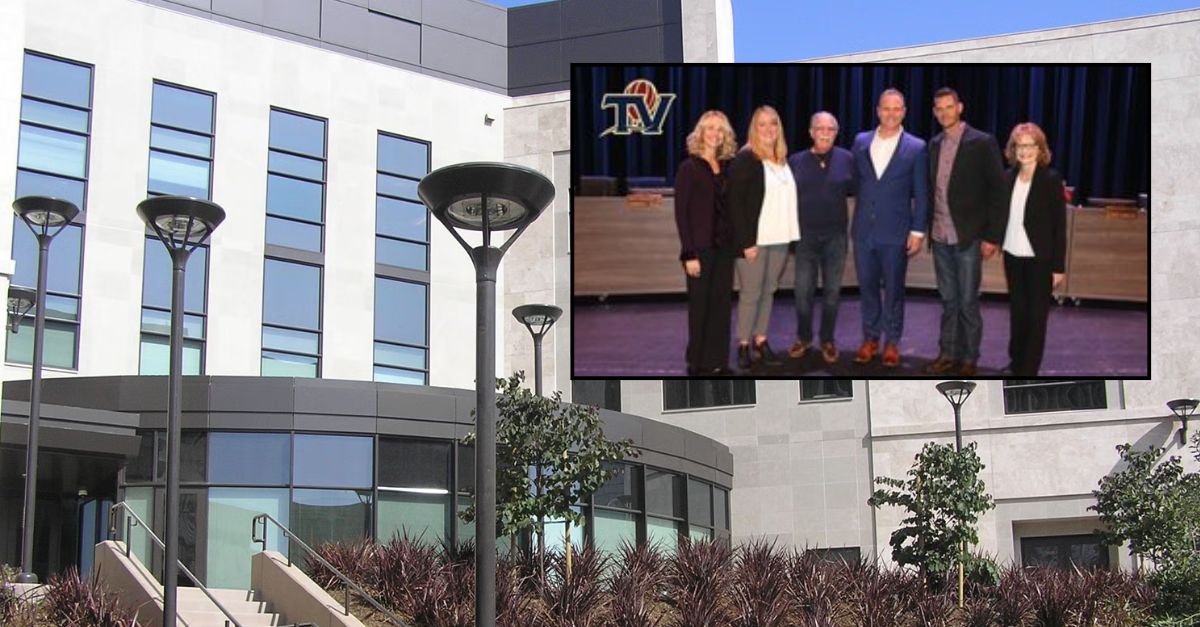
Main: Photo of California Court of Appeal, Fourth District (California Judiciary). Inset: Temecula Valley Unified School Board (Advocates for Faith & Freedom).
A California appeals court unanimously ruled Tuesday that a local school district’s ban on the teaching of critical race theory (CRT) is unconstitutionally vague, leading to an order that the policy’s enforcement be halted.
The legal case marked a pioneering effort against the conservative Temecula Valley Unified School District, which had prohibited the instruction of “critical race theory or other similar frameworks.” This was enacted through a 2022 measure called Resolution 21, which narrowly passed with a 3-2 vote on Dec. 13, 2022. The resolution came on the day three new conservatives joined the Temecula Valley Unified School Board. It described critical race theory as “a divisive ideology that assigns moral fault to individuals solely based on race” and accused CRT of attributing “generational guilt and racial guilt” for long-past actions and policies.
In actuality, CRT is a decades-old interdisciplinary academic theory that focuses on the impact of social conceptions of race on the development of law and politics. Typically, critical race theory is only taught in the context of higher education and not at the K-12 level.
According to the ruling, Resolution 21 banned the teaching of a number of concepts including:
1. Racism is racial prejudice plus power, a concept that is often used to argue that (i) only individuals classified as ‘white’ people can be racist because only ‘white’ people control society and (ii) individuals in ethnic minorities cannot be racist because they do not control society.
2. Racism is ordinary, the usual way society does business.
3. ‘Interest convergence’ or ‘material determinism’, according to which the incentive to move away from racist policies depends primarily on the self-interest of the oppressor class, i.e. ‘whites’.
4. ‘Differential racialization’, according to which the ‘dominant society racializes different minority groups at different times, in response to different needs such as the labor market”[.]
5. The ‘voice-of-color’ thesis, according to which merely ‘minority status … brings with it a presumed competence to speak about race and racism’, a concept often used to discredit opposing arguments on the basis of the opposing person’s race[.]
It also banned teaching that the “advent of slavery … constituted the true founding of the United States” — a reference to the New York Times Magazine’s “1619 Project.” The same three board members who championed Resolution 21 went on to ban a textbook covering the activism of California gay rights figure Harvey Milk after the Temecula school board president Joseph Komrosky called Milk a “pedophile.”
California Gov. Gavin Newsom, a Democrat, denounced Komrosky’s statements, and shortly thereafter, Newsom and California Attorney General Rob Bonta announced the opening of an investigation into the Temecula Valley Unified School Board.
In 2023, a group of parents, teachers and students sued the school board seeking to invalidate Resolution 21 on the grounds that it is not only unconstitutionally vague, but that also that it violates their fundamental right to education and their right to equal protection under the law. Their complaint alleged that students of color and LGBTQ+ students have been the victims of intentional discrimination and that the regulation was an illegal use of taxpayer funds.
More from Law&Crime: ‘Trampling the First Amendment’: Teachers ask judge to block Trump admin funding threat targeting schools that promote diversity and ‘race-consciousness’
The trial court denied the plaintiffs’ motion for injunctive relief, but the appeals court reversed, leaning heavily on the confusion expressed by teachers about what lessons they would be permitted to teach under the ordinance. As a result, the resolution remains blocked while the underlying litigation proceeds.
Presiding Justice Kathleen O’Leary penned the decision for the unanimous panel, which also included Associate Justices Eileen Moore and Joanne Motoike. O’Leary said in the decision that the lower court judge was wrong to ignore the entirety of the plaintiffs’ evidence.
One teacher, O’Leary noted, “struggles to answer her students’ questions about slavery for fear that she could be reported for inadvertently implying one of the enumerated prohibited elements or doctrines in the Resolution,” while another was “unsure how to teach about the controversies that have resulted over changing interpretations of civil rights and past civil rights United States Supreme Court cases or how to teach about European imperialism without discussing CRT or violating the Resolution’s provisions.”
The three-judge panel ruled that the resolution’s “language is ambiguous, lacks definitions, is unclear in scope, is seemingly irreconcilable with state mandated educational requirements, and contains no enforcement guidelines,” and is therefore “unconstitutionally vague.”
Moreover, the panel said, “there are no guidelines for how a teacher should modify their curriculum, if at all.”
Further, said the judges, Resolution 21 does not just ban CRT — it bans “other similar frameworks,” but does not define them.
“As discussed, we do not know what the Resolution meant when it referenced CRT, let alone frameworks similar to CRT,” wrote O’Leary. “Other similar frameworks leaves open for interpretation whether a teacher could be unwittingly implicated for teaching a topic wholly separate from racial inequities, but that could be categorized as having a similar framework by whoever is interpreting the Resolution.”
The panel also noted that the resolution was missing an enforcement mechanism as well as any process for an accused teacher to defend their actions.
Bonta issued the following statement Tuesday in response to the court’s ruling:
Every student deserves the right to feel seen, valued, and welcome in their learning environment. This decision reinforces the principle that all students should have access to inclusive, affirming curricula that reflects the diversity of their communities and the richness of our shared history. And it reaffirms that California law protects the rights of transgender students to live authentically and without fear. In California, we recognize the importance of curricula that reflect the full scope of the human experience and all our communities — including through instruction on history, racial and socioeconomic inequality, and other subjects — and equip students with the tools to work towards a more just society. Education is meant to empower students to think critically, challenge injustice, and see themselves, as well as one another, in the narratives that shape our society. Schools have a responsibility in providing environments where all students can thrive. Policies that ban inclusive curricula or forcibly out transgender and gender-nonconforming students not only target some of our most vulnerable youth, but also inflict real harm, undermining students’ well-being and academic success. That’s why at the California Department of Justice, we remain committed to protecting the rights of all students and ensuring that schools remain a welcoming and inclusive place for all.
The appellate court’s ruling is a preliminary one, and the case will proceed toward trial. During the pending litigation, however, the resolution cannot be enforced.
The Temecula Unified Valley School Board did not immediately respond to request for comment.
You can read the full ruling here.