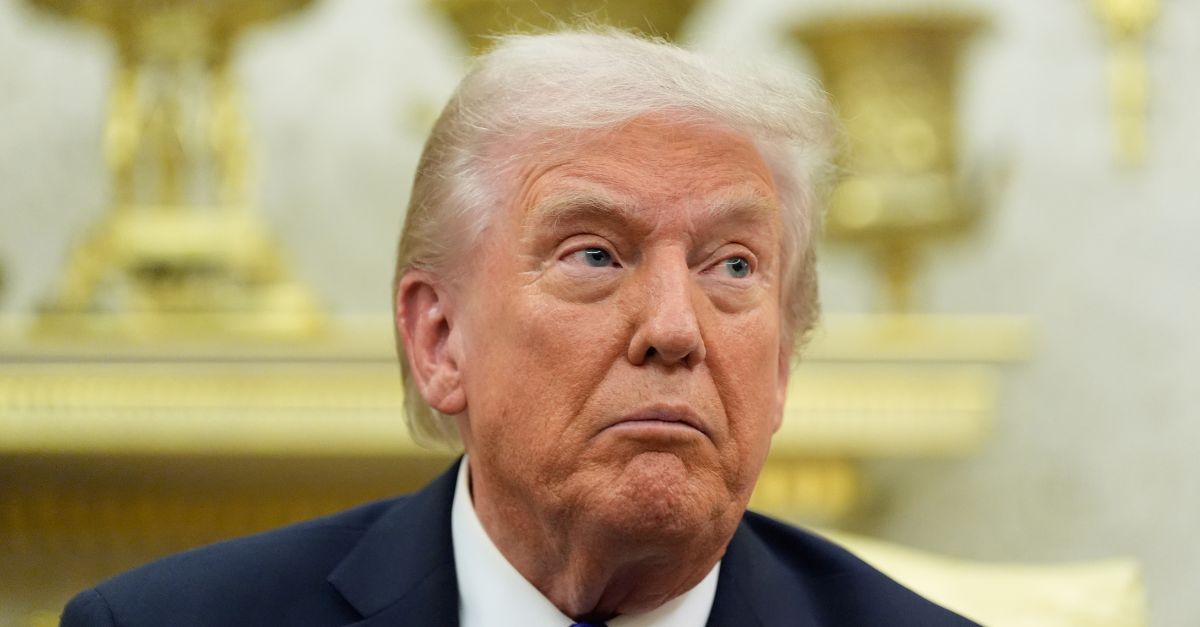

President Donald Trump listens to a question from a reporter as he meets with NATO Secretary General Mark Rutte in the Oval Office of the White House, Wednesday, Oct. 22, 2025, in Washington (AP Photo/Alex Brandon).
A federal judge has effectively halted the Trump administration’s plans to implement a series of contentious budget cuts.
The case, spearheaded by Rhode Island, involves a coalition of states opposing the administration’s attempts to slash funding and undermine operations at four key agencies responsible for managing library resources, business development, and mediation services. This is detailed in a 58-page complaint filed earlier this year.
In May, Chief U.S. District Judge John J. McConnell, Jr., appointed by Barack Obama, issued a preliminary injunction preventing the Trump administration from enacting the proposed cuts. This order required certain agency officials to reinstate essential staff and contractors, as well as distribute previously allocated grants and provide other forms of relief.
Since the injunction, Justice Department lawyers have made multiple unsuccessful attempts to limit its impact, including a recent effort to halt proceedings due to the impending government shutdown.
The judge has now decisively ruled in favor of the plaintiffs, declaring that the Trump administration “acted without constitutional or statutory authority” when pursuing these budget reductions.
In a comprehensive 47-page memorandum and order, Judge McConnell characterizes the issue as an effort by the Trump administration to “dismantle federal agencies.”
“By now, the question presented in this case is a familiar one: may the Executive Branch undertake such actions in circumvention of the will of the Legislative Branch?” the order asks and then answers. “In recent months, this Court—along with other courts across the country—has concluded that it may not. That answer remains the same here.”
Of note, the original litigation sought to block funding cuts at three agencies — and earlier versions of relief only applied to three agencies. Since filing an amended complaint, however, a fourth agency was named as a defendant. The Friday ruling covers all four agencies.
The lawsuit was largely based on violations of the Administrative Procedure Act (APA), the federal statute governing the behavior of federal agencies. In ruling on dueling motions for summary judgment, the judge explained how the plaintiffs secured a vacatur — a form of annulment widely used in APA cases — of the executive order issued by President Donald Trump which set the funding cuts in motion.
“Because Defendants’ actions were ‘arbitrary and capricious’ and ‘contrary to law,’ the Court concludes that the proper remedy is to vacate those actions in their entirety,” McConnell writes, signaling the use of two terms of art in reaching his conclusion.
Under longstanding APA precedent, the popularized “arbitrary and capricious” term describes government actions that go too far while simultaneously eschewing formal, mandatory processes. The notion of something being “contrary to law,” while perhaps a bit more self-explanatory, is also language native to the APA — and part of the same widely-used framework for assessing agency behavior.
Here, the court reiterates its earlier findings from the order granting the preliminary injunction, explaining that “Congress mandated certain staffing requirements” for the defendant agencies and tasked them with “various functions” in order to carry out statutory duties.
“Defendants have acted ‘contrary to law’ because they have made it impossible for the agency to continue to perform its statutory duties,” the court says, in an analysis typical to each named defendant.
Additionally, McConnell relies on a recent report by the Trump administration’s own Government Accountability Office (GAO).
In the court’s words, this report says one of the defendant agencies “unlawfully withheld funds that Congress had appropriated” in violation of the Impoundment Control Act (ICA), a law governing how the executive branch can delay or cancel already-appropriated funds.
“Defendants also acted unlawfully when they failed to follow the procedures set forth in the ICA for rescinding or deferring funds appropriated to each agency,” the court summarized.
McConnell says the agencies did not follow mandatory ICA processes – and invokes a common iteration of the “contrary to law” phrase.
“Also important to note—for the purposes of this claim—that contrary to law ‘means, of course, any law, and not merely those laws that the agency itself is charged with administering,’” the order goes on. “The Court therefore finds that Defendants’ actions in implementing the Reduction [executive order] were ‘not in accordance with law’ and must be set aside.”
McConnell also outlined some constitutional problems with the spending cuts.
“[T]he President has no statutory authority to cancel appropriations passed by Congress or abolish federal agencies created by Congress,” the order continues. “Accordingly, the Court finds that Defendants violated the Constitution’s Take Care Clause and the Separation of Powers doctrine.”
But the court was not nearly done. The judge granted proactive relief for the plaintiff states to make sure the funds continue flowing.
McConnell issued a permanent injunction barring the agencies “from taking any future actions to implement, give effect to, comply with, or carry out the directives contained in” Trump’s executive order.
Part of the court’s analysis assesses the harm each side might suffer should they find themselves on the losing end of the litigation. Here, McConnell says there might be “some harm” to the defendant agencies “were they erroneously required to pay funds that could not later be recouped” but determines the harm to the states without the money is far worse.
From the order, at length:
[C]onsider the public libraries in New Mexico, New Jersey, Maine, and Oregon that would have to close branches, implement hiring freezes, and/or cease providing services that aim to foster literacy and support learning among its patrons…Or consider the State universities in Hawai’i, Maryland, and Arizona that would be forced to eliminate their student programming, default on their contracts, and/or terminate their employees absent continued funding…Next, consider the State entities in Rhode Island, Illinois, and Minnesota that face the very real prospect of work stoppage and negotiation impasses should their labor disputes go unresolved…And finally, consider the loss that Michigan, New York, and Wisconsin would suffer without the research-based and community-specific expert assistance that each State’s agencies have continuously relied on in their efforts to support unhoused individuals.
In sum, the court found the states’ professed harms “are far more than merely economic or speculative.”