
Share this @internewscast.com
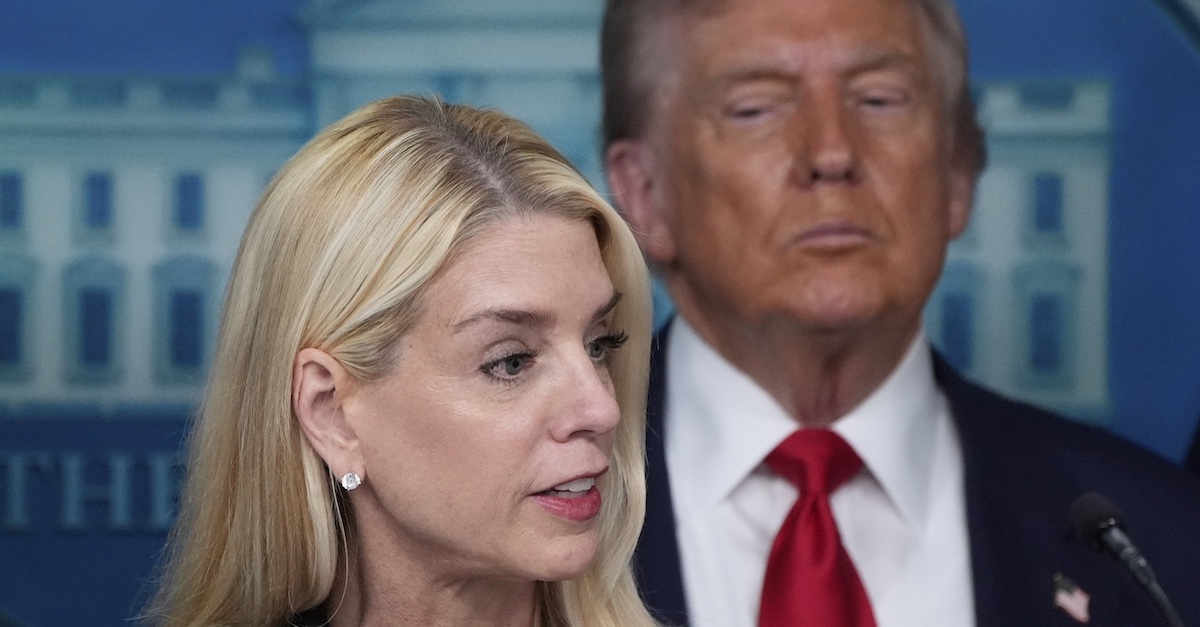
Attorney General Pam Bondi speaks with reporters in the James Brady Press Briefing Room at the White House, Monday, Aug. 11, 2025, in Washington, as President Donald Trump looks on (AP Photo/Alex Brandon).
The ongoing legal showdown between California Governor Gavin Newsom and former President Donald Trump has taken another turn, as oral arguments are set to proceed. This development follows a recent decision by a judge, who declined to mandate that federal agents reveal their identities but expressed a different opinion regarding the display of badge numbers and names.
On February 9, Senior U.S. District Judge Christina Snyder ruled on two California state laws signed by Newsom last September. This ruling came months before Trump retracted his plans to deploy the National Guard in response to protests against aggressive immigration enforcement actions involving often-disguised federal agents.
The first law, known as the “No Secret Police Act,” seeks to prevent federal agents from covering their faces or otherwise concealing their identities while on duty in most situations. Violations of this law could result in misdemeanor criminal charges for those who “willfully and knowingly” breach it.
The second piece of legislation, the “No Vigilantes Act,” mandates that law enforcement officers in California, who are not in uniform, must visibly display identification that includes their agency and either their name or badge number while performing their duties. This requirement applies to both state and federal officers and also carries a misdemeanor penalty for non-compliance.
Since November, the Trump administration has been challenging these laws, arguing that they infringe upon the Supremacy Clause of the U.S. Constitution by improperly regulating federal government activities.
Judge Snyder, appointed by Bill Clinton, found that the government did not convincingly demonstrate how requiring federal agents to have visible faces, names, and badge numbers would “threaten to interfere with or control federal law enforcement operations.”
“[T]he Court concludes that the United States is not likely to succeed on the merits of its complaint that the two challenged Acts directly regulate the federal government in violation of the intergovernmental immunity doctrine,” the judge stated.
But Snyder did find that the “No Secret Police Act” discriminated against the feds for treating them differently than similarly situated state officers.
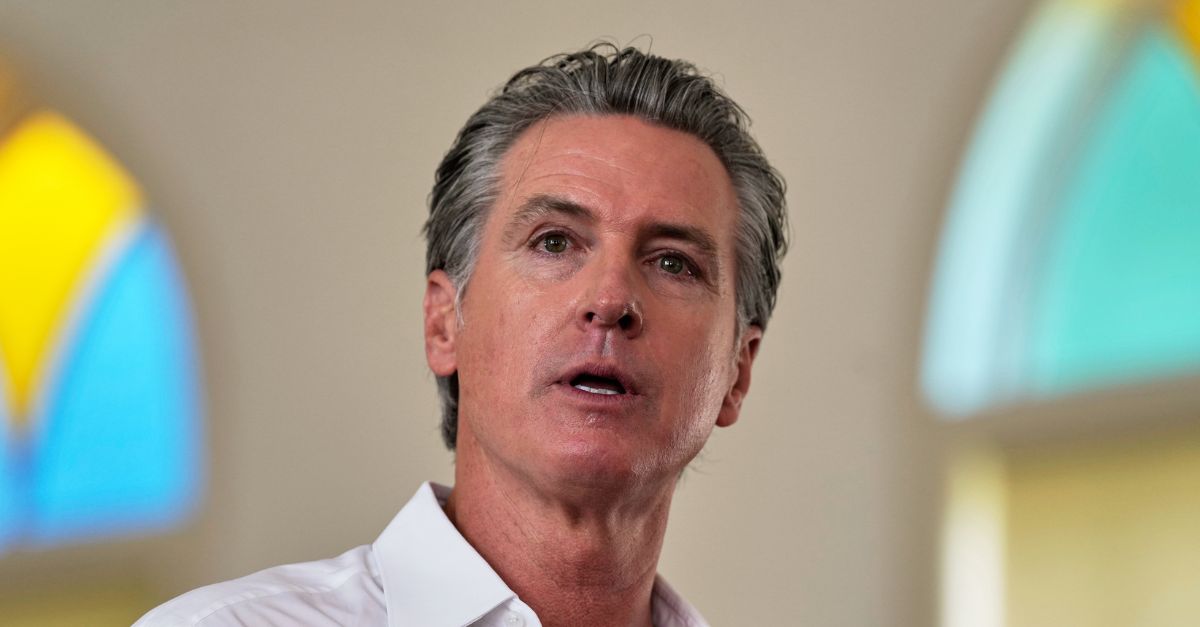
Gov. Gavin Newsom, D-Calif., gives remarks to a crowd at St. Paul First Baptist Church on Wednesday, July 9, 2025, in Laurens, S.C. (AP Photo/Meg Kinnard).
“Accordingly, the Court finds that the United States is likely to succeed on the merits of its claim that the facial covering prohibition of the No Secret Police Act unlawfully discriminates against the federal government in violation of the intergovernmental immunity doctrine,” the judge said.
Finding irreparable harm, the judge granted an injunction blocking the state”s enforcement of its no-masking law.
Snyder did not go nearly as far as the administration hoped, however.
“The Court denies the United States’ motion for a preliminary injunction with respect to all other challenged provisions of the No Secret Police Act and the No Vigilantes Act,” she said.
The Trump administration went to the 9th U.S. Circuit Court of Appeals on Wednesday with an emergency appeal, claiming that Snyder’s refusal to shut down the “No Vigilantes Act” was erroneous, as the law is “patently unconstitutional[.]”
The timing, the government emphasized, was of the essence.
“Although California agreed not to enforce these laws against the federal government while the preliminary injunction motion was pending, that stipulation expires on February 19 at noon,” the filing noted.
U.S. Circuit Judges Jacqueline Nguyen, a Barack Obama appointee, and Mark Bennett and Daniel Collins, both Trump appointees, responded swiftly on Thursday by granting an administrative halt on the enforcement of the second law “pending full review of the emergency motion for an injunction pending appeal.”
California has been ordered to respond by Monday at 5 p.m., and oral arguments have already been set for 10 a.m. on March 3.
U.S. Attorney General Pam Bondi reacted by claiming to have “secured another key victory.”
“The 9th Circuit has now issued a FULL stay blocking California’s ban on masks for federal law enforcement agents,” Bondi said. “Law enforcement officers risk their lives for us, only to be doxxed by radical anti-police activists. Unacceptable. This crucial ruling protects our brave men and women in the field. We will not stop fighting bad laws like these in California and across the country.”