
Share this @internewscast.com
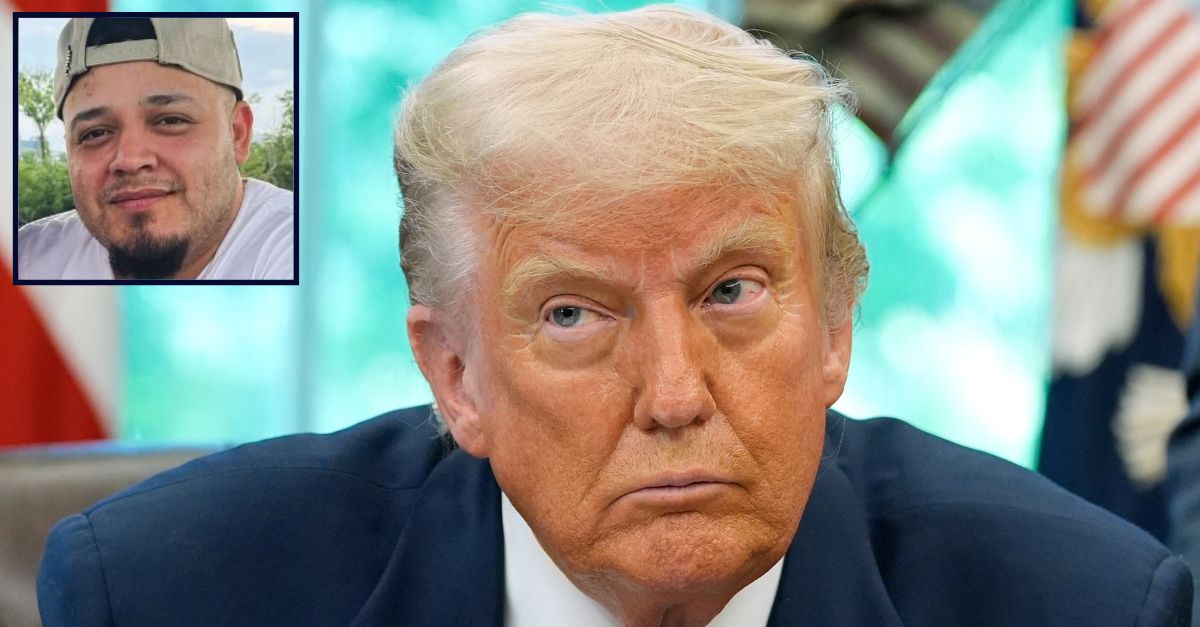
In this image, President Donald Trump engages with reporters as he signs executive orders and declarations in the Oval Office at the White House on Monday, May 5, 2025, in Washington (AP Photo/Alex Brandon). Inset: Kilmar Abrego Garcia in an updated photo (CASA).
Lawyers representing Kilmar Abrego Garcia criticized the Trump administration for persistently pushing a concerning proposal in its tactics to dismiss the lawsuit contesting the protected resident’s “illegal” deportation to a terrorism-linked jail in El Salvador, conducted without due legal process.
The attorneys submitted a 26-page rebuttal to the government’s attempt to dismiss the case in a Maryland federal court. This comes after the Justice Department reiterated its claim last week that federal courts lack jurisdiction or power to resolve the matter.
“The Government asks this Court to accept a shocking proposition: that federal officers may snatch residents of this country and deposit them in foreign prisons in admitted violation of federal law, while no court in the United States has jurisdiction to do anything about it,” the filing states. “This Court, the Fourth Circuit, and the Supreme Court each rejected that jurisdictional gambit. All three courts unanimously affirmed a preliminary injunction that the Government must facilitate the return of Kilmar Armando Abrego Garcia from El Salvador to the United States.”
Love true crime? Sign up for our newsletter, The Law&Crime Docket, to get the latest real-life crime stories delivered right to your inbox.
The filing claims the Trump administration has been “unfazed” by its repeated court losses and further insinuates that the DOJ was unprepared for U.S. District Judge Paula Xinis to deny its day-of request for a 30-day extension on last week’s filing. After Xinis ordered the DOJ to stick to the original deadline, the government filed a “nearly verbatim” recitation of “the same jurisdictional arguments” already rejected by the district court, circuit court, and Supreme Court, according to Abrego Garcia’s attorneys.
“The Government’s position that courts cannot order it to aid the return of U.S. residents it unlawfully removed to foreign cells was ‘eye-popping’ before,” the filing states. “Repetition does not make it less so. Jurisdiction is not a game of ‘best two out of three.’ Once decided, it stays decided unless the facts or the law change. Neither has.”
In last week’s motion to dismiss, the Trump administration claimed that Abrego Garcia’s case “must” be dismissed for lack of subject matter jurisdiction because, despite being removed from the U.S. as the result of an “administrative error,” courts did not have the authority to redress his injury.
The administration’s jurisdiction argument targeted Abrego Garcia’s threshold habeas claim, which is a challenge to the legality of an individual’s confinement — or in this case, removal — that must be filed in the jurisdiction where the individual is being held. According to the DOJ, because Abrego Garcia is being held in the custody of El Salvador and the U.S. “cannot exercise its will over a foreign sovereign.”
Abrego Garcia countered by effectively arguing that he “remains in U.S. custody” — at least constructively — “because he is detained in El Salvador at the behest of the U.S. Government.”
Constructive custody, in the context of the federal habeas statute, extends to prisoners who are not in “actual, physical custody” because they are being held by someone else “under or by color of the authority of the United States.” Examples of constructive custody include a petitioner who is free on parole but still subject to parole restraints or where an individual is “imprisoned by a private party at the behest of the U.S. Government.”
Xinis, a Barack Obama appointee, is unlikely to credit the motion, as last month she rejected the very same jurisdictional argument from the Trump administration, writing that it “fails as a matter of law” and emphasizing that the government defendants “can and do return wrongfully removed migrants as a matter of course.”
The judge has previously upbraided the administration for ignoring court orders to produce information regarding Abrego Garcia’s detention and the steps being taken to facilitate his return and for allegedly “mischaracterizing” the Supreme Court’s April order.
Abrego Garcia’s case has garnered international attention, quickly becoming one of the most high-profile and combative lawsuits amid the blizzard of legal challenges filed against Trump and his administration since he retook office in January. The government has conceded in numerous filings that he removal to El Salvador was an “administrative error,” but has steadfastly insisted that he is a member of MS-13 and refused to cooperate with multiple court orders demanding he be brought back to the country.
Notably, the government has proffered little, if any, evidence that Abrego Garcia was a gang member. He has no criminal record in the U.S. or El Salvador and has submitted sworn statements that he was fleeing El Salvador due to gang violence.