
Share this @internewscast.com
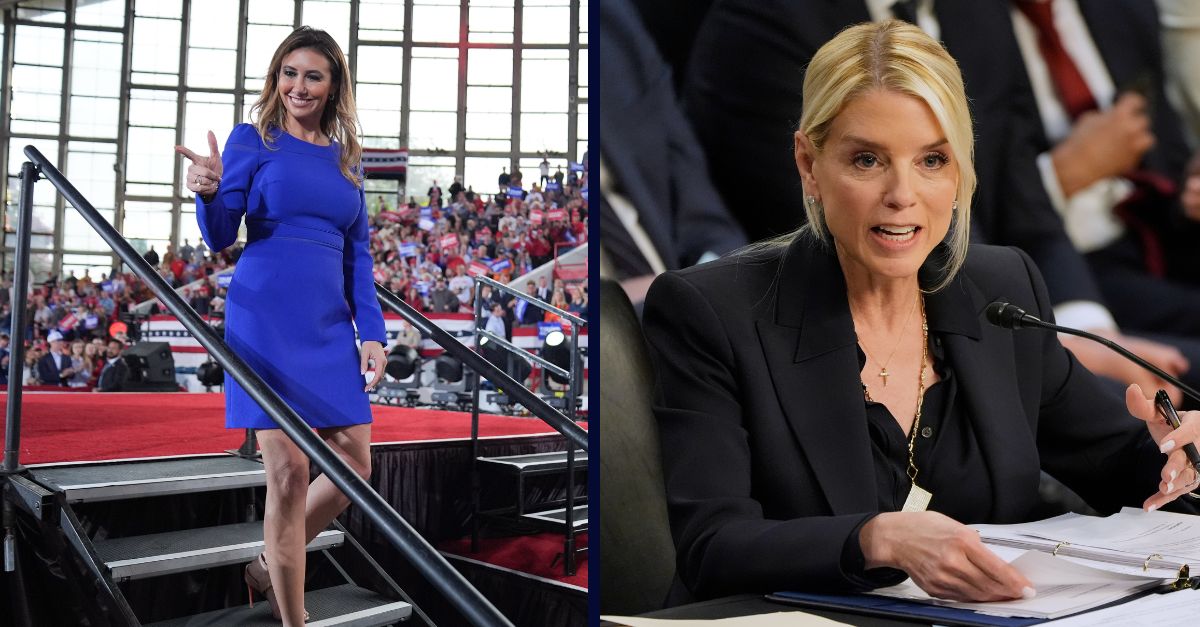
Left: Alina Habba walks off stage after speaking before Republican presidential nominee former President Donald Trump arrives at a campaign rally at J.S. Dorton Arena, Monday, Nov. 4, 2024, in Raleigh, N.C. (AP Photo/Evan Vucci). Right: Attorney General Pam Bondi appears before a Senate Judiciary Committee oversight hearing on Capitol Hill in Washington, Tuesday, Oct. 7, 2025. (AP Photo/Mark Schiefelbein).
A federal judge has sharply criticized the Trump administration for its continued practice of mandatorily detaining noncitizens already residing in the United States. This approach persists despite numerous court decisions opposing it, leading the judge to assert that the government is aware that its actions are “illegal,” yet it remains unchanged in its methods.
In a decisive move to halt what he termed as “intentional misconduct,” U.S. District Judge Zahid Quraishi ordered the immediate release of Diana Elizabeth Cartagena Hueso from federal immigration custody on Thursday.
Expressing his exasperation with the administration’s conduct in this and other habeas corpus cases, Judge Quraishi, who was appointed by President Joe Biden, highlighted a previous directive for a bond hearing and instructions to keep the 29-year-old Salvadoran woman in New Jersey. However, he discovered she had already been transferred to Oklahoma.
Cartagena Hueso was moved from Oklahoma to Texas and back again, all within a span of two days. The administration has offered no explanation for these transfers and insists it is not obligated to return her to New Jersey, according to the judge.
Having entered the U.S. in 2016 under the “credible fear” of returning to El Salvador, Cartagena Hueso had been living in the country for a decade without a criminal record. During this time, she married and had a child who is now five years old. Nonetheless, on January 27, immigration agents arrested her and her husband while they were en route to a doctor’s appointment in New Jersey, as noted in court documents.
Judge Quraishi emphasized that the ten years Cartagena Hueso had been allowed to live freely in the U.S. significantly distinguish her from an “arriving alien,” thus exempting her from mandatory detention requirements.
“In this matter, the Government released Petitioner on her own recognizance in 2016, and left her at large in the United States for nearly a decade before returning her to custody. While release for such a length of time is ‘not … regarded as an admission of the alien’ and will permit an alien to be returned to mandatory detention status, the outright release that the Petitioner received is a legitimate change in status,” the judge wrote. “An individual like Petitioner who has been released into the United States without parole is no longer considered to be standing at the border.”
“The Government has abandoned its right under the statute to take Petitioner into custody. Her continued detention is therefore unlawful,” he added.
Writing that the Trump administration “knows” this because courts have articulated as much in more than 300 cases and counting, Quraishi decided it would not be enough to simply force the government to facilitate a bond hearing, as that was tried already and the petitioner ended up in Oklahoma.
“No more,” the judge said. “On the individual merits of this case, the undersigned now finds that this relief is insufficient and will instead order that Petitioner be released.”
Quraishi also seized the opportunity to criticize the performance of the U.S. Attorney’s Office for the District of New Jersey, once the home of Alina Habba.
Law&Crime has chronicled how U.S. Attorney General Pam Bondi’s unsuccessful maneuvering to keep Habba in place as acting U.S. attorney backfired in the courts to the point that Habba stepped aside in December, leaving the office and the state with no U.S. Senate-confirmed top federal prosecutor.
U.S. attorney offices across the country have experienced turmoil in leadership and in the rank-and-file, causing varying degrees of issues in court, while having to respond to the flood of habeas petitions challenging the Trump administration’s immigration enforcement actions. Multiple judges have pressed attorneys working for the DOJ on a volunteer or special assignment basis about why the lack of compliance with court orders has become so commonplace in immigration cases.
By Quraishi’s count, the U.S. attorney’s office in New Jersey has violated 72 court orders and “expressly admitted” violating 56, albeit unintentionally, as “[i]mmigrants are swept up into custody and shifted repeatedly around the country without warning or explanation.” The judge found that “objectively appalling” and said the formerly Habba-led office has “eroded” the presumption of its credibility.
“That number by itself is objectively appalling, but at least one judge has indicated that it underreported,” the judge remarked. “The U.S. Attorney’s Office has counted these citations as unintentional. Sadly, the well-deserved credibility once attached to that distinguished Office is now a presumption that ‘has been undeniably eroded.’”
In a final blow, the judge threatened to force prosecutors or DHS officials to “testify under oath” and provide explanations if the mandatory detention cases continue to come before him.
“The government’s continued actions after being called to task can now only be deemed intentional,” Quraishi concluded. “The undersigned will not stand idly by and allow this intentional misconduct to go on. It ends today.”