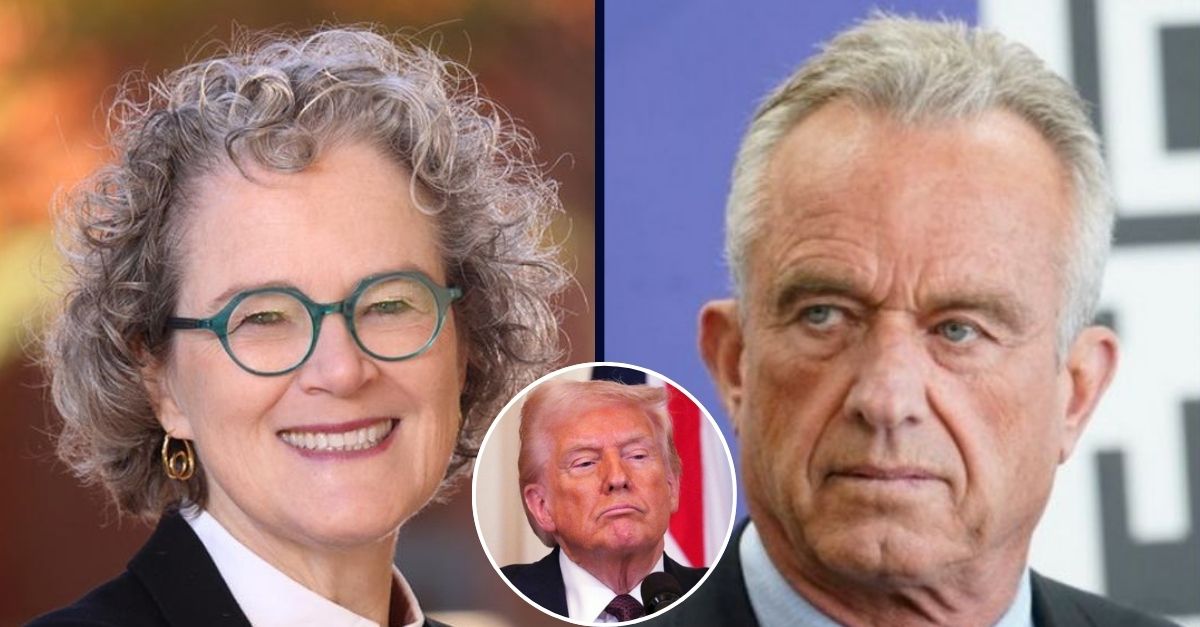

Left: Dr. Jeanne Marrazzo (National Institute of Allergy and Infectious Diseases). Right: Robert F. Kennedy Jr. hosts a fireside chat (John Lamparski/Sipa USA/Sipa via AP Images). Inset: President Donald Trump speaks in the East Room at the White House Thursday, Feb. 27, 2025, in Washington (Carl Court/Pool Photo via AP).
Dr. Jeanne Marrazzo, a former senior federal health official, has initiated legal action against the Trump administration, claiming her dismissal was a retaliatory move after she criticized the government’s “reckless actions.”
In a 31-page lawsuit filed in a Maryland federal court, Marrazzo contends that the administration, which assumed office in January, prioritized “unscientific and unsupported political biases” over “scientific integrity.” She asserts that her outspoken opposition to these developments led to her losing her esteemed position.
Dr. Marrazzo took over as director of the National Institute of Allergy and Infectious Diseases (NIAID) in August 2023, succeeding Dr. Anthony Fauci. Her appointment was widely praised within the scientific community, and her tenure was marked by “the highest possible performance ratings,” the complaint states.
However, the dynamics shifted when President Donald Trump returned to power earlier this year and appointed Robert F. Kennedy Jr. as the head of the Department of Health and Human Services (HHS).
According to Marrazzo, the new leadership at HHS and the National Institutes of Health (NIH), which oversees NIAID, started to suppress scientific research, placing political agendas above scientific integrity. She claims these actions compromised NIH’s mission to advance scientific research. One major policy change was the administration’s stance on vaccines, which aligned with an “anti-vaccine (‘anti-vax’) political agenda” contrary to “decades of incontrovertible scientific evidence.”
Additionally, Marrazzo highlights that HHS began slashing funding for research grants containing the words “diversity,” “equity,” or “inclusion.” These measures echoed Trump’s executive agenda, which Marrazzo describes as “reckless” and a “substantial and specific danger to public health and safety.” She notes that these funding cuts particularly impacted her work, as “the majority of NIH grants and contracts canceled in 2025 were related to infectious diseases.”
But Marrazzo did not intend to keep her disagreements — and fears — to herself. Rather, she became a whistleblower — “object[ing] to the censorship of scientific research” and destruction of scientific integrity “for political reasons” in emails, conversations, and meetings with her bosses in NIH and HHS.
As she tells it, her opposition to the new administration’s priorities resulted in a “blatantly retaliatory act.” She was removed from her position as NIAID director and placed on administrative leave pending a reassignment to the Indian Health Service (IHS). She had been shut out, she says: directed not to return to work, barred from NIH facilities and equipment, and never actually reassigned.
But Marrazzo, again, did not relent. On Sept. 4, months after her proposed reassignment, she appealed to the U.S. Office of the Special Counsel (OSC), alleging that “HHS retaliated against her for her protected whistleblowing by placing her on administrative leave.” She also spoke with national media outlets, both in print and on television, about her complaints and concerns with where public health was heading.
On Sept. 26, the relegated NIAID leader received a letter from Kennedy. She had been fired.
Marrazzo maintains that the government officials acted unlawfully against her in numerous ways. For one thing, she says, they violated her First Amendment rights because they fired her over her “protected speech.” For another, they violated the Fifth Amendment because they terminated her without due process, she alleges.
She is seeking to be reinstated to her position and receive back pay.
One section of Marrazzo’s complaint summarizes the perceived wrongs she faced.
“HHS removed Dr. Marrazzo from her position as NIAID Director and terminated her employment because she raised concerns—both internally within HHS and externally to the OSC and the media—about government actions that she reasonably believed constituted a violation of law, rule, or regulation; gross mismanagement; a gross waste of funds; an abuse of authority; a substantial and specific danger to public health or safety; and censorship related to scientific research or the integrity of the scientific process,” reads the filing. “The concerns she raised constitute protected activity under the Whistleblower Protection Act (“WPA”), and her disclosures to the OSC and the media about matters of public concern are protected by the First Amendment to the United States Constitution.”
Law&Crime has reached out to HHS for comment on the lawsuit.