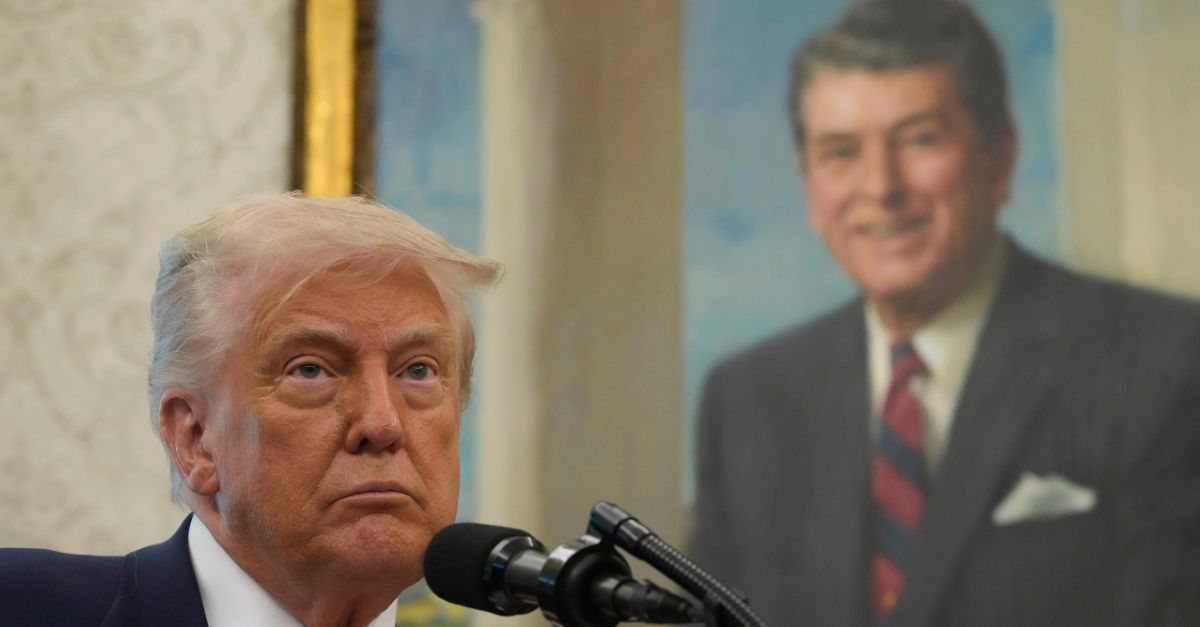

President Donald Trump delivers remarks prior to Steve Witkoff taking the oath as a special envoy during a ceremony held in the Oval Office of the White House on Tuesday, May 6, 2025, in Washington, set against the backdrop of a portrait of former President Ronald Reagan (AP Photo/Mark Schiefelbein).
The Trump administration encountered a legal setback in a Seattle federal court on Wednesday in a long-standing lawsuit that challenges the federal government’s immigration policies.
Initially, the plaintiffs, led by a Congolese refugee known only as Pacito, gained class certification, successfully transforming their lawsuit into a class action following a significant U.S. Supreme Court decision that limited the avenues for nationwide injunctions.
Second, the U.S. Department of Justice lost its bid to have the lawsuit dismissed for failure to state a claim and lack of jurisdiction.
The court’s decisions raise the probability that the plaintiffs might soon secure another injunction that would prevent the Trump administration from dismantling the refugee resettlement program or cutting its key funding.
This legal battle was triggered by President Donald Trump’s initiative to pause the U.S. Refugee Admissions Program (USRAP) for 90 days “until further entry of refugees aligns with U.S. interests.” The plaintiffs argued in their initial lawsuit that the executive order by both the 45th and 47th presidents constitutes a grave breach of federal law, an assertion the court has thus far validated.
In February, U.S. District Judge Jamal Whitehead, appointed by Joe Biden, issued a preliminary injunction ruling. This decision was solidified in March when the court released a 62-page order formalizing the opinion.
Meanwhile, mindful of the high court’s order on district court-authored universal injunctions, the plaintiffs took a pro-active and dual-pronged approach to maintaining the bar on the policy change.
On one hand, Pacito’s evolving group of plaintiffs insisted the universal injunction-busting opinion by Justice Amy Coney Barrett technically could not apply to their case because the original injunction was before the U.S. Court of Appeals for the 9th Circuit. Simultaneously, the refugees argued their interests were so similar and representative of others like them that they should be able to represent all similarly affected refugees throughout the country.
One aspect of the USRAP relevant to many plaintiffs is the statutory provision known as “follow to join” or “following to join” (FTJ) and which allows refugees already in the country to petition for their spouses and minor children to join them — subject to two conditions.
The plaintiffs, for their part, say meeting those two conditions ends the government’s inquiry – or, in real terms, its ability to deny placement. So long as the annual number of refugees has not been met, and the family members are not statutorily prohibited from entering the country under the Immigration and Nationality Act (INA), the FTJ process should move forward.
In his first order, Whitehead did not address the plaintiffs’ jurisdictional argument but accepted part and parcel the class action arguments.
The court determined the plaintiffs’ claims were still worth pursuing and, more importantly, that the plaintiffs themselves – grouped into three different subclasses – to have a valid and intertwining interest in pursuing such claims.
“Common questions of fact and law prevail across all subclasses,” Whitehead writes.
The judge then rubbishes the government’s arguments, at length:
The Government offers several arguments why Plaintiffs fail to establish commonality. First, they assert that Plaintiffs “cannot point to a universal policy that applies to all proposed class members.” But this argument fails because there is no requirement that a single policy affect every class member. Plaintiffs have proposed three subclasses, each bound together because the USRAP [executive order and other anti-USRAP policies] commonly affect their members, who all seek the same injunctive and declaratory relief.
Second, the Government argues that factual differences within each subclass preclude commonality. … This argument fails. Such differences—inevitable in any class action—do not alter the fact that common questions unite each subclass.
The government, for its part, has vociferously protested every step of the way – hewing to the second Trump administration’s stock-in-trade argument that Trump’s actions, broadly, are not reviewable by the court system.
As has often — but not always — been the case, the judge overseeing the matter decided he did, in fact, have the authority to hear the dispute.
At the heart of the government’s argument is the notion that the refugees are actually lodging breach-of-contract claims under the auspices of the Administrative Procedure Act, the statute that governs agency actions.
Rather, the government says, the contract nature of the dispute means the litigation is governed by the obscure Tucker Act of 1887. Under this law, the U.S. Court of Federal Claims has jurisdiction to rule on “any claim” against the federal government that relies “upon any express or implied contract with the United States.”
Whitehead, however, has heard this line before – several times.
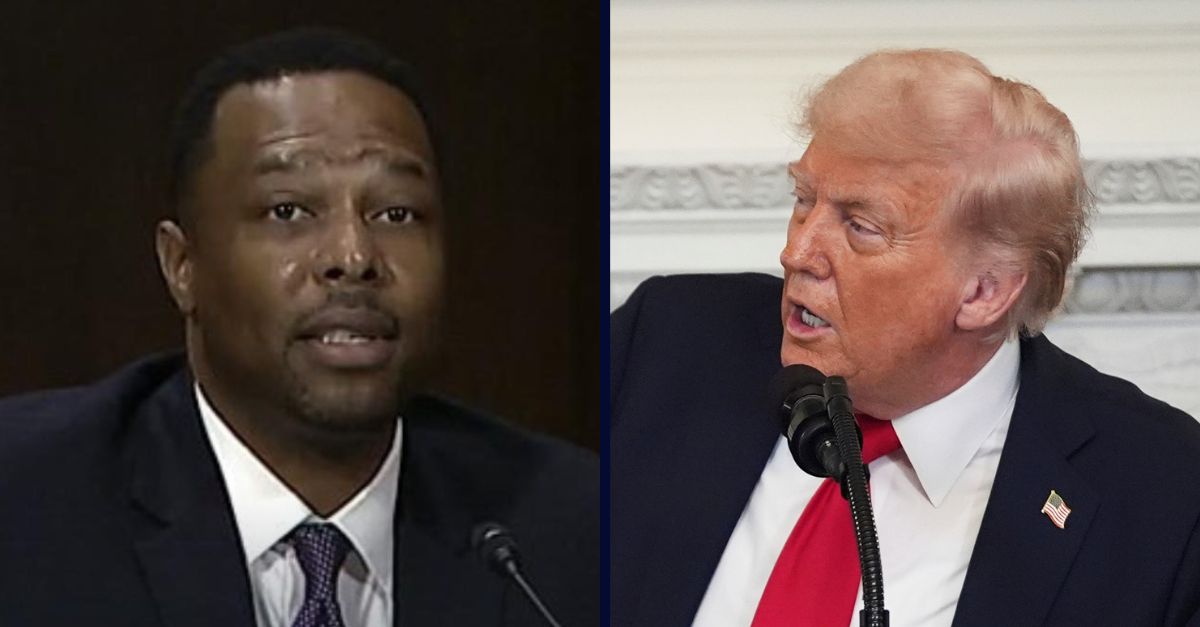
Left: U.S. District Judge Jamal Whitehead before being confirmed to the U.S. District Court for the Western District of Washington (Senate Judiciary Democrats/X). Right: President Donald Trump speaks during the White House Faith Office luncheon in the State Dining Room, Monday, July 14, 2025, in Washington (AP Photo/Evan Vucci).
“The Government rehashes its thrice rejected argument that Plaintiffs’ APA claims amount to no more than ‘disguised breach-of-contract claims’ subject to the exclusive jurisdiction of the Court of Federal Claims,” the second order reads. “Having explained the fault in this position three times, the Court addresses it here only briefly.”
The court elaborates to rubbish the government again, at length:
The organizational Plaintiffs do not seek damages for breach of their cooperative agreements. Rather, they seek to set aside the Agency Suspension, Funding Suspension, and Funding Termination and, in so doing, to compel the Agency Defendants to fulfill their statutory obligations, including to fund resettlement programs “to the extent of available appropriations.” The organizational Plaintiffs have no adequate remedy in the U.S. Court of Federal Claims—not only because the Claims Court lacks the power to order the relief sought, but also because the USRAP cooperative agreements are not the sort of “money-mandating” contracts that are enforceable under the Tucker Act.
On the Trump administration’s broader argument that the plaintiffs failed to state a claim, the court delves into the facts a bit. And here, the judge gives the clearest indication of where the case is heading.
“This Court has already found that the complete, indefinite suspension of USRAP—the program by which the Government fulfills its statutory duties under the Refugee Act—countermands not only the INA statutory provisions discussed above but also the considered policy judgments of Congress,” Whitehead goes on. “When the President, through the USRAP EO, effectively subordinated this Congressional policy interest in refugee resettlement to countervailing Executive policy interests in, among other things, ‘appropriate assimilation’ he impermissibly ‘countermand[ed] Congress’s considered policy judgment.'”
Notably, Whitehead also stakes out a strong vision of judicial autonomy independent from the executive branch – by way of a direct response to an argument by DOJ lawyers that courts cannot enjoin the president.
Yes, and no, the court replied.
“It is true that courts generally lack authority to enjoin the President in the performance of official duties,” the second order goes on. “But Plaintiffs do not seek such relief. The only relief that Plaintiffs seek against the President himself is a declaratory judgment that the USRAP [executive order] is ultra vires. As the Court explained when issuing its First Injunction, district courts have jurisdiction to declare executive orders unlawful and to enjoin sub-Presidential Executive Branch officials from carrying out unlawful orders Because Plaintiffs seek only declaratory relief against the President, the Court declines to dismiss their claims against him.”


