
Share this @internewscast.com
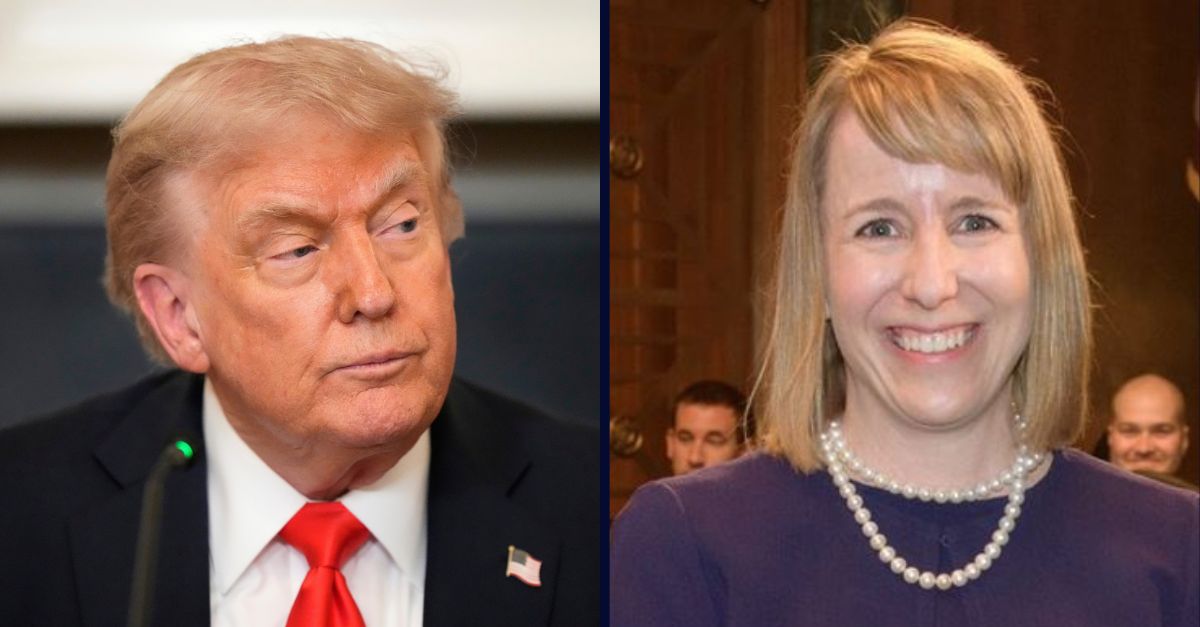
Left: President Donald Trump attends a meeting with the Fraternal Order of Police in the State Dinning Room of the White House, Thursday, June 5, 2025, in Washington. (AP Photo/Alex Brandon) Right: U.S. District of Maryland Judge Stephanie Gallagher during a nomination hearing in April, 2016 (Facebook page of then-Sen. Barbara Ann Mikulski)
A federal judge in Maryland has criticized the Trump administration for not complying with court orders concerning a Venezuelan man wrongly deported from the United States. The judge expressed her “grave concerns” about the government’s actions.
The 15-page order by U.S. District Judge Stephanie Gallagher addresses the case of Daniel Lozano-Camargo, a Venezuelan national referred to in documents as “Cristian.” Despite his pending asylum application in the U.S., he was deported to El Salvador and later sent to Venezuela through a U.S.-facilitated prisoner exchange, returning him to the country from which he sought asylum.
Judge Gallagher noted with concern that Lozano-Camargo is now missing. She remarked that while he might have given up on returning to the U.S., it is equally plausible that he has fallen victim to the violence he initially sought to escape by seeking asylum.
In March, following President Donald Trump’s invocation of the Alien Enemies Act and warnings about the Venezuelan gang Tren de Aragua, the administration deported hundreds of Venezuelans to El Salvador, where they were detained in a notorious prison. Lozano-Camargo was included in this group.
Due to his open asylum case, Lozano-Camargo’s lawyers filed an emergency motion for his return, leading Judge Gallagher to order the administration to “facilitate” his return. This included the Department of Homeland Security making a “good faith request” to El Salvador for his release.
By May, the Trump administration was instructed to provide updates on Lozano-Camargo’s whereabouts and condition, as well as the efforts being undertaken to ensure his return. The U.S. State Department and Secretary of State Marco Rubio were also involved in these efforts.
The status reports were lacking, according to Gallagher, finding that “none of them detailed steps being taken for his return or provided evidence that either Defendants or the State Department had made a good faith request to El Salvador for Cristian’s release.” Then, in July, the court learned that Venezuela and the U.S. had agreed to a prisoner exchange, and Lozano-Camargo, who was just 20 years old when he was deported, was among the people in El Salvador heading further south.
Within the context of fulfilling the court’s order, things have only gotten worse.
“[B]eginning in late August, 2025, Class Counsel has been unable to reach Cristian to provide updates on his desire to return to the United States,” Gallagher wrote on Nov. 14. “His whereabouts are presently unknown.”
Three motions were filed to which the judge was responding, with two coming from Lozano-Camargo’s lawyers. One of them sought “prompt notice” of his return to the U.S., which Gallagher denied, finding it “moot” because he is not believed to be in any government’s custody. Their other motion was for the defendants — including Rubio, who they argued was acting as the defendants’ “agent” — to be held in contempt.
Though Gallagher expressed her “frustration” with the administration and its behavior, she would not grant this.
“While this Court shares Class Counsel’s frustration with what appears to be lack of good faith government efforts at compliance with this Court’s order, it cannot find, on the particular facts of this case, the factors needed to find probable cause for criminal contempt,” Gallagher wrote.
She went on: “Even if one assumes, as is reasonable, that the State Department focused its efforts on using Cristian as one of many pawns in its prisoner swap instead of endeavoring to comply with this Court’s order to facilitate his return, criminal contempt is unavailable because this Court’s order did not (and could not) clearly direct the State Department or Secretary Rubio to take action.”
Still, Gallagher was harsh in her critique of the president’s administration, saying that their status reports were “often woefully deficient” and at times, “also filed late.” For one report filed on July 18, “Class Counsel can establish that the violation of the filing deadline was willful” because officials did not want the prisoner swap operation to fall apart.
“This Court has grave concerns about the government’s apparent willingness to disregard this Court’s orders,” as well as “its determination that protection of the prisoner swap (apparently from prospective judicial intervention) is a valid reason to ignore (or at least delay compliance with) a valid Court order to provide a status report,” Gallagher wrote. But ultimately she found that the “immense power” of criminal contempt proceedings was a step too far.
The administration, for its part, filed a motion for the “facilitation” paragraph of her order to be thrown out, arguing Lozano-Camargo has shown an “unwillingness to return” to the U.S. This, too, she denied, “reject[ing] the premise” that he doesn’t want to come back.
Furthermore, as the administration is not currently obligated to file status reports because his whereabouts are unknown, it is not suffering any burden, the judge found. “And, should Cristian resurface and express a desire” to return, the administration “should retain their existing obligation” to bring him back.