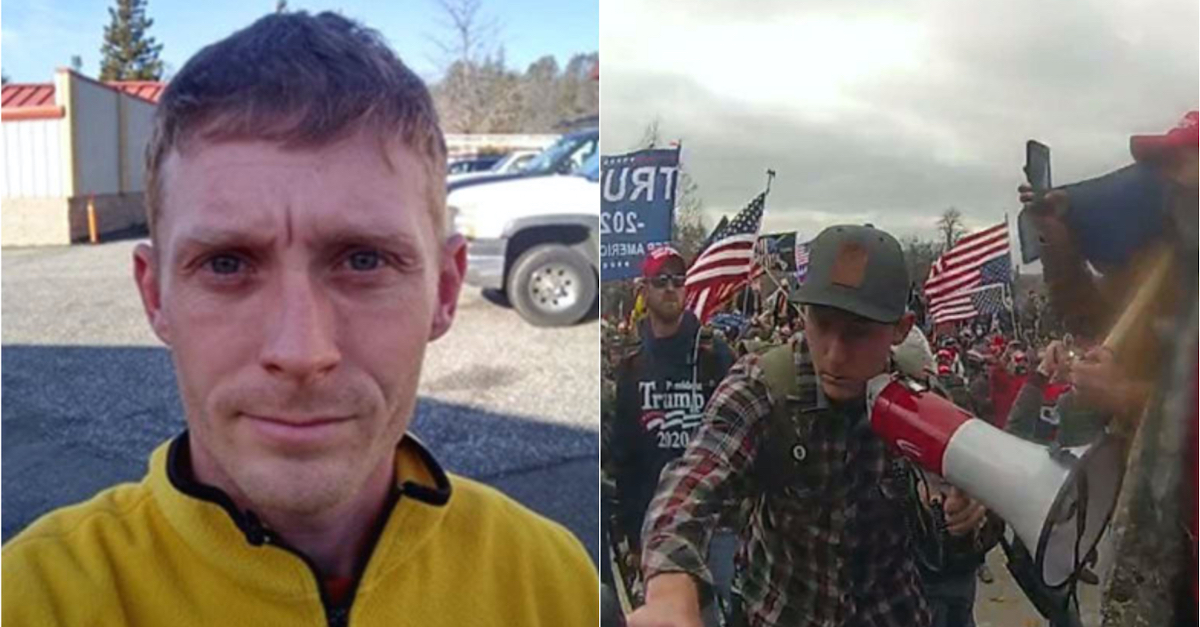
Sean McHugh (via FBI court filing)
The judge overseeing the case of a California man accused of assaulting police during the Jan. 6 attack on the U.S. Capitol has denied his request to move the case out of Washington, D.C., but has left the door open for him to raise the issue later.
Sean Michael McHugh, who allegedly accused police of “protecting pedophiles” before attacking them with a metal sign and bear spray during a confrontation on the west side of the U.S. Capitol building on Jan. 6, said that he wouldn’t be able to get a fair trial in the nation’s capital. McHugh himself has been convicted of a sex crime against a minor.
He is now charged with felony assault, civil disorder, obstruction of Congress, as well as various other felonies and misdemeanors for allegedly joining the crowd of violent Donald Trump supporters who overran police and swarmed the Capitol, temporarily putting a halt to the certification of Joe Biden‘s 2020 electoral win.
According to McHugh’s lawyers, several factors have created an “irreparable bias” against him that would result in him not getting a fair trial, as the U.S. Constitution guarantees.
McHugh, through his lawyers, argues that the jury pool in D.C. would be prejudiced against him because of the likelihood that the jury members, or their friends and family, work on Capitol Hill, and D.C. residents connected to the federal government are “more likely to view themselves as the direct victims of the events.” His brief also cites the fact that 92 percent of D.C. residents voted for Biden in the 2020 presidential elections, and they would therefore view McHugh’s participation in the Jan. 6 attack as an attempt to “nullify” their votes.
McHugh also said that local and national media coverage of Jan. 6, which his brief describes as “charged and inflammatory,” support a presumption of prejudice against McHugh.
U.S. District Judge John Bates denied the request Wednesday, echoing rulings from several other D.C. judges overseeing Jan. 6 cases.
“I conclude that at this point in these proceedings, transfer is not appropriate, and I’m going to deny the motion without prejudice,” Bates, a George W. Bush appointee, said. “It’s something that can be raised—and any other concerns about prejudice can be raised—again after voir dire in this case,” he added, referring to the process of asking potential jurors questions in order to identify potential bias.
During the hearing, McHugh’s lawyer Maria Jacob pointed to not only national media coverage of the Capitol riot but also coverage of McHugh specifically, including stories about his criminal record that includes allegations of domestic violence and a statutory rape conviction.
“It’s very important here that the publicity is not about the individual’s specific case, but is instead about the broader events of Jan. 6,” Bates said. “It is likely that not a single member of the venire will have ever heard of Sean McHugh. I think that’s likely to be the case. And they will not be familiar with the facts of this case or have formed any opinion of his guilt based on those facts when the trial begins.”
As Bates noted, not one judge has granted a change of venue request for a Jan. 6 defendant.
It is unclear why McHugh wanted his case tried in the Eastern District of Michigan. Prosecutors noted that he has no apparent connection there, but McHugh’s defense attorney said that the federal rule that allows a change of venue doesn’t require such a link, only a showing that a defendant would be prejudiced if the trial were held where the crime allegedly occurred.
Bates has previously denied McHugh’s requests to limit the case against him. On Monday, Bates issued a written opinion denying a request from McHugh to deny a federal obstruction charge. Bates had previously denied McHugh’s motion to dismiss that charge, having taken the same position as at least nine other district judges that the charge is valid under the statute.
McHugh renewed his motion after one judge, Carl Nichols, granted a similar motion in a Jan. 6 case, concluding that the obstruction charge applies only to crimes alleged to have occurred “with respect to a document, record, or other object.”
Nichols, a Trump appointee, is reportedly “very seriously contemplating” the government’s request to reconsider that dismissal.
McHugh’s trial had previously been set for June 9, but Bates vacated that date. The parties were supposed to set a new trial date at Wednesday’s hearing, but Jacob indicated that plea negotiations had resumed and requested instead a status conference in 30 days.
[Image via FBI court filing.]
Have a tip we should know? [email protected]
Source: This post first appeared on