
Share this @internewscast.com
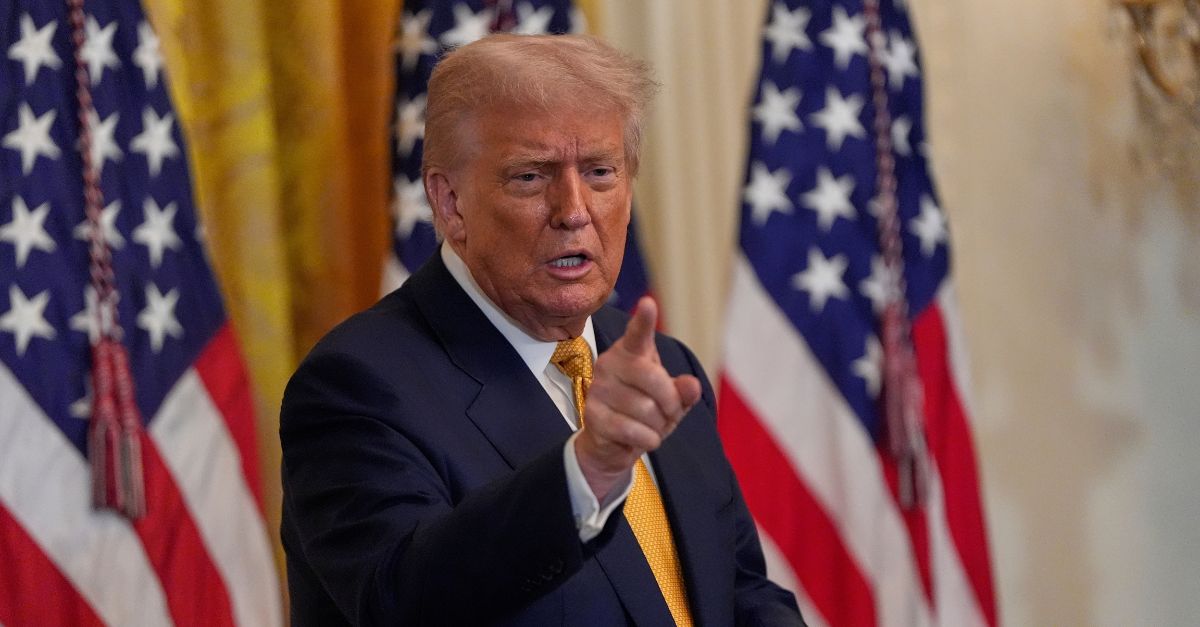
President Donald Trump gestures during a reception for Republican members of Congress in the East Room of the White House, Tuesday, July 22, 2025, in Washington. (AP Photo/Julia Demaree Nikhinson)
The Trump administration is not permitted to end its agencies’ collective bargaining agreements (CBAs). A key reason for this is that allowing such an action would resemble “judicial overreach,” which the Supreme Court aimed to address in a recent decision supporting President Donald Trump, as stated by a federal judge on Wednesday.
The effort by the White House to remove labor unions from major federal agencies, according to U.S. District Judge Alan Albright of the Western District of Texas, essentially relates to the separation of powers among the branches of government.
And on this matter, because the Trump administration’s lawsuit was preemptive – that is, asking the court to approve of their future conduct in breaking the CBAs as part of an executive order – the judge found that his hands were tied.
To explain why he came to that decision, the judge pointed to the highest court in the land and its recent case in Trump v. CASA that severely limited the power of U.S. district judges to issue nationwide injunctions.
“This Court’s decision to dismiss this case for lack of jurisdiction is bolstered by the Supreme Court’s recent decision in Trump v. CASA, wherein the Supreme Court held that universal injunctions likely exceed the equitable authority that Congress has granted to federal courts,” Albright, a Trump appointee from the president’s first term, wrote in a 27-page filing.
In making its decision in the landmark birthright citizenship case, the Supreme Court found that universal injunctions were not present for most of the country’s history. And in this case, the district judge opined, the White House asked a court to go a step further – by asking for relief to do something before having even begun.
Albright wrote, at length:
Here, pre-enforcement declaratory judgments pre-approving an Executive Order have been conspicuously nonexistent for all of this Nation’s history. CASA was not decided upon the issue of standing before us today. Nonetheless, the practical impact of the holding in CASA as well as the core legal principle espoused by the Supreme Court remains central to this Court’s decision today— “federal courts do not exercise general oversight of the Executive Branch; they resolve cases and controversies consistent with the authority Congress has given them.” Absent a justiciable case or controversy, this Court will not exercise general oversight of the Executive Branch. Accordingly, this case is dismissed for lack of subject matter jurisdiction.
Trump’s March 27 Executive Order 14251 – titled Exclusions from Federal Labor-Management Relations Programs – declared to “enhance the national security of the United States” by having agencies “have as a primary function intelligence, counterintelligence, investigative, or national security work.”
On the same day, the Office of Personnel Management issued a memo to the relevant agencies – which include the Department of Defense and Department of State – that they are “no longer required to collectively bargain with Federal unions.”
It is also on this fateful March day that the administration filed its lawsuit against the American Federation of Government Employees (AFGE), the largest labor union representing federal workers, seeking pre-approval for the termination of the CBAs. The timing of that action is where the district judge takes issue, finding that no “controversy” requiring him to act existed at the time of the lawsuit because the executive order had not yet been publicly announced.
“It is difficult to imagine how the parties could have formed a concrete dispute over the Executive Order when that document had not yet been released to the public,” Albright wrote. And because a “controversy” could not be found, the White House did not have the legal authority to bring the case, and the court did not have the jurisdiction to hear it.
The Texas-based judge was not unsympathetic to the Trump administration’s position, however. Pointing to nearly 25 nationwide injunctions being filed in the first 100 days of the administration, Albright wrote: “The Court is sympathetic to the administration’s desire for legal certainty with respect to its ability to enforce its Executive Orders when faced with the unavoidable reality that a district court somewhere will likely issue a universal injunction.”
But, again pointing to the Supreme Court, he wrote that “it is appropriate to presume” district courts will follow the high court’s ruling in Trump v. CASA and “curtail the availability” of nationwide injunctions – thus helping ease their concerns.
Albright focused on the issue of precedent while underscoring how much the judiciary can step in on the executive branch’s behalf.
“Allowing the government to seek a declaratory judgment every time (as in this case) the Executive signs a new Executive Order appears to this Court to simply be an escalation in the battle to gain some advantage by being able to select the venue in which the litigation is filed,” he wrote. “The perception, whether correct or not, that one party or the other can gain advantage by selecting a favorable forum threatens the legitimacy of the federal courts.”
He then concluded by once again referencing the Supreme Court’s recent ruling.
“[T]he relief Plaintiffs now seek is roughly the flip-side of the same coin as the relief sought by litigants seeking nationwide injunctions against this Administration,” Albright wrote. “One litigant rushes off to select a forum it perceives to be favorable to enjoin an Executive Order; and the Administration now rushes to preempt that injunction with a declaratory judgment in its own forum of choice.”
“While the Court understands the reasoning behind the Administration’s response to what it perceives as improper judicial overreach, the solution to perceived judicial overreach is not more judicial overreach, but a return to the principles of judicial restraint and strict adherence to the constitutional limits imposed upon the federal judiciary,” he concluded.