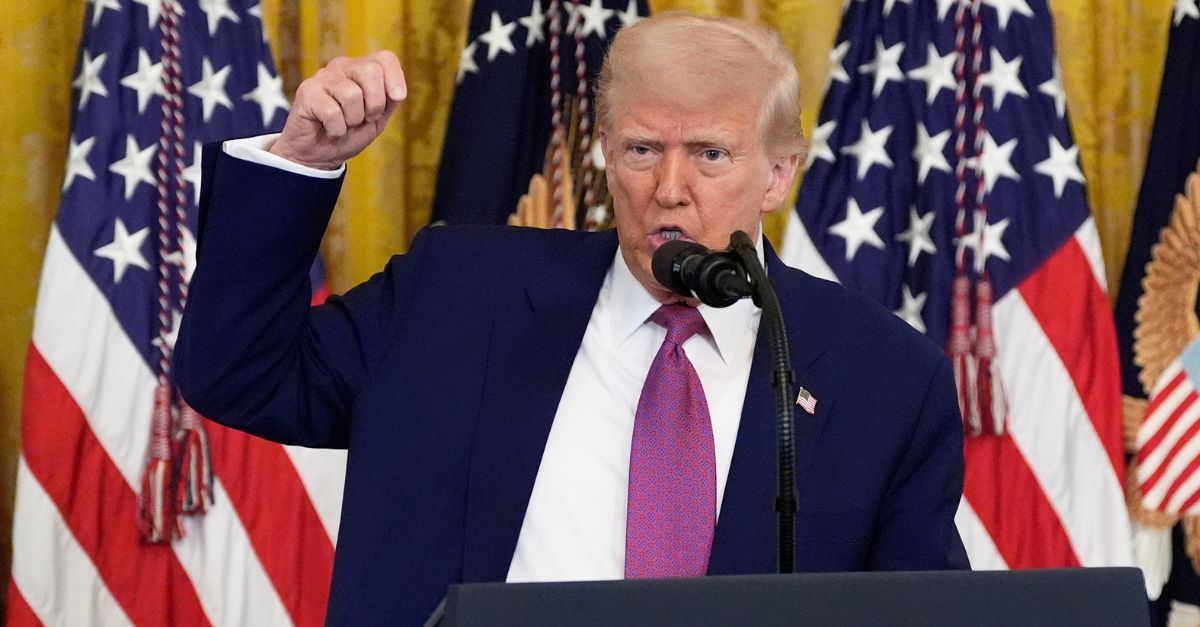

President Donald Trump addresses the audience after signing a bill preventing California from implementing its rule to ban the sale of new gas-powered cars by 2035, during an event in the East Room of the White House, Thursday, June 12, 2025, in Washington (AP Photo/Alex Brandon).
The Trump administration achieved a significant win on Wednesday when a Washington, D.C. court permitted the government to retain critical documents outside the reach of open records laws.
In a 14-page memorandum opinion, U.S. District Judge James Boasberg, who has recently been challenging for the government, denied a move to impose additional record-keeping obligations on the U.S. Department of Government Efficiency (DOGE).
In February, the Project on Government Oversight (POGO), a nonprofit, nonpartisan government watchdog, sued President Donald Trump and DOGE over a policy purporting to keep the advisory group’s records beyond the reach of the Freedom of Information Act (FOIA). The 19-page complaint challenged DOGE’s records being stored as non-agency records under the Presidential Records Act (PRA).
In late March, the plaintiffs moved for injunctive relief, warning about the possibility of “irretrievable removal, loss, or destruction of DOGE records during the pendency of this case.”
Love true crime? Sign up for our newsletter, The Law&Crime Docket, to get the latest real-life crime stories delivered right to your inbox.
The judge tidily rejected those concerns.
“[T]he Court ultimately concludes that POGO cannot show that its claimed injury, which turns solely on the risk of document destruction, is ‘certain and great,’ ‘actual and not theoretical,’ and ‘of such imminence that there is a clear and present need for equitable relief.'”
In the underlying case, the plaintiffs argue the PRA is not the appropriate record-keeping statute for DOGE. Rather, they say DOGE should be subject to the Federal Records Act (FRA). This is because, in the broader sense, POGO also claims DOGE is actually an agency subject to the Administrative Procedure Act (APA).
Boasberg, perhaps mindful of the acronym salad before him, says the underlying claims about DOGE being subject to the FRA as a function of the possibility of the APA generally controlling the group’s actions are “immaterial” in the inquiry into the injunctive request.
“[A]s long as some policy protects the records, POGO is safe from the threat of destruction,” Boasberg writes. “Such is the case here given that any PRA-compliant records-retention policy necessarily also obeys the strictures of the FRA. That is because the PRA, by its own terms, covers a broader set of records than does the FRA.”
In other words, DOGE’s records are currently subject to more strenuous record-keeping requirements under the PRA than they would be if the plaintiff’s remedy — the FRA — were enforced on it. That’s because, Boasberg notes, the FRA gives agencies “discretion in determining which records should be preserved.” Meanwhile, the PRA “leaves no comparable room for an official’s judgment.”
The court also noted the PRA has more stringent disposal standards, directly addressing the specter of record disposal during the litigation.
Boasberg explains the difference at length:
Presidential records are presumed to be permanent. During his term of office, the President may dispose of a presidential record only after obtaining the Archivist’s written views regarding the value of its preservation; after the presidential term has concluded, the Archivist must deposit all of the records in a government-operated archival facility, and may dispose of them only if she determines that they lack sufficient value to justify continued preservation. Federal records, however, have no such presumption of permanence. Agency heads regularly submit to the Archivist lists of records, including categories of records, that they believe do not warrant continued preservation and intend to dispose of, and the Archivist authorizes them to do so if she agrees.
And, the court observes that “presidential records are subject to a presumption of disclosure to the public.” While such processes can take decades, the archivist is generally under an obligation to make presidential records “available to the public as rapidly and completely as possible.” Federal agencies, again, have substantial discretion when fulfilling their statutory mandate to single out records of public interest and are then only under an obligation to digitize them.
The judge makes clear, however, that POGO is gunning for the less-expansive FRA treatment of DOGE’s records because that statute is what opens records up to FOIA requests, while PRA-designated records are not subject to FOIA requests. Additionally, the FRA has stronger “procedures to prevent improper destruction of documents,” Boasberg notes.
But those distinctions don’t matter, the judge says, because of a 30-year-old case in the D.C. Circuit that stands for the proposition “a PRA-compliant record-keeping policy cannot be a mechanism for evading the FRA’s record-keeping requirements,” according to the opinion.
“[G]iven that the PRA requires the preservation of a broader scope of records than does the FRA, the Government could not use the former to avoid preserving records under the latter,” Boasberg continues. “Put differently, any PRA-compliant records policy necessarily protects from destruction all the records that would be safeguarded under the FRA — regardless of which regime is actually appropriate.”
And, in the present case, the judge says DOGE has sufficiently argued their record-keeping methods are, in fact, PRA-compliant.
Rejecting an ancillary request to issue preservation orders against the government defendants, Boasberg notes that two other courts in D.C. alone have ordered DOGE to preserve their records. The court decided against further ordering similar relief, finding those earlier orders sufficient.
While the underlying lawsuit, which seeks to enforce FOIA standards on DOGE’s documents, and the injunction request, which is based on fears of DOGE’s documents being destroyed, are different, the judge does not see much tension between them.
“[I]f POGO ultimately prevails on its argument that DOGE should be subject to the FRA such that its desired records may be obtained through FOIA, those records will be available regardless of the regime from which USDS currently understands its preservation obligations to flow,” Boasberg writes. “[T]he point is that the preservation Plaintiff seeks is required under both statutes.”
In the end, because of the overlap — both statutory, due to case law, and — between the PRA and the FRA, the plaintiffs were unable to show that they faced irreparable harm, a term of art meaning a kind of harm that cannot be cured by one party in a dispute paying money to the other.
“Because POGO has not shown a likelihood of irreparable harm, it does not stick the landing,” the judge says — employing a sports metaphor.
Such harm is unlikely, the court explains, even if the plaintiffs win their overarching lawsuit on the merits.
“Plaintiff’s fear of document destruction has been allayed several times over,” Boasberg concludes. “POGO is therefore in little danger of losing access to documents to which it may be entitled if it prevails in its litigation against DOGE, much less at risk of irreparable harm. It consequently cannot demonstrate that it is entitled to a preliminary injunction.”


