
Share this @internewscast.com
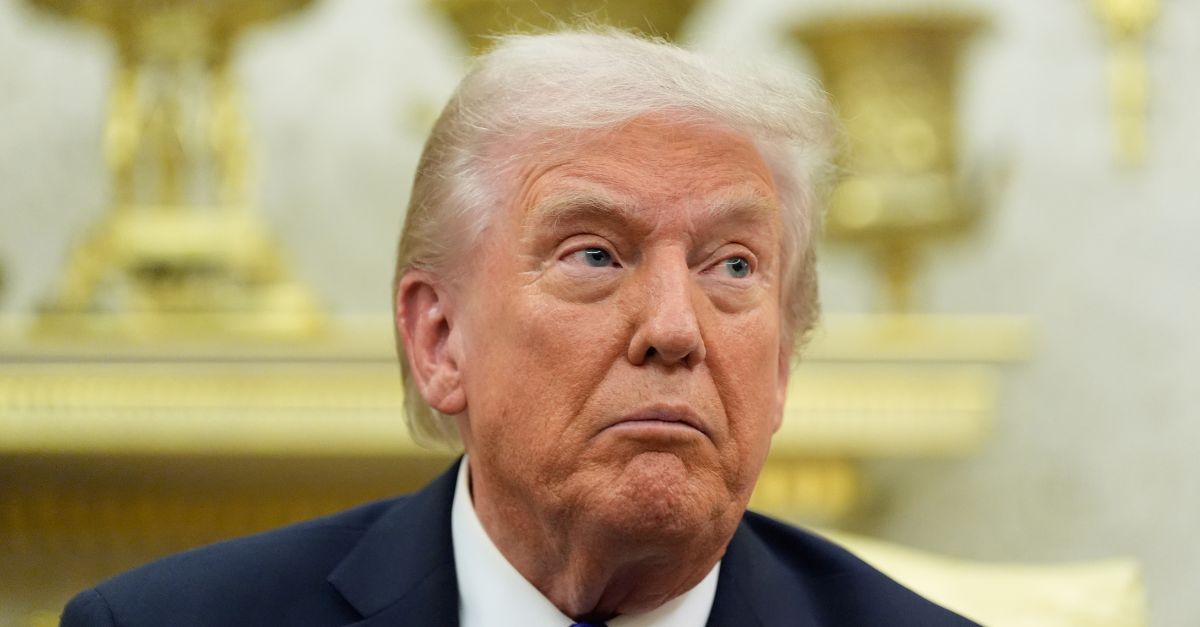
President Donald Trump listens to a question from a reporter as he meets with NATO Secretary General Mark Rutte in the Oval Office of the White House, Wednesday, Oct. 22, 2025, in Washington (AP Photo/Alex Brandon).
A recent decision from a federal judge in San Francisco has presented a new challenge for the Trump administration, as it faces a lawsuit aimed at overturning funding cuts for sanctuary cities. On Tuesday, Senior U.S. District Judge William H. Orrick, appointed under former President Barack Obama, ruled against a motion to dismiss the case, a motion filed by the federal government last summer.
In his detailed 31-page order, Judge Orrick expressed his disapproval of the administration’s legal arguments. The lawsuit in question, initiated in February 2025, represents more than 15 cities and counties, all of which are seeking to restore access to billions of dollars meant for public safety initiatives. The plaintiffs have consistently found favor in the court’s rulings, starting with a preliminary injunction granted last April.
The latest ruling marks yet another victory for these cities and counties in their ongoing battle to secure the federal funds they claim are crucial for their operations. Despite previous setbacks, attorneys from the U.S. Department of Justice revisited arguments that have been previously dismissed, particularly the notion that the claims are not justiciable or suitable for court adjudication.
Judge Orrick, known for his critical stance on these recurring arguments, once again rejected the DOJ’s position. His ruling underscores a continued legal struggle as the government attempts to defend its stance on funding cuts against persistent judicial opposition.
In their motion to dismiss, U.S. Department of Justice attorneys reprised several previously-rejected notions — chiefly the notion that the claims themselves are not justiciable, or able to be ruled on by a court in the first place.
Orrick, who has repeatedly given short shrift to such claims — and who has gone on, at length, about why he believes the government should stop making such arguments — again disagreed with the DOJ.
In one earlier ruling, the judge observed that the plaintiffs had a well-founded fear of immigration-related action in general terms.
This time, however, the court took to the minutiae of the Trump administration”s arguments in order to weigh in on justiciability.
In the underlying litigation, San Francisco and others sued President Donald Trump over two executive orders — “Protecting the American People Against Invasion” and “Ending Taxpayer Subsidization of Open Borders” — issued in January and February 2025, respectively, threatening to cut off all federal funds for jurisdictions deemed to run afoul of federal immigration priorities.
Over the past several months, however, the president has issued additional executive orders, and the Trump administration has issued various pieces of guidance meant to effectuate those orders — resulting in several additional salvos from the plaintiffs. Some of those additional filings included amended complaints encapsulating what the plaintiffs view as the nearly ever-expanding nature of their allegations due to the federal government’s never-ending focus on immigration matters.
In turn, the plaintiffs asked for additional relief and permission to file new iterations of their lawsuit in May, July, and twice in August 2025.
The Trump administration, for its part, tried to frame this ongoing push-pull as indicative of the plaintiffs’ purported weakness.
But the judge simply was not having it.
“Defendants claim that I previously found plaintiffs ‘failed to establish an injury in their [first amended complaint] and that the same issue remains in the [second amended complaint],’” the order reads. “That is incorrect. My prior Order concluded that they did, in fact, establish an injury-in-fact in their [first amended complaint]—plaintiffs showed that a directive to halt federal funds to sanctuary jurisdictions would ‘irreparably harm their budgets and, by extension, their abilities to govern and provide services to the public.’ That is the same injury plaintiffs assert in their [second amended complaint].”
Beyond that basic misreading of the court’s earlier order, the judge was otherwise unimpressed with the DOJ’s motion to dismiss.
“[D]efendants’ remaining injury-in-fact arguments are futile,” the order goes on.
To hear the Trump administration tell it, the executive orders that gave rise to the litigation “merely” gave administrative agencies “policy directives,” but did not contain any actual rules or regulations.
The judge said that simply was not true.
Rather, the judge found, the text of the challenged executive orders “requires compliance” and “unambiguously command[s] action.”
“Because their alleged injuries are concrete, particularized, and imminent, plaintiffs have established an injury-in-fact for purposes of Article III standing,” Orrick determined.
The DOJ also offered a similar argument by claiming the executive orders do not actually proscribe any particular conduct. But the judge noted this argument was, again, a retread.
“My mind is unchanged,” the order goes on. “Defendants have not provided any new arguments.”
The court goes on to note that, if anything, the Trump administration’s actions with regard to sanctuary jurisdictions have indicated the federal government has very much chosen to proscribe certain conduct that plausibly aligns with the executive orders at the root of the lawsuit.
From the order, at length:
Plaintiffs articulate that President Trump tried throughout his first term to “threaten and coerce municipalities like Plaintiffs that limit cooperation with federal civil immigration enforcement.” They then list numerous instances where “Trump administration officials have . . . publicly confirmed the Administration’s intent to go after localities they deem to be ‘sanctuary’ jurisdictions” during President Trump’s second term. These facts plausibly suggest that plaintiffs have a “well-founded fear of enforcement” that confers upon them pre-enforcement standing.
“Nothing has meaningfully changed in defendants’ standing arguments since I last decided the question,” Orrick continues. “I decline to depart from my previous holdings.”