

Share this @internewscast.com
Left inset: Christina Peterson (Douglas County Probate Court- Judge Christina J. Peterson/Facebook). Right: Peterson in handcuffs following her June 2024 arrest (Law&Crime Network).
In a dramatic turn of events, a former probate judge from Douglas County, Georgia, is seeking justice through a substantial federal civil rights lawsuit. Christina J. Peterson, who was previously removed from her judicial position by Georgia’s highest court due to a “pattern of misconduct,” is now pursuing a $50 million lawsuit against the City of Atlanta. Her legal battle stems from a controversial arrest outside a Buckhead nightclub in 2024.
Peterson, 40, has taken the bold step of filing the lawsuit pro se in the U.S. District Court for the Northern District of Georgia. She stands as her own legal representative, alleging that her arrest by Atlanta police officer Kenneth Wadsworth was not only unjust but also involved excessive force. According to Peterson, Wadsworth “violently slammed” her head-first to the ground in the early hours of a June morning in 2024. The incident led to a felony obstruction charge, which has since been dropped, although a misdemeanor obstruction charge remains pending, as reported by Fox 5 Atlanta.
The core of Peterson’s argument is that Officer Wadsworth’s actions cannot be shielded by qualified immunity. Her lawsuit argues that the officer’s conduct, which allegedly involved fabricating evidence and making false statements, constitutes a violation of her Fourth Amendment rights. Peterson insists that such actions by law enforcement are unmistakably unlawful and that no reasonable officer could have thought otherwise.
Despite her removal from office, Peterson remains a licensed attorney in good standing with the Georgia State Bar and has no disciplinary record. She maintains that the charges connected to the Red Martini nightclub incident were baseless. In her lawsuit, she emphasizes that the dismissal of the felony charges should be seen as an indication of her innocence and underscores the significant deprivation of her liberty during the legal ordeal.
Peterson’s legal claim is a powerful statement against what she views as a gross miscarriage of justice. “It was clearly established that an officer violates the Fourth Amendment by fabricating evidence or knowingly making false statements to initiate criminal charges,” her lawsuit asserts. “Defendant Wadsworth is therefore not entitled to qualified immunity for his malicious prosecution of Plaintiff.”
“It was clearly established that an officer violates the Fourth Amendment by fabricating evidence or knowingly making false statements to initiate criminal charges, and no reasonable officer could have believed such conduct was lawful,” the lawsuit stated. “Defendant Wadsworth is therefore not entitled to qualified immunity for his malicious prosecution of Plaintiff.”
Peterson made headlines after video footage showed the messy scene outside the Red Martini nightclub, inside the back of a police car, and at the Fulton County Jail.
Shortly thereafter, the Georgia Supreme Court removed Peterson from her office for other reasons relating to her “flagrant disregard for the law.”
Peterson, who ran for office as a Democrat, relied on the “want of prosecution” expressed by Fulton County DA Fani Willis’ office on the most serious offenses she was accused of, including for allegedly hitting the arresting officer and felony obstruction.
The video of the incident showed that Peterson and her friends on the scene claimed she never meant to hit Wadsworth, and the lawsuit contends the same.
Peterson, the lawsuit said, “observed a man violently assaulting a woman by throwing her backward and repeatedly punching her in the face” at the nightclub.
“Plaintiff attempted to assist the victim and did not use or threaten violence against anyone,” the complaint said. “While the assault was still ongoing and the victim was walking backward while the assailant continued to pursue her and strike at her, Plaintiff momentarily grasped the back of the assailant’s shirt solely to interrupt the ongoing violence, did not strike, push, restrain, or threaten the assailant, and immediately disengaged.”
“Immediately after disengaging, Plaintiff observed a different male individual unlawfully seize and hold the victim. Plaintiff verbally directed the individual to release the victim and briefly attempted to free the victim’s arm from his grasp using minimal, non-violent contact,” the suit went on. “Plaintiff did not strike, threaten, or use force against the individual. It was at this point—without warning, inquiry, or command—that Defendant Wadsworth seized Plaintiff.”
The pro se plaintiff maintains that Wadsworth has a history of “unconstitutional arrests and uses of force in prior incidents” and essentially showed up out of nowhere with “no personal knowledge of the altercation,” did not see any “criminal conduct by [Peterson],” and “conducted no investigation before using force.”
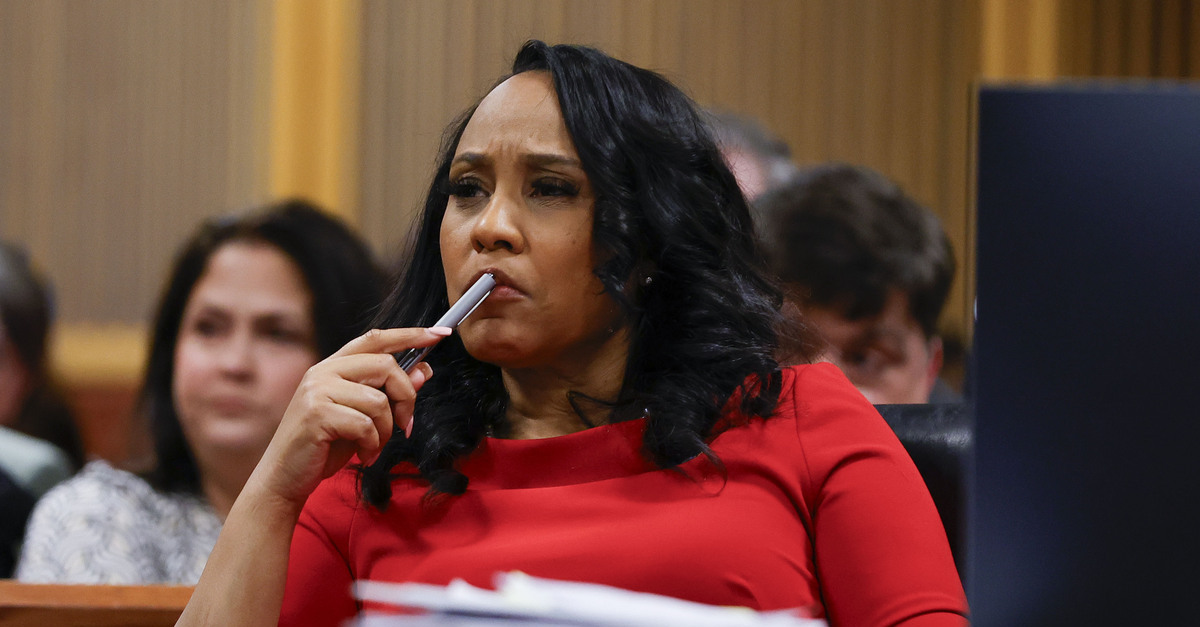
Fulton County District Attorney Fani Willis looks on during a hearing on the Georgia election interference case, Friday, March, 1, 2024, in Atlanta (AP Photo/Alex Slitz, Pool).
“Without provocation or justification, Defendant Wadsworth violently slammed Plaintiff head-first to the ground and applied compressive force to her neck and back while she was prone, non-resisting, and compliant, before placing her in handcuffs,” the complaint continued, stating that she “did not strike, attempt to strike, or batter Defendant Wadsworth at any time.”
What followed next, Peterson claimed, was an Atlanta-approved and “affirmatively promoted edited and curated body-worn and dash-camera footage that implied [she] committed felony obstruction and battery on a police officer,” a narrative she said was false given the Democratic DA’s decision to drop those charges.
“After the felony charges were dismissed, the City continued publication of the misleading footage and narratives without correction, disclaimer, or contextual clarification,” Peterson said. “The City had actual or constructive notice that the felony obstruction and battery allegations were disputed, unsupported, and dismissed, yet made a conscious decision to continue dissemination.”
After authorities made the arrest, they said Peterson “forcibly pushed the officer in the chest” twice and then “she refused to cooperate.”
“You gonna have to kill me, sir,” she could be heard saying from the back of the police car. “Just to protect yourself, you’re gonna have to kill me.”
Subsequently, Peterson’s attorney Marvin Arrington identified “inconsistencies” in Wadsworth’s statements about what took place.
For instance, Arrington said that in the footage, the arresting officer claimed he was “punched” multiple times, and later penned an affidavit stating he was struck with a “closed fist.” Yet, the department’s statement said Wadsworth was pushed, the attorney said.
Peterson’s lawsuit argued likewise.
“In arrest citations and charging narratives, Defendant Wadsworth falsely alleged that Plaintiff struck him with a closed fist and/or shoved him and struck him in the head and/or chest,” the complaint added. “These allegations were knowingly false and were made to justify Defendant Wadsworth’s unlawful use of force and prolonged detention.”