
Share this @internewscast.com
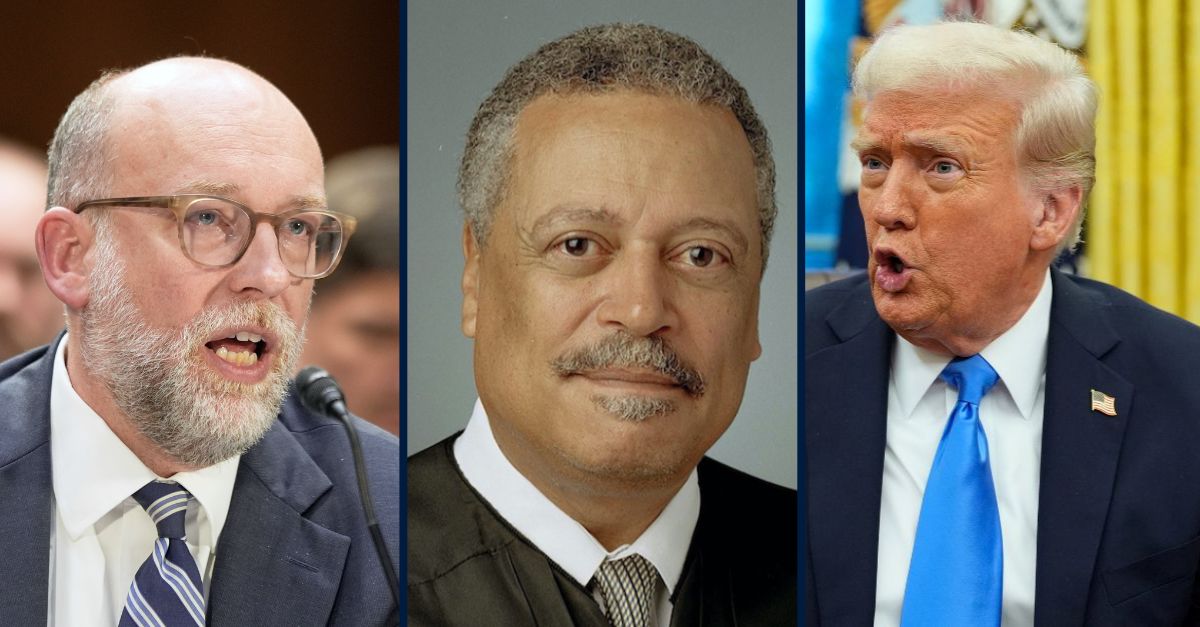
Left: Office of Management and Budget director Russell Vought testifies during a Senate Appropriations Committee hearing on the rescissions package on Capitol Hill, Wednesday, June 25, 2025, in Washington (AP Photo/Mariam Zuhaib). Center: Senior U.S. District Judge Emmet Sullivan (U.S. District Court photo). Right: President Donald Trump speaks with reporters in the Oval Office at the White House, Tuesday, Feb. 11, 2025, in Washington (AP Photo/Alex Brandon).
On Wednesday, a federal judge issued a directive to the Trump administration, demanding transparency regarding agency expenditures, thereby delivering a stern reprimand to the Office of Management and Budget (OMB).
The legal action stems from a lawsuit filed by Citizens for Responsibility and Ethics in Washington (CREW) alongside the Protect Democracy Project. They sought access to the “Public Apportionment Database,” which was removed from public view in March 2025 under the instruction of OMB Director Russ Vought.
In July 2025, Senior U.S. District Judge Emmet Sullivan, appointed by Bill Clinton, commanded the Trump administration to “cease unlawful actions” and reinstate access to the database. The court sided with the plaintiffs, noting that the database’s removal breached the previous two years’ appropriations acts and certain provisions of the Paperwork Reduction Act.
By August 2025, the database was back online. However, the plaintiffs noted that several documents within the database mentioned an “undisclosed spend plan,” as detailed in an eight-page motion to enforce submitted last September.
The essence of the plaintiffs’ motion argues that referencing these plans “in legally binding footnotes” implies they are documents that “apportion” an appropriation under the pertinent law. Essentially, this non-public information pertains directly to the funding in question and should be included in the database.
“In other words, by integrating the terms in spend plans using legally binding footnotes to allocate appropriations, OMB has effectively made these spend plan terms part of the apportionments,” the motion to enforce states. “Thus, to adhere to statutory transparency obligations, OMB must reveal the spend plans in the Public Apportionments Database.”
In a 14-page memorandum opinion and order, Sullivan cites from Black’s Law Dictionary to provide the U.S. Department of Justice with something not entirely unlike remedial legal education.
From the order, at length:
When a “secondary document” is incorporated by reference, it becomes “part of [the] primary document.” Moreover, “[w]here a writing refers to another document, that other document . . . becomes constructively a part of the writing, and in that respect the two form a single instrument.” Put otherwise, “[t]he incorporated matter is to be interpreted as part of the writing.”
The court goes on to note that the Trump administration defendants “fail to respond to Plaintiffs’ incorporation-by-reference argument.”
And that argument, Sullivan says, is enough here.
“The Court agrees with Plaintiffs that when OMB conditions the ability of an agency to obligate funds upon OMB’s agreement with the contents of a spend plan in a legally-binding footnote, OMB has incorporated-by-reference the terms of the spend plan into the apportionment and therefore the spend plan is a ‘document apportioning an appropriation’ that must be disclosed under the 2022 and 2023 Acts,” the order reads.
The government, for its part, argued that Joe Biden’s administration similarly did not provide access to such spend plans. But, the court noted, the plaintiffs countered that the Biden administration’s database documents “rarely” even contained such references.
The court rejected the argument about the Biden precedent out of hand. In turn, the court also rejected a related defense claim that the plaintiffs waived their argument because the Biden administration established the practice of referencing undisclosed spend plans.
“[B]ecause Defendants illegally removed the database, Plaintiffs could not have known that OMB is now with significantly greater frequency incorporating spend plans by reference into apportionment documents,” Sullivan explains. “Plaintiffs have not waived this argument because until the illegally removed database was restored, Plaintiffs could not have known that documents ‘required to be disclosed by the 2022 and 2023 Acts’ were missing.”
The court then tidily summarized the issue and order:
OMB has incorporated-by-reference the terms of certain spend plans in legally binding footnotes. Since the terms of such spend plans contain legally binding limits on the agencies’ ability to obligate funds, the spend plans are “documents apportioning an appropriation,” and must be made publicly available under the 2022 and 2023 Acts and this Court’s July 21, 2025, Order. Because the spend plans have not been made publicly available, Plaintiffs have not “received all relief required by the Court’s earlier order.”