
Share this @internewscast.com
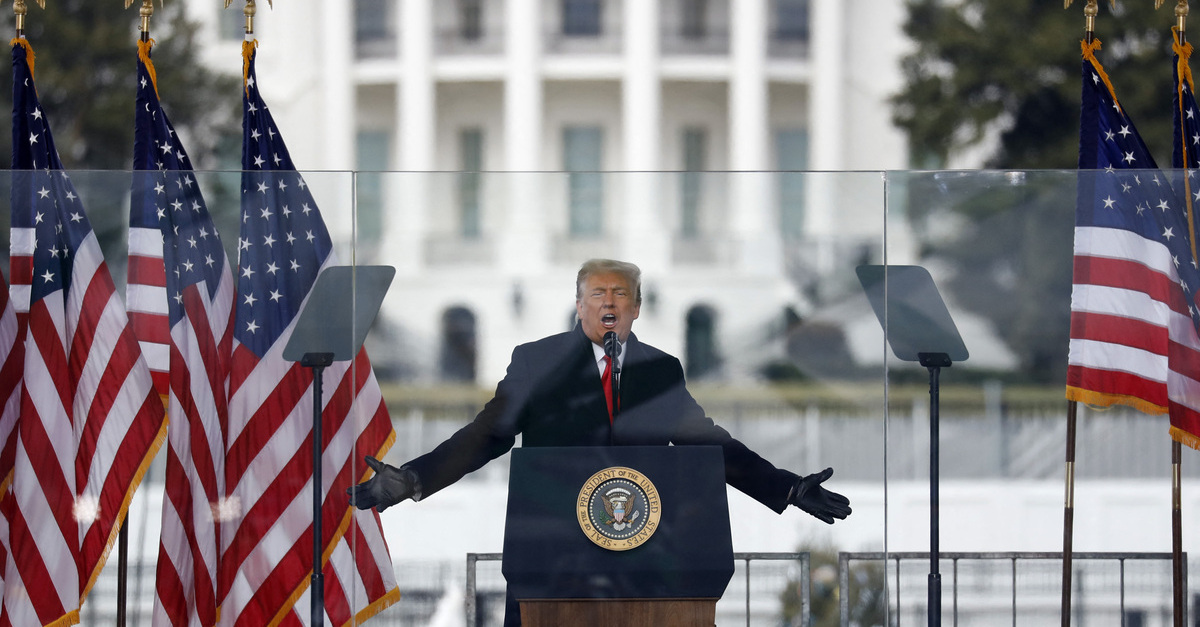
U.S. President Donald Trump speaks to his supporters at Save America Rally on the Ellipse near the White House in Washington on January 6, 2021 Photo by Yuri Gripas/Abaca/Sipa USA(Sipa via AP Images).
On Monday, the BBC urged a federal judge to prevent Donald Trump from initiating an extensive inquiry before the UK’s public broadcaster attempts to have the president’s defamation lawsuit dismissed. The lawsuit pertains to allegedly misleading edits in a January 6 documentary, which the BBC argues is unrelated to Florida.
According to a detailed 21-page document, the BBC contends that Trump’s lawsuit concerning the Panorama documentary “Trump: A Second Chance” should be dismissed due to a fundamental jurisdictional flaw. The filing argues that since the documentary was neither created, produced, nor broadcast in Florida, U.S. District Judge Roy K. Altman, appointed by Trump, lacks the authority to preside over the case.
The broadcaster has requested Judge Altman to halt any discovery processes related to the merits of the case and instead focus on discovery limited to jurisdictional questions.
The defendants maintain that the documentary in question is irrelevant to Florida, arguing that Trump should not be permitted to pursue extensive discovery unless he can demonstrate that the case has been filed in a suitable jurisdiction.
The filing highlights that Trump’s complaint implies an intention to seek wide-ranging and objectionable discovery, potentially involving the BBC’s entire history of coverage on Donald J. Trump over the past decade or more, and alleging harm to his business and political reputation. The document stresses that jurisdictional issues should be resolved before engaging in any discovery related to the case’s merits, which could lead to contentious disputes.
Trump’s legal team, however, has reportedly dismissed this proposed sequence for discovery proceedings. Consequently, the BBC has requested a stay and indicated confidence in its “clearly meritorious” motion to dismiss, which it believes will resolve the case entirely.
“As the Motion to Dismiss will show, exercising personal jurisdiction over Defendants would violate Florida law and constitutional due process protections,” the filing previewed.
Citing the Supreme Court’s landmark defamation precedent New York Times v. Sullivan, the BBC said Trump, a public figure and official, “fails to plausibly allege” actual malice.
While the president has claimed the documentary was edited to create a “false, defamatory, deceptive, disparaging, inflammatory, and malicious depiction” of his Jan. 6, 2021, speech from the Ellipse — amounting to a “brazen attempt to interfere in and influence” the 2024 election — the BBC counters that Trump can’t show “any cognizable injury,” even though it offered an apology.
At issue is an edit in the documentary that stitched together different parts of Trump’s Jan. 6 speech that, by the BBC’s own admission, “unintentionally created the impression that we were showing a single continuous section of the speech, rather than excerpts from different points in the speech, and that this gave the mistaken impression that President Trump had made a direct call for violent action.”
Trump’s complaint said the documentary “falsely depicted” Trump telling the crowd that would become a mob, “We’re going to walk down to the Capitol and I’ll be there with you. And we fight. We fight like hell and if you don’t fight like hell, you’re not going to have a country anymore.”
“President Trump never uttered this sequence of words,” the complaint said — and the BBC acknowledged.