Share this @internewscast.com
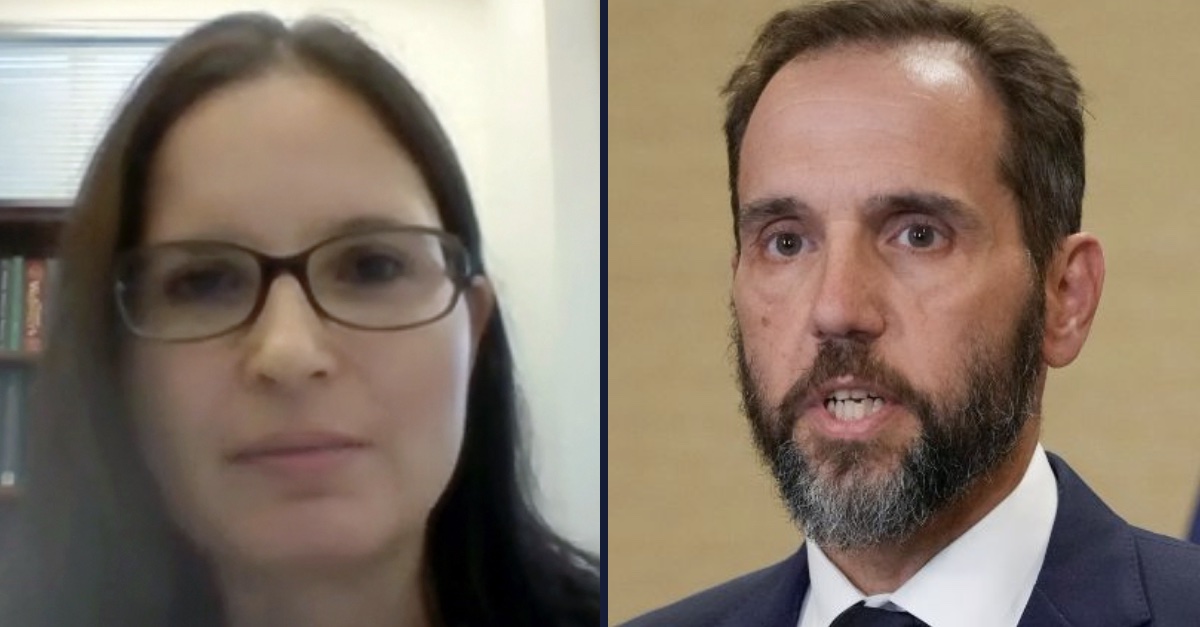
Judge Aileen Cannon (left) during a Senate Judiciary Committee oversight nomination hearing on July 29, 2020 (U.S. Senate via AP), Special counsel Jack Smith (right) speaks about an indictment of former President Donald Trump, Aug. 1, 2023, at a Department of Justice office in Washington. (AP Photo/Jacquelyn Martin)
The special counsel can “redact, substitute, or delete” two categories of classified information and “most” of a third category from shareable discovery, the judge in former President Donald Trump’s Espionage Act prosecution ruled Friday.
U.S. District Judge Aileen Cannon wrote that Jack Smith’s motions prevailed as far as categories 3 and 4 are concerned — the first dealing with “documents relating to a potential government witness” and the second with “classified information which the Special Counsel seeks to delete from discovery in its entirety.”
Cannon, a Trump appointee, also granted “most of the Category 2 requests” made by Smith, but not all.
“Category 2 contains a subset of After-Action Reports (‘AARs’) and related emails from which the Special Counsel seeks to redact limited words and phrases,” the judge wrote. “The vast majority of the requests are not topically related to the charged documents and thus neither relevant nor helpful to the defense. A very limited number of redaction requests, however, cannot be resolved at this stage.”
The judge said that the “words and phrases” Smith wants to redact from reports are “bound up in requests made in Defendants’ Motions to Compel, and/or (2) have potential bearing on essential elements” of the willful retention of national defense information charges Trump faces.
“Thus, pending resolution of Defendant’s Motions to Compel and a follow-up ex parte CIPA § 4 hearing with the Special Counsel to clarify the nature of the information at issue, the Court reserves ruling on the few requests identified in the Classified Order,” she wrote.
Similarly, category 1 — “two sensitive intelligence reports directly related to a document charged in one of the unlawful-retention counts” — cannot be ruled upon at this time, Cannon said. Only after the judge rules on Trump’s motions to compel discovery — and/or only after another Classified Information Procedures Act (CIPA) § 4 hearing — will the judge address category 1, Cannon said.
Back in December, the judge and Jack Smith clashed as the special counsel insisted that unsealing certain details about the CIPA § 4 motion to “redact, substitute, or delete” itself would reveal the “contours and extent” of the government’s plans to delete classified information from discovery.
Asserting a need to “protect four separate categories of classified information from disclosure” to criminal defense lawyers, and to Trump and his co-defendants, valet Walt Nauta and Mar-a-Lago property manager Carlos De Oliveira, Smith argued that “even disclosing” the “number of categories of classified information that the Government seeks to delete from discovery would reveal the contours and extent of the Government’s CIPA Section 4 motion.”
While Smith did not succeed in hiding the number of categories from the defense, he had better luck on Friday on his “redact, substitute, or delete” requests. Still, it was not a total win for the special counsel.
At the end of her order, Cannon did acknowledge the existence of Jack Smith’s pending motion for reconsideration. Recall that the special counsel threatened to appeal to the U.S. Court of Appeals for the 11th Circuit if the judge did not correct her “clear error” threatening to name government witnesses through discovery.
“The Court also reserves docketing the Special Counsel’s proposed public stand-alone brief as to Defendant Trump—previously submitted ex parte and under seal as an attachment to the Special Counsel’s Third Classified Supplement to CIPA § 4 Motions—until the Court has resolved the Special Counsel’s pending Motion for Reconsideration,” Cannon wrote.
At least one witness for the prosecution, Trump Employee 5, revealed his identity after it appeared the judge was leaning towards outing witnesses regardless of Smith’s protestations.