
Share this @internewscast.com
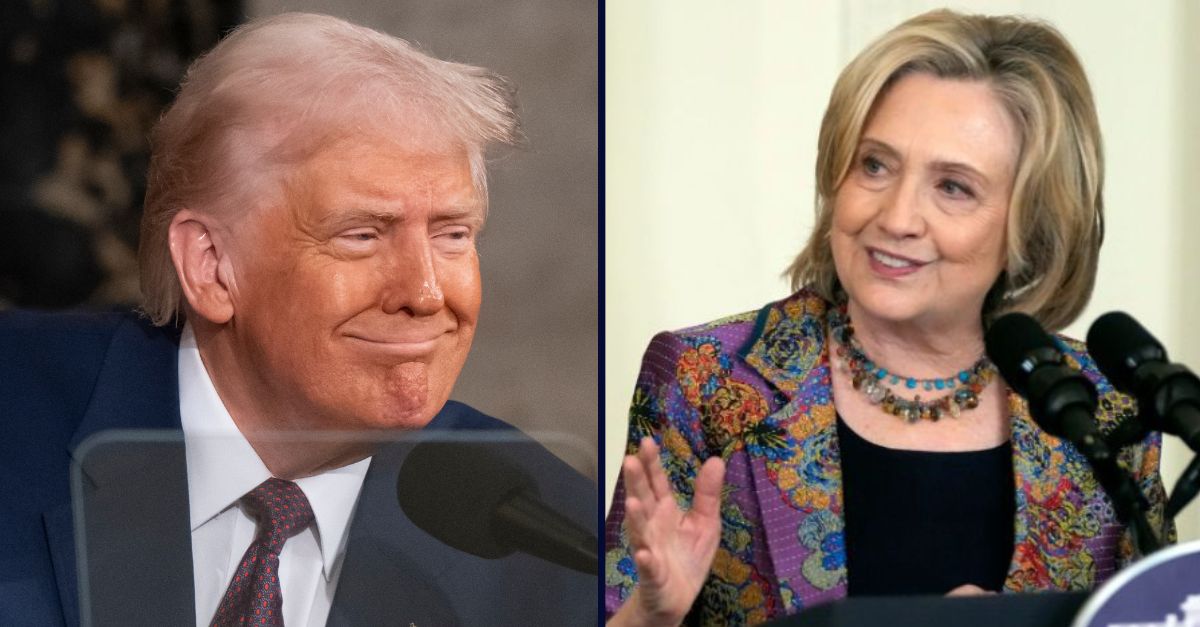
Left: President Donald Trump addresses a joint session of Congress on Capitol Hill in Washington, Tuesday, March 4, 2025 (AP Photo/Alex Brandon). Right: Hillary Clinton speaks during an event with first lady Jill Biden to celebrate the 2023 Praemium Imperiale Laureates in the East Room of the White House, Tuesday, Sept. 12, 2023 (AP Photo/Alex Brandon).
Former President Donald Trump’s ambitious $15 billion defamation lawsuit, which was swiftly dismissed shortly after its initial filing in September, has resurfaced with minimal changes. The New York Times is once again urging a federal judge to permanently dismiss the case, branding it as filled with unnecessary allegations.
The Times, along with its journalists Susanne Craig, Russ Buettner, Peter Baker, and publisher Penguin Random House LLC, has filed two motions challenging the lawsuit. One motion contends that the suit was improperly filed in the Middle U.S. District of Florida, while the other argues that Trump has not successfully established a defamation claim. They are appealing to Senior U.S. District Judge Steven Merryday for a dismissal with prejudice, which would prevent Trump from refiling the case.
In September, Judge Merryday, appointed by George H.W. Bush, dismissed the initial lawsuit, criticizing it as a “decidedly improper and impermissible” lengthy document. Instead of concisely presenting the defendants with the claims against them, it was filled with “vituperation and invective” and appeared to serve as a platform for public relations rather than a legitimate legal complaint. The document included excessive self-praise and praise for Fred Trump, using the federal court docket as a tool for political grandstanding.
The judge highlighted the arduous nature of reviewing the complaint, noting that it was replete with statements such as accusing the Times of reaching “a new journalistic low” and describing the publication’s efforts as “a partisan spear” instead of genuine reporting. The complaint further accused the defendants of perpetuating false narratives, likening their actions to “a melting iceberg of falsehoods.”
In October, Trump reasserted his primary claims that the Times and its journalists conducted a flawed investigation, allegedly supported by Charles “Chaz” Littlejohn, a former IRS contractor and convicted felon who leaked tax returns. Trump accused the publication of defaming him with actual malice, purportedly intending to harm his 2024 reelection campaign and to undermine his achievements as a businessman and reality TV star prior to “The Apprentice.”
The second time around in October, Trump repeated his central claims that the Times and its employees conducted a shoddy investigation — supported by former IRS contractor, tax returns leaker, and convicted felon Charles “Chaz” Littlejohn — and defamed the president with actual malice. Trump claimed the Times set out to cause maximum damage to his then-extant 2024 reelection campaign and to diminish his accomplishments as a businessman and real estate mogul before he starred in “The Apprentice.”
Trump took issue with Craig and Buettner’s September 2024 article “The Star-Making Machine That Created ‘Donald Trump,’” an adaptation of their “Lucky Loser” book, and Baker’s October 2024 article “For Trump, a Lifetime of Scandals Heads Toward a Moment of Judgment,” for essentially drawing the conclusion that he failed upward in life, thanks to his father’s wealth, “fraudulent tax evasion schemes,” and celebrity status.
“The statements in question wrongly defame and disparage President Trump’s hard-earned professional reputation, which he painstakingly built for decades as a private citizen before becoming President of the United States, including as a successful businessman and as star of the most successful reality television show of all time — The Apprentice,” the amended complaint said, accusing the Times of green-lighting an “improper pattern and practice” of “couch[ing] statements in ways that they subjectively know will be taken by a reasonable reader as assertions of fact in language that allows them to claim they are making mere opinion statement.”
According to the New York Times, the revised version of Trump’s lawsuit shouldn’t fare any better in the judge’s eyes.
The first problem, the defendants said, is that the lawsuit has “nothing to do” with Florida and, thus, can only have been filed there for “forum shopping” reasons.
“This lawsuit should be dismissed or transferred to the Southern District of New York. None of the material events giving rise to President Trump’s defamation claims transpired in this District, and virtually all of the relevant transfer factors point to New York instead,” the motion to dismiss said. “To the contrary, the statements are about various aspects of President Trump’s storied New York life—including his time at the New York Military Academy; his relationship with his father, ‘legendary New York City builder’ Fred Trump; his business career in New York; his inheritance of a New York real estate empire and avoidance of New York tax; and his starring role on the reality television show The Apprentice, which was famously filmed at Trump Tower in New York.”
Nor does Trump live in the Middle District of Florida, considering Mar-a-Lago is located in the Southern District of Florida, the Times noted.
The next issue with the suit, the defendants said, goes right to the heart of it: Trump not only failed to allege defamation with actual malice, the “knowledge of falsity or probable falsity” a public figure must show the Times defendants had, but also focused more on “scoring political points against […] perceived enemies in the press.”
This “ignores these clear instructions” from the court about refiling and reminds of the “bad faith” Trump v. Hillary Clinton RICO lawsuit smacked down by the 11th U.S. Circuit Court of Appeals mere weeks ago, the defendants said.
“The Eleventh Circuit recently affirmed the dismissal of a separate lawsuit President Trump filed against other perceived adversaries, emphasizing that it was not clear error for the trial court to find ‘Trump filed a shotgun complaint ‘to harass,’ that the complaint ‘recklessly forwards frivolous legal theories,’ or that ‘Trump’s activity showed a ‘pattern of misusing the courts,’” the Times said in a footnote, citing Trump v. Clinton.
Throwing “generic allegations about irrelevant matters” into a complaint, in “sweeping, kitchen sink” fashion, does not establish the defendants had “serious doubts” about what they printed and does not “sufficiently allege the most basic element of a defamation claim: a false and defamatory statement of fact,” the defendants went on.
“[M]any of the challenged statements express the authors’ subjective interpretations of undisputed facts, which are not capable of being proven false. These statements are ‘opinion’ as a matter of law and are not actionable,” the filing said.
Trump’s “misguided” objection to Littlejohn’s involvement in the project doesn’t get his lawsuit anywhere either, the Times concluded.
“None of the challenged Statements is even attributed to the tax returns Littlejohn provided. Nor is there any suggestion that the information provided by Littlejohn or any other source was inaccurate,” the motion said, seeking dismissal with prejudice. “The First Amendment safeguards that protect journalists’ right to report information they believe to be true is not encumbered by a ‘duty to find only pure, unimpeachable sources of information.’”