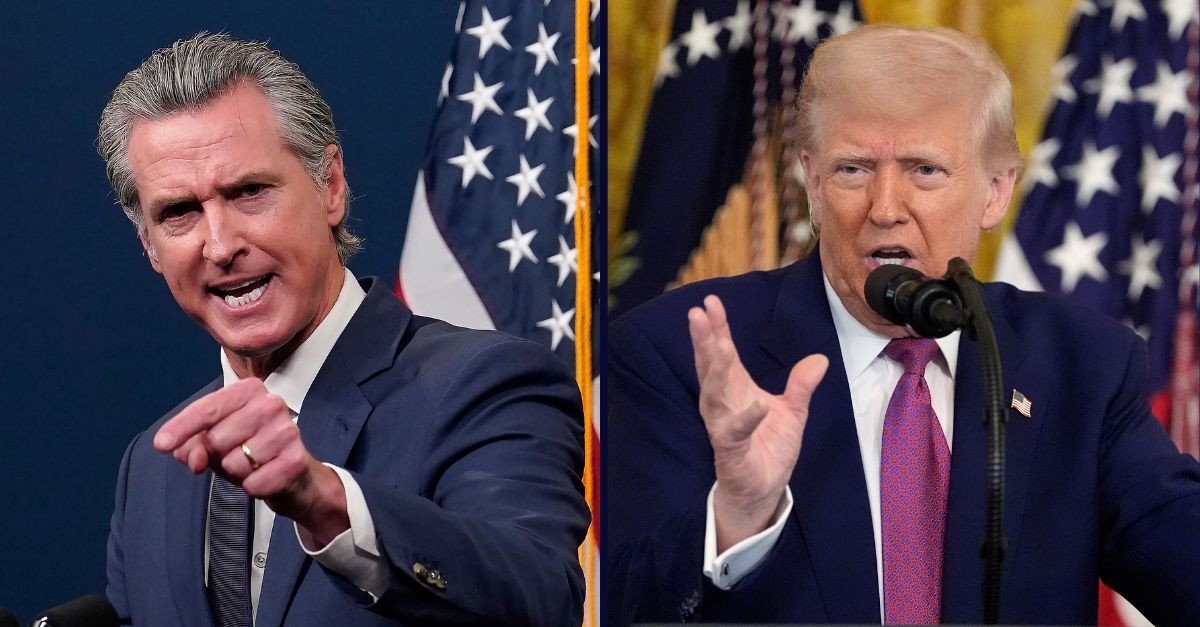

Left: FILE – California Governor Gavin Newsom presents his updated state budget during a press conference in Sacramento, California, on Wednesday, May 14, 2025 (Photo by Rich Pedroncelli, File). Right: President Donald Trump speaks at an event where he signed a bill blocking California’s rule prohibiting the sale of new gas-powered cars by 2035, held in the East Room of the White House on Thursday, June 12, 2025, in Washington (Photo by Alex Brandon/AP).
President Trump has sent nearly 4,000 National Guard members along with 700 U.S. Marines to Los Angeles, surpassing the legal restrictions on military involvement in enforcing domestic laws within American cities.
California Governor Gavin Newsom plans to challenge this action legally. The state has filed a lawsuit stating, “President Trump has repeatedly used emergency powers to stretch beyond the legal limits of executive authority.”
“On Saturday, June 7, he used a protest that local authorities had under control to make another unprecedented power grab, this time at the cost of the sovereignty of the state of California and in disregard of the authority and role of the Governor as commander-in-chief of the state’s National Guard,” says the complaint, which was filed in federal court.
Love true crime? Sign up for our newsletter, The Law&Crime Docket, to get the latest real-life crime stories delivered right to your inbox.
U.S. District Judge Charles R. Breyer agreed. Breyer, a Bill Clinton appointee who also happens to be the brother of retired Supreme Court Justice Stephen Breyer, declared that Trump’s “actions were illegal — both exceeding the scope of his statutory authority and violating the Tenth Amendment to the United States Constitution,” and ordered control of the National Guard returned to Newsom. The order was supposed to take effect Friday at noon, but the 9th U.S. Circuit Court granted an administrative stay late Thursday night, pausing — at least temporarily — Breyer’s order.
What this lawsuit comes down to is the Insurrection Act versus the Posse Comitatus Act. One act is more than 200 years old and the other, nearly a century and a half.
The Insurrection Act, passed in 1807, authorizes the president to deploy military forces inside the United States to suppress rebellion, invasion or to enforce federal law in certain situations. The Posse Comitatus Act, passed in 1878, was put in place to ensure that the federal military would not be used to intervene in the establishment of Jim Crow laws in the former Confederacy after Reconstruction. The overarching principle of the Act is to prevent the military from interfering in the affairs of civilian government.
When it comes to the Insurrection Act, troops can be deployed under several sections of the law. The statute’s requirements are not clearly defined, leaving some aspects of the law to the discretion of the president. One provision provides that the president can send in troops at a governor’s request. A second provision provides the president with the authority to deploy troops to “enforce the laws” of the United States or to “suppress rebellion” whenever unlawful obstructions make it difficult to enforce federal law — even against the state’s wishes.
A third provision provides if anyone in a state is being deprived of a constitutional right and state authorities are unable or unwilling to protect that right — think Presidents Dwight D. Eisenhower and John F. Kennedy following Brown v. Board of Education — the president can deploy troops.
“He [Trump] is declaring utterly bogus emergencies for the sake of trying to expand his power, undermine the Constitution and destroy civil liberties,” Ilya Somin, a libertarian professor at Antonin Scalia Law School, told the New York Times.
Now let’s juxtapose the Insurrection Act with the Posse Comitatus Act. The Posse Comitatus Act consists of just one sentence: “Whoever, except in cases and under circumstances expressly authorized by the Constitution or Act of Congress, willfully uses any part of the Army or the Air Force as a posse comitatus or otherwise to execute the laws shall be fined under this title or imprisoned not more than two years, or both.”
In practice, this means that members of the military who are subject to the law may not participate in civilian law enforcement unless doing so is expressly authorized by a statute or the Constitution. Supposedly that statute would be the Insurrection Act — but clearly there is no insurrection or rebellion, and Trump has said as much.
Here is Trump’s rationale, straight from a June 7 White House memo:
In light of these incidents and credible threats of continued violence, by the authority vested in me as President by the Constitution and the laws of the United States of America, I hereby call into Federal service members and units of the National Guard under 10 U.S.C. 12406 to temporarily protect ICE and other United States Government personnel who are performing Federal functions, including the enforcement of Federal law, and to protect Federal property.
Section 12406 provides that the President may active the National Guard if the country” is invaded or is in danger of invasion by a foreign country”; there is a “rebellion or danger of rebellion”; or the president is unable with regular forces “to execute the laws of the United States.” None of those circumstances exist, and even if one did, Section 12046 concludes with, “Orders for these purposes shall be issued through the governors of the States …
The White House is violating, in the most blatant way, the United State Constitution. But why? The New York Times suggests, after talking with various experts that the “real purpose, they worry, may be to amass more power over blue states that have resisted Trump’s deportation agenda. And the effect, whether intentional or not, may be to inflame the tensions in L.A., potentially leading to a vicious cycle in which Trump calls up even more troops or broadens their mission.”
Matthew T. Mangino is of counsel with Luxenberg, Garbett, Kelly & George P.C. His book The Executioner’s Toll, 2010 was released by McFarland Publishing. You can reach him at www.mattmangino.com and follow him on Twitter @MatthewTMangino.
This is an opinion piece. The views expressed in this article are those of just the author.