
Share this @internewscast.com
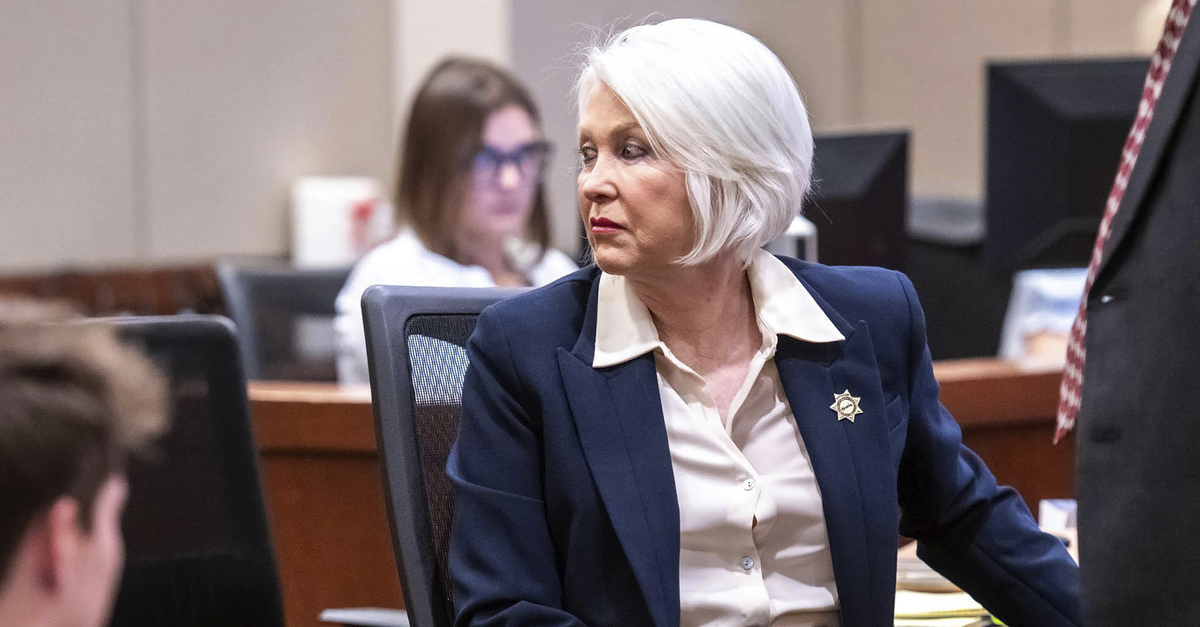
Former Mesa County Clerk and Recorder Tina Peters looks on during sentencing for her election interference case at the Mesa County District Court Thursday, Oct. 3, 2024, in Grand Junction, Colo. (Larry Robinson/The Grand Junction Daily Sentinel via AP).
A Colorado appellate court on Wednesday examined whether the trial of Tina Peters, the first election official convicted of a felony linked to 2020 election conspiracy theories, was derailed into an unconstitutional “circus” due to those very conspiracy theories, warranting a retrial.
In August, Peters was found guilty on seven counts related to a security breach involving unauthorized access to voting machines during her tenure as a county clerk in Mesa County, Colorado. Following an exhaustive hearing in October, where she defiantly reiterated conspiracy theories, the 70-year-old was sentenced to nine years in state prison for her felony charges.
During Wednesday’s session, judges Craig R. Welling, Ted C. Tow III, and Lino Lipinsky of the Colorado Court of Appeals questioned Senior Assistant Attorney General Lisa Michaels and Peters’ legal team about potential constitutional issues in the trial. They focused on whether Peters was denied the opportunity to present a “complete defense” after the court restricted evidence related to the conspiracy theories that Peters claimed influenced her actions. According to Michaels, the court limited this evidence to prevent the trial from devolving into a “mini-trial” on the conspiracy theories themselves.
“Does a trial court have the authority to limit a defendant’s constitutional right to present a complete defense to avoid the trial becoming a spectacle?” Tow inquired of Michaels. “Isn’t there a constitutional right to present a complete defense?”
The assistant attorney general responded, “We argue that the risk of unfair prejudice, confusion, or misleading the jury significantly outweighs any potential probative value of that evidence.”
Michaels further explained, “Even if there was any error in not admitting some evidence, it doesn’t constitute a constitutional violation because Peters was allowed to introduce some of that evidence and extensively cross-examined the presented evidence.”
One of the biggest points of discussion centered around whether statements made by District Court Judge Matthew Barrett during Peters’ sentencing posed a constitutional problem related to Peters’ First Amendment rights.
“The trial court, in sentencing, referred to Ms. Peters as ‘peddling snake oil that has proven to be junk,’” Lipinsky said, noting how Barrett also accused Peters of trying to “undermine the election” and “weaving tales,” per his sentencing statements.
“Didn’t he consider uncharged conduct, as he referred — given the references to snake oil, etc. — wasn’t he considering uncharged conduct in sentencing her and wasn’t that an error?” Lipinsky asked.
“I don’t think that that’s something that’s problematic,” Michaels responded. “All of that was part and parcel of, it was the context of the criminal conduct. She wanted to promote these allegations of election fraud.”
Lipinsky fired back, “But she wasn’t convicted of publicly saying it was election fraud.”
“But I think because of the context it’s relevant,” Michaels said, to which Lipinsky replied, “Why is the context relevant when the court excluded much of the evidence of election fraud? On one hand, the judge says, ‘Ms. Peters you can’t bring this in.’ On the other hand, he refers to it while he’s sentencing her.”
Michaels insisted that Barrett “didn’t exclude it entirely, he limited it,” while accusing Peters of spending “a great deal of time” at the sentencing hearing talking about the alleged election fraud. “She used it [the hearing] as a platform to make all these allegations, so of course it was relevant to what the court was doing at the sentencing hearing,” Michaels asserted. “The court was entitled to consider what she said.”
Welling argued that while the court is entitled to consider the larger context, “there’s some limitations” to that, according to the judge. “The court can’t punish her for the exercise of her First Amendment rights, is that a fair statement as a broad principle?”
Welling said that in defending the convictions and what testimony was brought in at trial and what defenses Peters could assert, state prosecutors “very narrowly tailored this to, ‘We’re not talking about her election conspiracy stuff. We’re not talking about making the copy before or making the copy after. We’re talking about this very specific conduct of misleading the secretary of state and the like.’” But then at sentencing, according to Welling, the language and the considerations ended up “broadening out from that considerably” and getting into the very issues that prosecutors claimed were “outside of that box that helps you defend the convictions on their merits,” per the judge.
“My concern is that it did substantially inform the sentence that was imposed and that creates some constitutional problems, and you don’t get to ride both horses,” Welling charged.
“She made it relevant,” Michaels replied. “She had a slideshow. She spent pages and pages going on about this. How is the court just supposed to ignore that? The court is considering, it has all its considerations in front of it. It referenced, she doesn’t have any remorse. In fact, she’s standing up here and doubling down on it.”
Welling told Michaels he believed a case could be argued on how it’s one thing to say, “She said this and I don’t agree.” But Barrett, as it appeared, chose to make it part of the calculation as to whether or not he was going to impose the length of the prison sentence, according to Welling.
“My concern is the court didn’t say, ‘She’s engaging in all of these hoaxes and she’s undermining public confidence and she’s doing all of these things that are very detrimental to society, but I’m not considering those for purposes of the sentence because she is here on these convictions and that is the exercise of her First Amendment rights,’” Welling explained. “Instead … the judge considered that and it went into the calculation of the sentence and that that’s a First Amendment problem.”
Michaels repeatedly insisted that Barrett “did say at the end of the day, this is about what you did” rather than her election beliefs. “You violated these security protocols,” she recalled Barrett as saying. “You had a duty to enforce the security of the elections and instead you violated it.”
Michaels added, “I understand the concern. I encourage the court to look at the transcripts because I do think the court made that distinction and what she did here.”
One of Peters’ lawyers, John Case, pushed back hard on Michaels’ statements.
“I say that’s bologna,” he told the appellate panel during his rebuttal. “I was there, I heard the way he imposed the sentence. He was vicious. And we’re asking the court, if this case is remanded, please order a different judge.”
Case added, “It’s up to the court to give her a fair trial and give her a fair sentence, and to rule justly. Not to bring that in when it wasn’t what she was convicted of. He can comment on it, but since she wasn’t convicted of anything in it he can’t sentence her for it.”
Peters’ attorneys have argued and asked for a pardon to be handed down by President Donald Trump. They sent a letter last month to Trump urging him to consider a workaround for pardoning Peters on her state charges. The Trump administration has said that it’s probing ways to get involved.
The appeals panel did not have time to hear oral arguments on whether Peters could be pardoned.
“The question of whether a president can pardon for state offenses has never been raised in any court,” her lawyers’ letter said. “The issue which needs to be answered whether our founders understood or intended when they wrote that the President had the Power to Pardon offenses against the United States, if it meant the states or only the federal government.”