Share this @internewscast.com
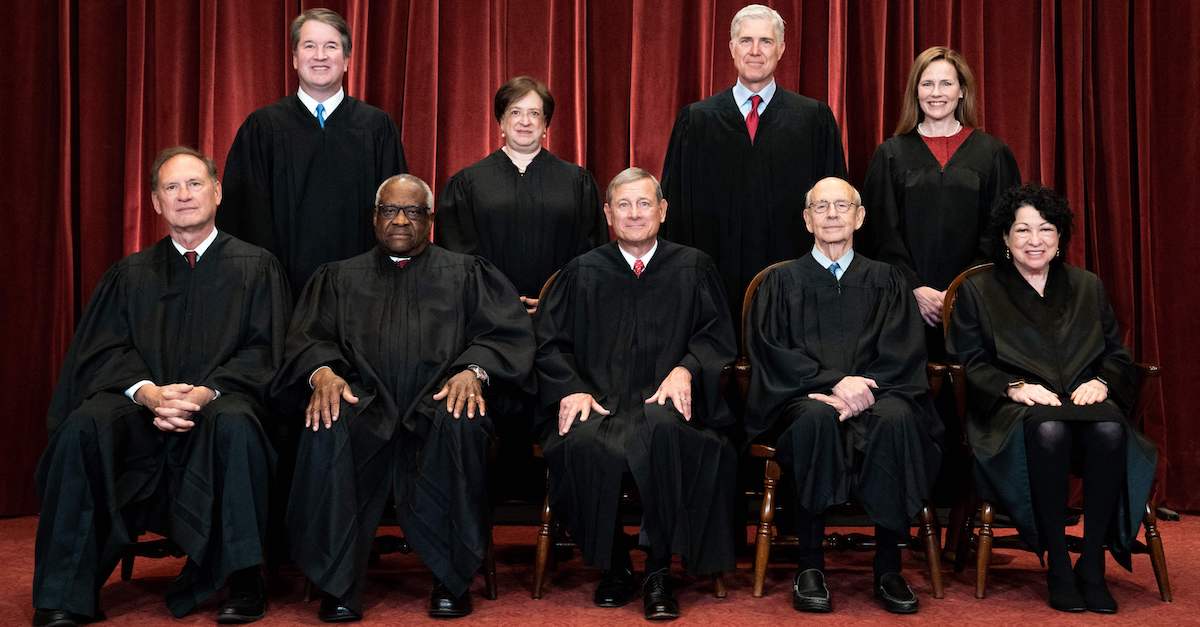
Seated from left: Associate Justice Samuel Alito, Associate Justice Clarence Thomas, Chief Justice John Roberts, Associate Justice Stephen Breyer and Associate Justice Sonia Sotomayor, standing from left: Associate Justice Brett Kavanaugh, Associate Justice Elena Kagan, Associate Justice Neil Gorsuch and Associate Justice Amy Coney Barrett pose during a group photo of the Justices at the Supreme Court in Washington, DC on April 23, 2021.
The U.S. Supreme Court on Friday ruled against three Southern California Muslims who claim they were subject to unlawful surveillance by an FBI informant who was ordered to have sex with community members and record some of those encounters.
While most of the nine justices appeared highly skeptical of the government’s claims during oral argument late last year, the court ultimately ruled in the government’s favor in the case stylized as FBI v. Fazaga. The unanimous opinion was penned by Justice Samuel Alito.
Yassir Fazaga and his co-plaintiffs sued the bureau on myriad constitutional claims, under various federal statutes and under sections of California law alleging unlawful surveillance premised on religious discrimination. They lost most of their claims at the district court level after the government invoked the state secrets privilege. The U.S. Court of Appeals for the Ninth Circuit revived the claims in question by holding that a section of the Foreign Intelligence Surveillance Act of 1978 “displaced” the state secrets privilege.
In a relatively short–and perhaps atypically dissent-free–opinion considering the subject matter, the nation’s high court determined FISA simply has nothing to say about the state secrets privilege at all and therefore cannot displace the judicially-created privilege.
“[T]he text of FISA weighs heavily against respondents’ displacement argument,” the opinion notes. “FISA makes no reference to the state secrets privilege. It neither mentions the privilege by name nor uses any identifiable synonym, and its only reference to the subject of privilege reflects a desire to avoid the alteration of privilege law.”
The court’s straightforward text-based analysis goes on:
The absence of any statutory reference to the state secrets privilege is strong evidence that the availability of the privilege was not altered in any way. Regardless of whether the state secrets privilege is rooted only in the common law (as respondents argue) or also in the Constitution (as the Government argues), the privilege should not be held to have been abrogated or limited unless Congress has at least used clear statutory language.
Likely undergirding the unanimity of the Ninth Circuit being reversed here is the admittedly narrow nature of the opinion.
Most of oral argument concerned dueling interpretations of what constitutes an effort to “otherwise use” the “information obtained or derived” from allegedly unlawful surveillance.
The plaintiffs said the FBI was using the surveillance to dismiss the causes of action by referring to its contents in order to invoke the privilege. The government said that invocation wasn’t really a use in the legal sense and, if anything, an effort to prevent its use.
The Supreme Court sidestepped that argument entirely.
“We need not resolve this dispute,” Alito noted before later writing: “We reiterate that today’s decision addresses only the narrow question whether §1806(f ) displaces the state secrets privilege. Because we conclude that §1806(f ) does not have that effect under either party’s interpretation of the statute, we do not decide which interpretation is correct.”
The opinion goes on to keep several litigation options open:
Nor do we decide whether the Government’s evidence is privileged or whether the District Court was correct to dismiss respondents’ claims on the pleadings. According to respondents, the state secrets privilege authorizes dismissal only where the case concerns a Government contract or where the very subject of the action is secret. The Government, by contrast, relies on lower court cases permitting dismissal in other circumstances. The Ninth Circuit did not decide those questions, and we do not resolve them here.
Fazaga’s attorney Ahilan Arulanantham took stock of the setback but said he was “pleased” with the narrow ruling via Twitter, adding that the opinion “explicitly leaves open several paths to victory for us.”
The American Civil Liberties Union, whose attorneys took part in the case as well, had a more dire outlook, tweeting that the ruling allows the FBI to try and “to hide its discriminatory and harmful surveillance of Muslim American communities under the guise of ‘state secrets.””
“[T]his is wrong,” Arulanantham replied. “The opinion explicitly doesn’t decide whether our religion claims can be dismissed on state secrets.”
[image via ERIN SCHAFF/POOL/AFP via Getty Images]
Have a tip we should know? [email protected]
Source: This post first appeared on