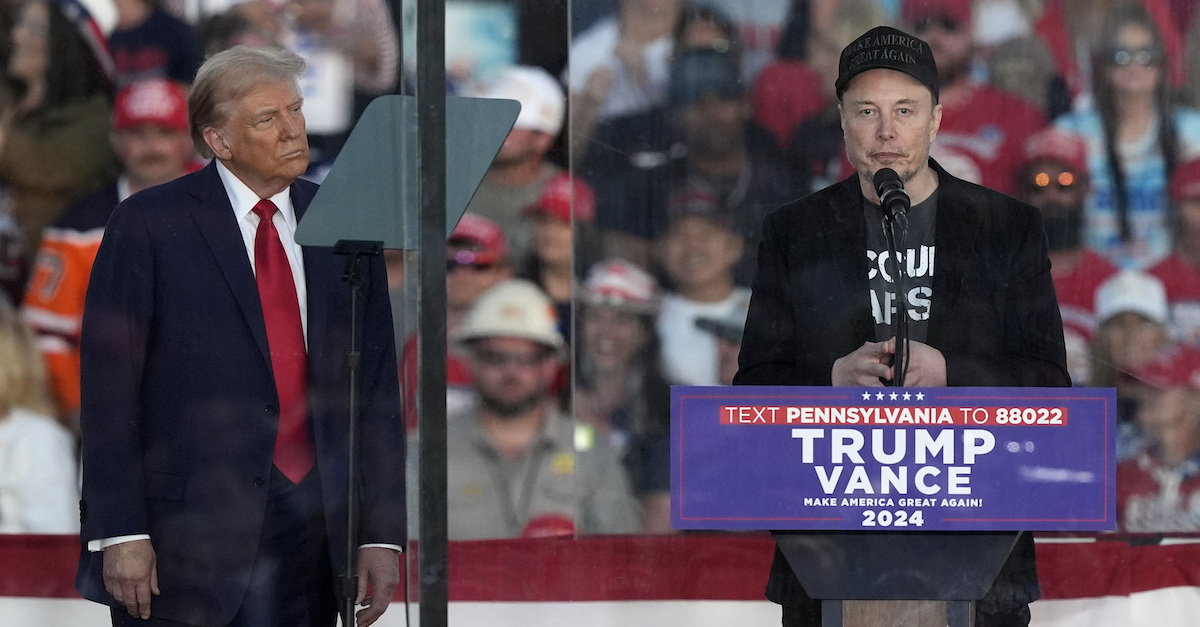

President Donald Trump listens as Elon Musk speaks during a campaign rally at the Butler Farm Show on Saturday, October 5, 2024, in Butler, Pennsylvania. (AP Photo/Julia Demaree Nikhinson, File).
A federal appellate court on Friday upheld a previous court’s decision to block the Trump administration’s plans to significantly overhaul the federal government and dismiss federal employees.
With a 2-1 ruling, the U.S. Court of Appeals for the 9th Circuit declined to suspend the restraining order put in place by U.S. District Judge Susan Illston, a judge appointed by Bill Clinton, earlier this month.
In no uncertain terms, the majority rubbished the government’s legal arguments as wholly deficient in terms of procedure and merit.
“It has now been over a month since Plaintiffs first filed their complaint,” the court muses. “Defendants have yet to show the district court—or us—a single piece of evidence in support of its allegation of irreparable injury resulting from the district court’s [temporary restraining order] TRO or preliminary injunction.”
Love true crime? Sign up for our newsletter, The Law&Crime Docket, to get the latest real-life crime stories delivered right to your inbox.
On Feb. 11, President Donald Trump issued an executive order entitled “Implementing The President’s ‘Department Of Government Efficiency’ Workforce Optimization Initiative.” The order purported to “commence” a “critical transformation of the Federal bureaucracy” by “eliminating waste, bloat, and insularity.”
In real terms, Trump’s plans would have administrative agency heads quickly “initiate large-scale reductions in force” (RIFs), or massive layoffs, in service of the goal to restructure the government.
Illston pumped the brakes on those efforts.
The lower court reasoned the three agencies principally tasked with the firings and reorganization – the Office of Personnel Management (OPM), the Office of Management and Budget (OMB), and the Department of Government Efficiency (DOGE) – simply lacked the requisite statutory authority to carry out such tasks.
“In sum, no statute gives OPM, OMB, or DOGE the authority to direct other federal agencies to engage in large-scale terminations, restructuring, or elimination of itself,” Illston wrote. “Such action is far outside the bounds of any authority that Congress vested in OPM or OMB, and, as noted, DOGE has no statutory authority whatsoever.”
The appeals court echoed the district court’s findings on the authority of the three agencies tasked with the reorganization plans – finding each agency acted beyond its statutory authority.
“As Defendants concede, OMB and OPM have only supervisory authority over the other federal agencies,” the order reads. “DOGE has no statutory authority whatsoever. We therefore agree with the district court that these organizations’ actions directing other federal agencies to engage in restructuring and large-scale RIFs were ultra vires.”
In the government’s bid for a stay, attorneys with the U.S. Department of Justice argued the U.S. Constitution’s take care clause provided enough justification in lieu of statutory authority.
The appeals court rejected these alternative arguments as merely expedient – and not entirely unlike too little, too late.
“Defendants never argued that the Constitution was a proper source of authority for the Executive Order, relying solely on federal statutes governing agency authority,” the order goes on. “Having been rebuffed by the district court, they change tacks, now arguing that the Constitution does confer such authority. Both arguments are unavailing. Neither the Constitution nor any federal statute grants the President the authority to direct the kind of large-scale reorganization of the federal government at issue.”
The government, for their part, also argued President Donald Trump was merely providing “policy direction to executive agencies.”
But the panel was not having it.
“[S]uch a characterization is at best disingenuous, and at worst flatly contradictory to the record,” the order reads. “Defendants cannot now assert that this language merely constituted guidance.”
The order explains why this argument failed, at length:
The Executive Order at issue here far exceeds the President’s supervisory powers under the Constitution. The President enjoys significant removal power with respect to the appointed officers of federal agencies. But even that power is not unlimited. Determinative of the case before us, the President has never exercised such control over inferior officers, much less over the thousands of rank-and-file employees affected by the Executive Order.
In dissent, Circuit Judge Consuelo Callahan, a George W. Bush appointee, argued the district court should have guided its legal analysis by asking whether the firings would have rendered agencies unable to fulfill statutory obligations.
The majority, led by Senior Circuit Judge William A. Fletcher, another Clinton appointee, accepted that standard for the sake of argument – but still found the government’s behavior lacking.
“We do not agree with the dissent that this is the proper standard,” the majority opines. “But even applying the dissent’s preferred standard, it is unlikely that Defendants can satisfy it. Defendants have not produced any evidence showing that the forty planned RIFs across seventeen agencies would not essentially eliminate Congressionally created agencies or prevent them from fulfilling their statutory duties.”


