
Share this @internewscast.com
Britain’s former top al-Qaeda leader may soon find himself free, as he makes another attempt at securing his release.
Rangzieb Ahmed, once referred to as Osama bin Laden’s right-hand man, is scheduled to appear before a parole board on February 13. He intends to argue that he has undergone a transformation and is now a “reformed character.”
At 33, Ahmed made history in the UK as the first individual convicted of directing terrorism in 2008. A jury found him guilty of overseeing a three-member cell that was plotting large-scale attacks.
Since being imprisoned, Ahmed has repeatedly sought parole, but all his appeals have been unsuccessful.
In September 2022, officials concluded that he remained too dangerous for release, denying his request to leave prison.
A year later, authorities mandated that he participate in a deradicalisation programme, in hopes of addressing his extremist views.
And another bid for freedom was blocked in 2024 when parole chiefs found he was still a risk to the public.
Ahmed, now 48, is set to appear before a parole board for an oral hearing where a ‘huge range of evidence’ will be reviewed.

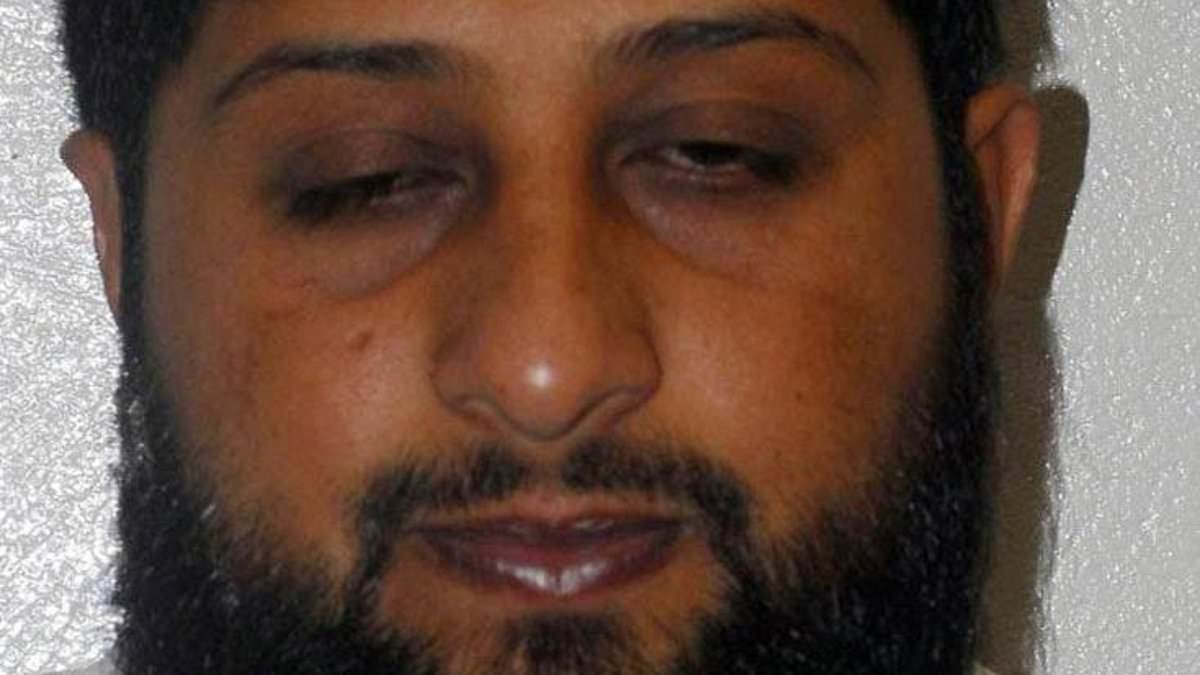
Rochdale-born Muslim Rangzieb Ahmed was jailed for life with a minimum of 10 years in 2008 for heading a three-man al-Qaeda cell planning mass attacks

The terror chief (pictured) could be freed from prison within weeks after the Parole Board confirmed the date of his new meeting
The Parole Board confirmed ‘hundreds of pages’ worth of information would be considered to help decide the terrorist’s future.
A spokesman told The Sun: ‘Parole Board decisions are solely focused on what risk a prisoner could represent to the public if released and whether that risk is manageable in the community.
‘A panel will carefully examine a huge range of evidence, including details of the original crime, and any evidence of behaviour change, as well as explore the harm done and impact the crime has had on the victims.’
The board added that its members would hear evidence from witnesses, including probation officers, psychiatrists and psychologists as well as officials who had supervised Ahmed in prison.
Victim impact statements would also be taken into account. It is understood that Ahmed will argue he is a reformed character.
The spokesman said: ‘Parole reviews are undertaken thoroughly and with extreme care. Protecting the public is our number one priority.’
In October 2024, it was decided Ahmed would not be paroled as he was likely to commit more terror acts.
A risk assessment suggested he was still ‘susceptible to indoctrination’ and could reoffend if released onto the streets.

Osama bin-Laden is seen in this undated photo in Afghanistan. A Pakistani foreign ministry spokesman said October 4, 2001 that it had seen sufficient evidence provided by U.S. investigators to allow an indictment against Osama bin Laden
The report said: ‘Having considered the index offence, past behaviour and the other evidence before it, the panel listed as risk factors those influences which made it more likely that Mr Ahmed would reoffend.
‘The sentencing Judge had found that Mr Ahmed was dedicated to the cause of Islamic Terrorism, with Mr Ahmed believing it was his religious duty to do so.’
Ahmed was jailed in 2008 for plotting carnage across Britain and was also linked to the London 7/7 bombers. He was sentenced to life with a minimum of ten years.
The first member of Al-Qaeda to be convicted of directing terrorism in the UK, he was also connected to the failed London bomb plot two weeks later.
He is thought to have links to every major British terror cell and was heard boasting of meeting the brains behind 9/11.
At Ahmed’s trial, he was sentenced to a minimum of 10 years after Manchester Crown Court heard he was behind the terror cell.
Counter-terrorism chiefs were not sure where Ahmed was planning to strike, but were convinced an attack was imminent.
His scheme was revealed with the discovery of three diaries, which were found to contain details and phone numbers of key al-Qaeda operatives written in invisible ink.

Attorney General Lord Hermer (pictured) fought for compensation for the terrorist. He tried to sue the government for alleged torture by Pakistan but the bid failed
He was initially arrested by Pakistan’s Inter-Services Intelligence (ISI) agency when he flew into the country in August 2006. He was held for a year before being deported to the UK where he was arrested.
Ahmed later sued MI5 and MI6 for alleged collusion in his torture by Pakistani intelligence, but in 2020 had his damages claim thrown out by the High Court.
It was reported that Attorney General Lord Hermer had fought for compensation for the terrorist.
Jurors at his trial were not told of any of the allegations of torture.
The court heard how Ahmed travelled to Dubai from Pakistan in December 2005 and was set to fly out to South Africa as part of a ‘major activity’, but that the plans were changed after Hamza Rabia, a senior al-Qaida leader, was killed in an explosion.
Another convicted terrorist Habib Ahmed was summoned to collect three diaries, and the pair returned separately to the United Kingdom shortly afterwards.
Manchester detectives had already been monitoring the two men and had bugged their hotel room in Dubai, where they made several coded references to al-Qaida. The surveillance continued in Manchester.
Ranzieb Ahmed continued his terror planning and was arrested upon arriving in Pakistan.
Last year, it emerged that Ahmed had been thrown into solitary after lying that a guard had been racist.
Officials found there was no evidence of racism after he had been told to obey social distancing rules.
The terrorist is believed to be currently held at HMP Buckley Hall, Greater Manchester.
In 2023, reports told how the warped terror boss was left fuming after prison chiefs banned him from making pizza and cakes at HMP Buckley Hall in Rochdale.
The one-time cab driver has received legal aid totalling almost £1million for all his proceedings.
Ahead of his previous parole hearing, Chris Phillips, the former head of the National Counter Terrorism Security Office said: ‘It’s madness to be considering this. Public safety will be at risk if either of these men are released.
‘You have to question whether it will ever be safe for either of them to walk the streets again.’