
Share this @internewscast.com
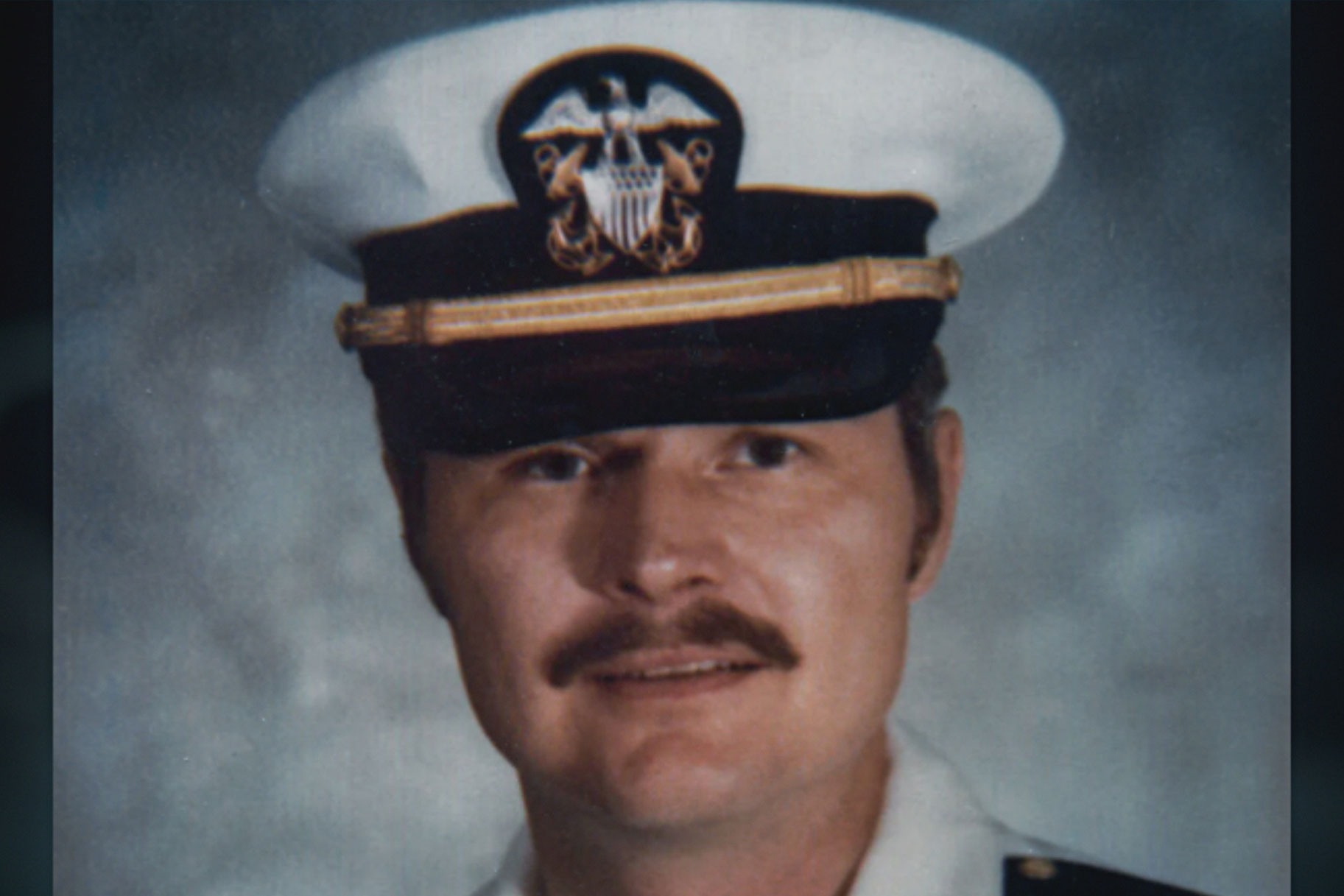
While stationed on a naval ship in the Mediterranean, Lt. Lee Hartley suddenly became ill with a mysterious condition that alarmed his crewmates.
Initially, Navy medical staff suspected the 37-year-old officer might be suffering from the flu. However, his health rapidly worsened, presenting severe symptoms that caught the attention of the investigative series Accident, Suicide, or Murder on Oxygen.
According to Laura Starrett, a former Assistant State Attorney from Florida, Hartley was experiencing a range of debilitating symptoms. “He was suffering from nausea, diarrhea, vomiting, and dizziness,” she recounted during the show’s November 6th episode.
Despite being a newlywed, Hartley’s health continued to spiral downward. He endured excruciating stomach pain and developed painful ulcers in his mouth. As his condition deteriorated, he was airlifted to a Naval hospital in Jacksonville, Florida, where he tragically passed away on November 18, 1982.
In the aftermath of Hartley’s death, investigators delved into the perplexing case, uncovering a sinister plot orchestrated by someone determined to end his life.
Lt. Lee Hartley’s “Shocking” Cause of Death
Hartley, the eldest of seven children, had dedicated his life to the Navy, enlisting at the young age of 17 with his parents’ consent. His commitment to his military career and his family was unwavering.
“He just really loved being in the service,” his sister Janet Humphrey recalled. “He was quite good at the job he did.”
By the age of 37, he was working as a lieutenant on the USS Forrestal, one of the Navy’s most elite vessels.
But the married father’s life took an unexpected turn when he fell in love with his secretary, Pamela Johnson, a woman 12 years his junior and decided to divorce his first wife. Just a few months into the new relationship, Lee and Pamela got married.
As retired NCIS special agent Walt O’Brien explained, “They’re making a life for themselves.”
But while out on a deployment in the Mediterranean Sea, Lee fell ill and died five months later after enduring a painful death.
“He was a healthy, reasonably young guy,” O’Brien said. “It was a puzzler.”
Doctors were unable to identify the cause of Lee’s symptoms until a toxicology report, conducted as part of his autopsy, revealed that he had approximately 1,000 times more arsenic in his body than normal.
“Somebody had poisoned him,” Humphrey said of the shocking cause of death.
Investigators Consider Possible Motives
With one part of the mystery solved, investigators set out to determine how the arsenic had gotten into Lee’s body.
Pamela told investigators that in the last few months of his deployment, Lee had become increasingly paranoid and worried about his own safety on the ship.
“Was there somebody who didn’t like him? Was there somebody who had some grudge against him?” O’Brien theorized. “Maybe somebody on the ship was trying to kill him, but we didn’t know why.”
Lee had served as a legal officer in charge of disciplinary actions on the ship, which could have put him on someone’s radar. Yet, investigators found that Lee had been well-respected on the ship.
They also considered the possibility that Lee—who had been desperate to return home to his new bride—poisoned himself in an effort to get sent home early.
“During the course of the investigation, it became obvious that not only was Lee homesick for being with his wife, but he was also a little bit jealous,” O’Brien said. “He had married a pretty woman who was younger than him, and now he’s at sea for six months.”
Yet, they couldn’t find any evidence to support that idea.
Hair Analysis Provides Telling Clue
Investigators got a break in the case when conducted a hair sample analysis that allowed to see when Lee was exposed to the arsenic. They learned that the spikes occurred just before Lee left on deployment and again every time the boat went into port.
They realized that the common denominator each time was Pamela, who would either visit Lee or send him care packages from home during the port stops.
“Pamela Hartley, before joining the Navy, had been a wildlife officer, where they did investigations into how arsenic and other substances affected wildlife,” Starrett said. “So she did have some scientific background.”
They also learned that Pamela stood to benefit financially from Lee’s death, both through a $35,000 life insurance policy and military spousal benefits.
Within weeks of Lee’s death, she’d also moved on to a romance with another officer and cut ties with Lee’s family.
Yet, the couple had only been married a short time when Lee died and Pamela passed a lie detector test.
Without much more to go on other than their suspicions, the case went cold.
Who Killed Lt. Lee Hartley?
Then in 1995, the case was reopened by the NCIS and Starrett’s office.
“There was just so much evidence, it just seemed like a good case,” she said. “Lieutenant Hartley deserved better. He died a very, very painful death, and he really deserved our trying to resolve it.”
By then Pamela was living in Georgia, after moving back to her hometown. Authorities re-examined her lie detector results and concluded it could have been interpreted incorrectly.
As they re-interviewed those with ties to the case, they were surprised to learn from Pamela’s brother that she’d once approached him about killing Lee and told him that she planned to poison her new husband while he was on the ship.
With her brother’s cooperation secured, authorities then went to talk to Pamela, who surprisingly confessed to the murder.
She told investigators that she’d purchased rat poison—which contained arsenic—and began putting the poison into her husband’s food and the baked goods that she sent him overseas, even adding the poison to his juice while he was in the hospital.
“It’s my understanding, and at one point she also said that the reason she did it is that she didn’t want to be married to Lee anymore, even though their marriage was of such short duration,” O’Brien said. “And so rather than hurt his feelings and divorce him, she decided to simply kill him.”
Pamela was arrested and charged with first-degree murder on March 2, 1996. She agreed to plead guilty later that year to second-degree murder. She spent 14 years behind bars before she was later granted release to care for her ailing mother.