
Share this @internewscast.com
The Western genre is intrinsically tied to tales of yesteryears, often exploring the post-Civil War era of the late 1800s. Typically, these narratives follow figures such as lawmen, outlaws, cowboys, and Native Americans navigating the untamed American West before it was subdued by civilization. The allure of the Western lies in its mythic and captivating nature, drawing us back repeatedly, though not every film in this genre succeeds in capturing audience acclaim.
Occasionally, the disappointment of a single movie can undermine the trust Hollywood and its audience place in an entire genre. Alternatively, it might transform the narrative approach used in future works. With this perspective, we’ve compiled a list of five Westerns that failed commercially but influenced the genre’s storytelling trajectory. These films span different eras, yet each has impacted how Westerns are depicted in cinema today.
Whether you appreciate these films or not, they have undeniably left a mark on the Western genre that it continues to grapple with. If you’re wondering why Westerns aren’t as prevalent today as they were during the eras of John Wayne, James Stewart, or even early Clint Eastwood, you need only examine these notable box-office disappointments.
One of the most infamous failures in Western cinema is Michael Cimino’s “Heaven’s Gate.” Released in 1980, this period drama draws inspiration from the Johnson County War, a historical event that has fueled many Western narratives. With Kris Kristofferson portraying James Averill and Christopher Walken as the formidable enforcer Nathan D. Champion, the film delves into the strife between affluent cattlemen and European immigrants they hoped to expel from the West, offering a richly nuanced, romantic, and dramatic story.
Despite Cimino’s ambitious attempt to recreate the Wild West, “Heaven’s Gate” fell spectacularly at the box office. The film, which underwent re-editing just before its premiere, grossed a mere $3 million against its hefty $44 million budget, and critics were ruthless in their reviews. The New York Times dubbed it “Murder in the West,” and it was long believed to have dealt a significant blow to the Western genre throughout the 1980s. Even Clint Eastwood, a prominent Western star, only ventured into the genre once during that decade.
Heaven’s Gate
The exorbitant cost of “Heaven’s Gate” soured Hollywood’s appetite for grand Western epics, delaying another attempt until Kevin Costner’s “Dances with Wolves” emerged a decade later. Nonetheless, “Heaven’s Gate” remains a notable film to revisit, particularly the director’s cut, which has since been reevaluated and is now regarded by many as a “masterpiece.”
But despite Cimino’s earnest efforts to bring the Wild West to life, “Heaven’s Gate” was an unadulterated commercial failure. It certainly didn’t help that the film was recut right before it premiered. In the end, it made just over $3 million against a $44 million budget, and critics carved through the picture mercilessly. The New York Times billed “Heaven’s Gate” the “Murder in the West,” and for decades, it was said that the film killed the Western throughout the 1980s. After all, even the genre’s biggest star at the time, Clint Eastwood, only made one Western the entire decade.
Because of the massively inflated budget of “Heaven’s Gate”, the Western failure turned Hollywood off to the period epic for quite some time. It took another decade before it would give the concept another try with Kevin Costner’s “Dances with Wolves.” Still, “Heaven’s Gate” is one box-office bomb that’s still worth watching, especially if you manage to catch the director’s cut, which has been looked back on more favorably and deemed a “masterpiece” by many.
The Assassination of Jesse James by the Coward Robert Ford
Compared to “Heaven’s Gate,” Andrew Dominik’s “The Assassination of Jesse James by the Coward Robert Ford” is nothing short of exquisite. The understated Western period drama is so character-centric in its approach that whenever a gun is fired or violence ensures, we feel the weight of each blow. Brad Pitt and Casey Affleck star as the respective title characters, and Roger Deacon’s haunting cinematography is perhaps the greatest in the genre. But that didn’t stop it from flopping.
“Jesse James” cost Warner Bros. $30 million to bring to life, but only grossed half that back worldwide. Despite the high praise the film garnered from critics and audiences alike, this artsy take on the genre — which emphasized detailed character development, muted performances, and visual splendor — didn’t make the splash that it easily could have. As a result, Hollywood strayed from more avant-garde methods of Western exploration. The lack of much of the genre’s usual action-packed fair likely had something to do with it.
Of course, “Jesse James” didn’t kill the arthouse Western for good, though it did make it more difficult. Indie projects have continued to highlight the deeper psychological aspects of the American West, and some studios have again become bold enough to pursue other moody Westerns that audiences ought to see. As for its box-office results, it probably didn’t help that it hit theaters the same year as “3:10 to Yuma,” “No Country for Old Men,” and “There Will Be Blood.”
Cowboys & Aliens
Although it may be a guilty pleasure alien movie for some, “Cowboys & Aliens” was a massive Western flop that certainly contributed to the genre’s general big-screen decline in the 2010s. Based on the graphic novel of the same name from Platinum Studios, the film followed amnesiac gunslinger Jake Lonergan (Daniel Craig) as he partners with Woodrow Dolarhyde (Harrison Ford) to stop an alien invasion in the 1870s American West. It’s “high concept” in every meaning of the term, but it landed on its face.
For starters, the film was (not unsurprisingly) the furthest thing from a critical darling, nor did it sit too well with audiences. With “Iron Man” director Jon Favreau at the helm, what should’ve been a stellar underdog hit barely broke even at the box-office. As a result, Hollywood became allergic to big-budget Western genre mashups — and it didn’t help that sci-fi and Western fans alike weren’t too impressed.
What could easily have pushed the Western back into the blockbuster space and proven its cross-genre potential ultimately turned most off to the idea. The $163 million price tag just wasn’t worth it. Although some might argue that sci-fi projects like “Prey,” which hit Hulu in 2022, signify a new interest in the Western/sci-fi crossover, the truth is that the “Predator” prequel really isn’t a Western at all. More than that, it was released primarily on streaming, reinforcing the negative impact “Cowboys & Aliens” had on the genre.
The Lone Ranger
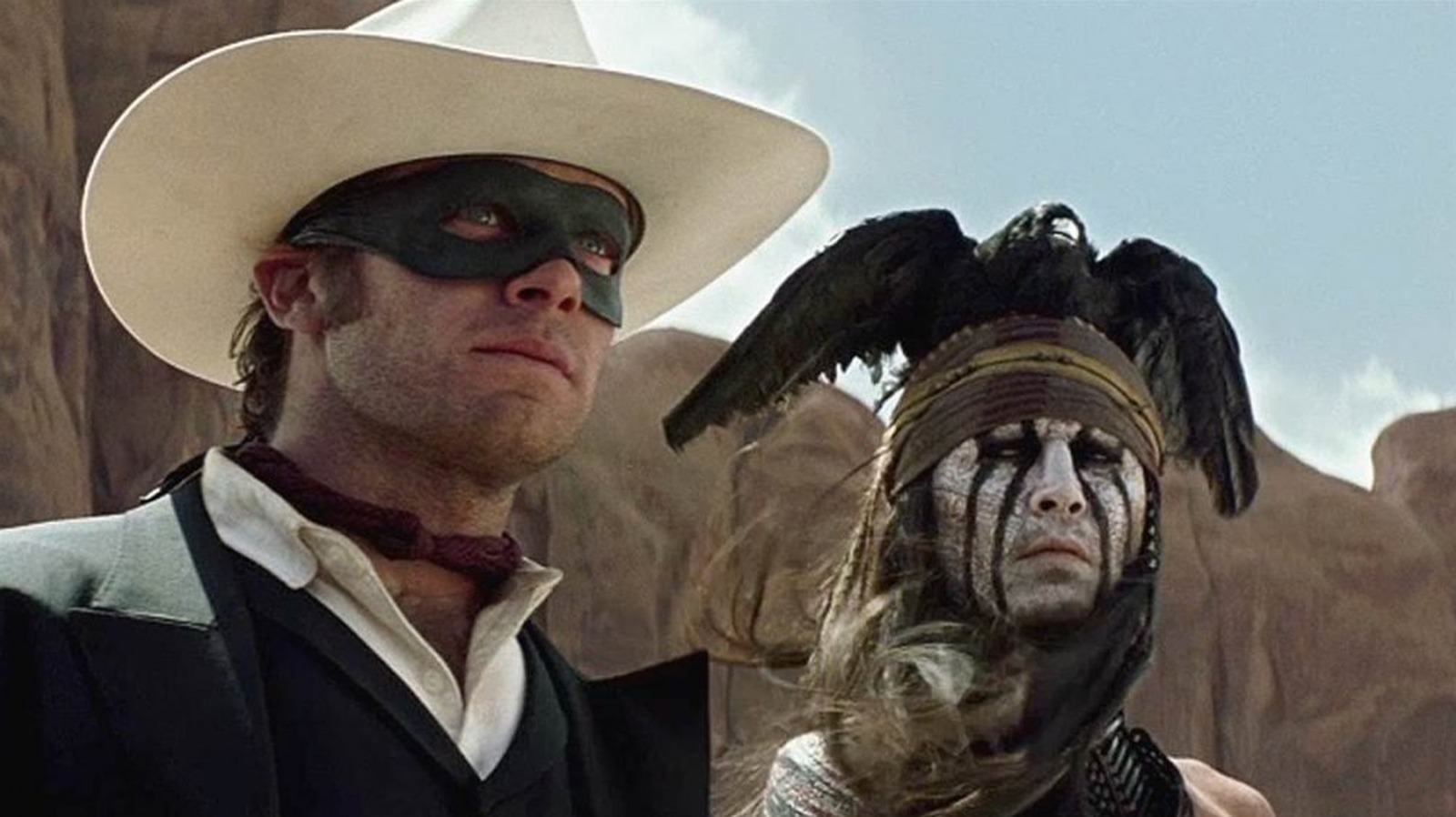
Speaking of big Western blockbusters that turned Hollywood off to the concept, “The Lone Ranger” seemed like it would be a hit on paper. It starred Johnny Depp, was helmed by “Pirates of the Caribbean” director Gore Verbinski, and planned to resurrect iconic source material in style. Disney put a considerable effort into this Western, spending upwards of $400 million to get “The Lone Ranger” made and promoted. So, what went wrong?
While this author thinks “The Lone Ranger” is a low-rated action movie still worth watching, most critics and audience members despised the picture. It didn’t help either that Depp’s controversial casting as Tonto turned many off from the get-go, and, in hindsight, Armie Hammer was a bit problematic himself. So, when the film only made $260 million worldwide, Disney (and the rest of Hollywood) let the Western blockbuster ride confidently into the sunset.
Of course, the notable exception to this “no more Western blockbusters” rule was the 2016 remake of “The Magnificent Seven.” The Antoine Fuqua-directed action flick starred the likes of highly bankable stars, including Denzel Washington, Chris Pratt, and Ethan Hawke, with no controversy to weigh it down. It was also made for significantly less by comparison, leaving “The Lone Ranger” in the dust.
Horizon: An American Saga – Chapter 1
New Line Cinema
After helping revitalize the genre on television with “Yellowstone,” Kevin Costner returned to the big screen to helm a large-scale Western for the first time since the massively underrated “Open Range.” Only this time, his vision for an epic horse opera would rival James Cameron’s “Avatar” series, with four planned installments of “Horizon: An American Saga.” In 2024, “Chapter 1” hit theaters, and we still have yet to see the rest of the saga.
Critics didn’t hold back on “Horizon: An American Saga – Chapter 1,” and the lack of initial fanfare is likely responsible for the sorry $38 million it pulled in at the box-office. Considering Costner put in at least that much of his own money to the project (on top of the $100 million already invested), it’s no wonder that “Chapter 2” was pulled from its theatrical release window. The sequel has yet to be released either in theaters or on streaming, though it has made rounds on the festival circuit.
Like “Heaven’s Gate” before it, the failure of “Horizon – Chapter 1” may have sealed the deal on the genre for the time being — though, perhaps it’s still too early to tell. On the other hand, audiences generally loved Costner’s latest Western epic, with many still hoping the sequel will find its way to theaters soon. “Chapter 1” has since become a huge success on streaming; here’s hoping that he will be able to finish his “American Saga,” even if it only ends up releasing direct-to-video.