Share this @internewscast.com
The promotional efforts for “Star Wars: The Mandalorian and Grogu” have so far focused exclusively on its main characters. The enigmatic bounty hunter (played by Pedro Pascal) and his charming companion form an intriguing duo that fans can’t seem to get enough of. However, the film offers more than just these two. Notably, Sigourney Weaver will make her first “Star Wars” appearance as a character named Ward from the New Republic. Additionally, the pair will face a host of sinister villains.
Among these antagonists is a familiar face that many “Star Wars” enthusiasts never expected to see again: Rotta the Hutt, portrayed by Jeremy Allen White. Known as Jabba the Hutt’s son, Rotta was last spotted as an infant in “Star Wars: The Clone Wars.” Now, he has transformed into a formidable warrior capable of taking on any challenger. If the idea of Jabba having a son who grew up to be a muscular fighter sounds unusual, it’s time to delve into this character’s backstory.
Rotta’s journey began well before “The Mandalorian and Grogu” was even on the horizon. Although not exactly a beloved character among “Star Wars” fans, there’s a rich history to uncover about Rotta. So, let’s explore his past and bring everyone up to speed before “The Mandalorian and Grogu” makes its theatrical debut.
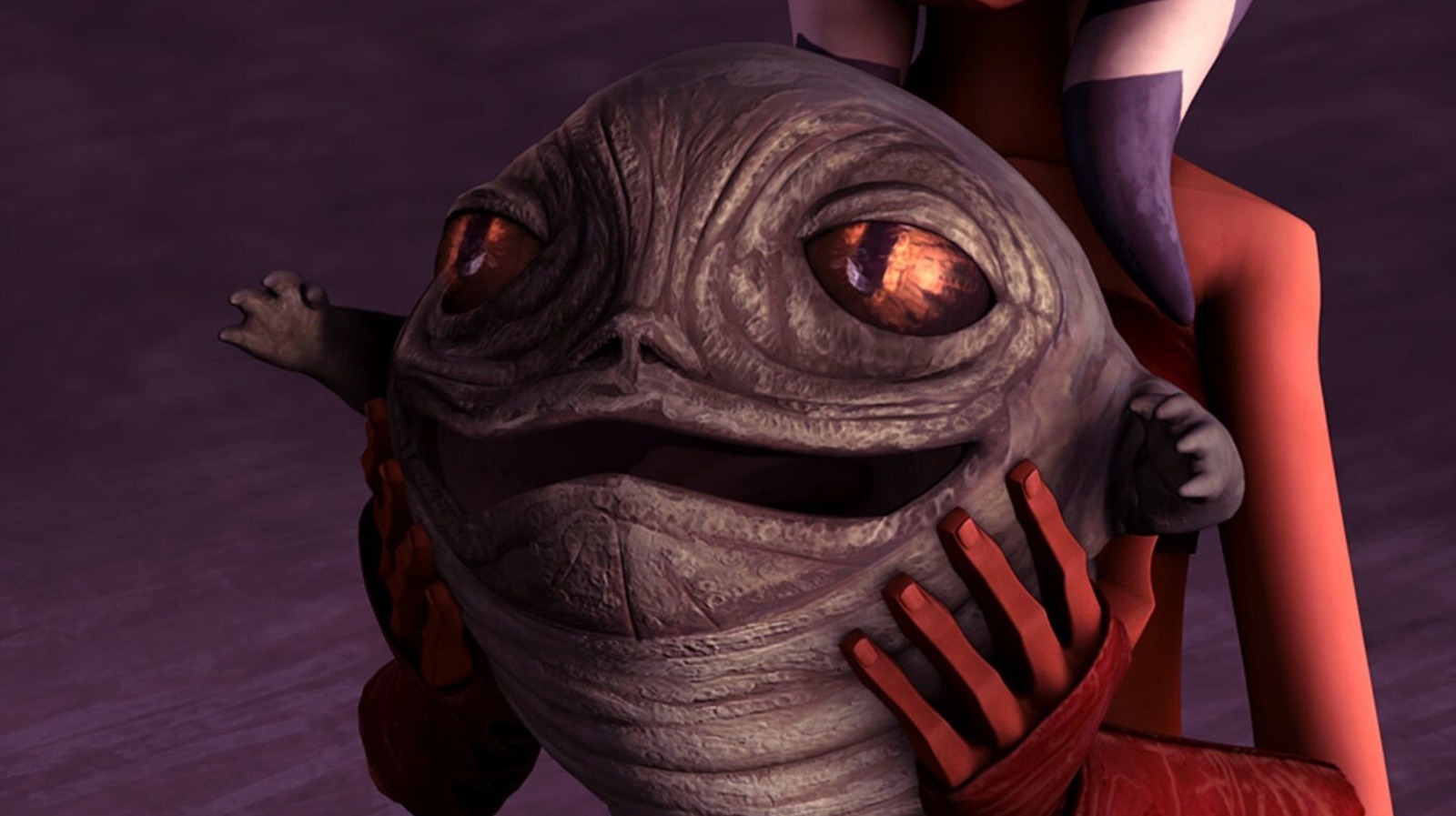
Rotta the Hutt may have faded into the background for years after his initial introduction, but his debut was nothing short of high-profile. In August 2008, “Star Wars: The Clone Wars” was released in theaters, setting the stage for the October launch of the “Clone Wars” TV series on Cartoon Network. This film was essentially a collection of four “Clone Wars” episodes, featuring Anakin Skywalker and Ahsoka Tano on their inaugural mission to reunite Jabba the Hutt’s son with his father.
In the movie, Rotta is so young and defenseless that he can do little more than belch, squeal, and occasionally appear sad. Essentially, he serves as a prop that the Jedi protagonists haul through various action scenes. Due to the film’s somewhat rudimentary animation, Rotta fails to come across as a particularly engaging or endearing character during his limited screen time. Nonetheless, he plays a crucial role in the storyline, ultimately reuniting with his elated father, who thanks the Jedi for rescuing his son.
Rotta made his debut on the big screen
This marked Rotta’s introduction to the world. It’s fascinating to consider how “Clone Wars” viewers in 2008 would react if told that Rotta would return to the silver screen 18 years later in a film called “The Mandalorian and Grogu.”
Rotta is so young and helpless in the movie that he can’t do much more than belch, squeal, and sometimes look sad. He’s basically a prop that the main Jedi characters lug from one action sequence to the next. Combined with the production’s relatively amateurish animation, Rotta doesn’t register as much of a compelling or cuddly character in his screentime. Still, he’s a prominent part of the story and made it through the narrative safe and sound. “The Clone Wars” ends with Rotta returning to his jubilant father, who expresses gratitude towards the Jedi for saving the Huttlet.
This was how the world met Rotta. Just imagine telling any “Clone Wars” moviegoers back in 2008 that Rotta would return to the big screen 18 years later for something called “The Mandalorian and Grogu.”
Rotta emerged from a more child-friendly corner of Star Wars
“Star Wars” has always been aimed at kids. That should be obvious to anyone who has seen the movies or characters like Wicket or Jar-Jar Binks. But when it first started, “Star Wars: The Clone Wars” was distinctly aimed at an even younger age group than the typical “Star Wars” outing. For viewers only accustomed to later “Clone Wars” seasons and their darker antics (including some surprisingly grisly kills), the 2008 “Clone Wars” movie especially registers as a juvenile enterprise. Rotta’s presence in the production was the epitome of what demographic this cartoon series was originally aiming for.
During his screentime, Ahsoka gives Rotta the nickname “Stinky,” a phrase which wasn’t in either “Revenge of the Sith” or “The Empire Strikes Back,” but sure gets said a lot in the “Clone Wars” movie. The character’s toyetic appearance, meanwhile, made it clear that the film’s creative team hoped Rotta would be ready to go for a Build-a-Bear tie-in. Emphasizing a baby character often referred to as “Stinky” confirmed that “Clone Wars” was aiming more for the “My Gym Partner’s a Monkey” crowd in its original episodes.
Though it always remained perfectly suitable for children (as it should), the storytelling on “The Clone Wars” grew more mature and confident as it went along. The childish nicknames and moments condescending to younger viewers vanished. Rotta’s debut, though, vividly demonstrates how prevalent those elements used to be in this corner of “Star Wars” media.
Rotta only appeared once more in the Clone Wars show
One curious element about the “Clone Wars” show is how the popularity of certain characters went up and down with viewers and even the writers. Major “Star Wars” baddie General Grievous, for instance, started out as a weekly villain in Season 1 before becoming a rare presence on the program. Meanwhile, newly created characters like Cad Bane ended up becoming focal points of the larger “Star Wars” mythology. Over the course of its seven seasons, the emphasis on different characters in “The Clone Wars” continuously evolved.
Having debuted in the theatrical “Clone Wars” movie, one might have expected Rotta to become a recurring fixture on the show. Instead, he only appeared once, in the Season 3 episode “Sphere of Influence.” Here, he briefly appears next to his father, chomping on a butterfly, when Chairman Papanoida appears before the crime lord. Papanoida is trying to rescue his kidnapped daughters and invokes Jabba’s prior experience with losing Rotta to secure the gangster’s help.
After that, Rotta was nowhere to be seen in the remaining seasons of “The Clone Wars.” Instead, the show focused on other adult Hutt gangsters who could more easily and dramatically interact with folks like Bane and Darth Maul. For so long, it looked like “Sphere of Influence” was Rotta’s final “Star Wars” appearance ever — until the franchise unexpectedly returned to this once-forgotten Huttlet.
Rotta expanded what Hutts could look like on-screen
Part of the untold truth of Jabba the Hutt is that he’s a member of a much larger clan of Hutt creatures all connected through a large crime syndicate family. The Hutts are also a species of aliens that go far beyond just Jabba and his immediate relatives and cohorts. But save for the brief appearance of Gardulla the Hutt in the background of Jabba’s “The Phantom Menace” cameo, those other Hutts were never seen in mainstream “Star Wars” media. They were rampant in the comics and other Expanded Universe material, but in the films, Jabba was basically it for Hutt representation.
Rotta was historic in that regard just by existing in “Star Wars: The Clone Wars.” The first Hutt audiences see aside from Jabba for a prolonged period of time, this creature’s tininess and wriggly nature were complete opposites of Jabba, an organism known for being massive and sedentary. Rotta upended expectations for the visual norms of Hutts, a feat another “Clone Wars” character also contributed to. Later in that 2008 movie, Ziro the Hutt makes his first appearance, and this vibrantly purple creature further expanded what Hutts could look like in “Star Wars” media.
With that, the gloves were off on the designs of Hutts. Further stylized Hutts would appear in proper “Clone Wars” episodes while a pair of Hutt characters known as The Twins would materialize in live-action streaming shows. All of this started, though, with Rotta’s exploits.
Rotta and Grogu once shared a voice actor
Baby Yoda, aka Grogu, may be worse than you realized in some of his bloodthirsty actions, but there’s no denying how adorable and iconic this “Star Wars” critter is. Ever since his debut in the final moments of the premiere episode of “The Mandalorian,” Grogu has stolen the hearts of even the most cynical “Star Wars” fans. While other cutesy sidekick characters have become sources of derision for “Star Wars” devotees, Grogu has been universally beloved. That’s in sharp contrast to another infant “Star Wars” character, Rotta, who neither took off as a merchandising bonanza nor as someone especially embraced by “Clone Wars” viewers.
Believe it or not, though, Rotta and Grogu have something massive in common. They share a voice actor in the form of sound editor David Acord. This film industry legend has provided sound work for countless films and TV shows, and has worked closely on decades of “Star Wars” media, even voicing characters in various video games, movies, and TV shows connected to the franchise. That includes him being Rotta the Hutt’s credited voice actor in “Star Wars: The Clone Wars,” while modulated variations of Acord’s voice were used (among other vocal sources) for Grogu’s assorted blabbering.
It seems Acord has a specialty in this galaxy far, far away: If you’ve got a baby version of a familiar “Star Wars” alien, he’s the go-to guy to voice that newborn, honing those skills on Rotta before excelling on Grogu.
Rotta’s role in The Mandalorian and Grogu remains mysterious
Marketing materials like the trailer for “The Mandalorian and Grogu” have offered only fleeting glimpses of the new grown-up version of Rotta the Hutt. Set at least 25 years after the “Clone Wars” movie, “The Mandalorian and Grogu” will star a beefy version of Rotta who has become some kind of gladiator. Since plot details for any “Star Wars” movie are kept under wraps before release, there’s no specific information on how Rotta will factor into the story. However, trailers and commercials have depicted Rotta fighting other alien beasts as well as lunging into battle against Din Djarin himself.
Rotta’s presence, though, reaffirms that “The Mandalorian and Grogu” will be heavily intertwined with the various Hutts scattered across the galaxy. After all, The Twins are in this film as well and make some ominous threats towards both Djarin and Grogu in the most recent trailer. There’s also a chance Rotta and Djarin might have to form some sort of uneasy alliance with each other. Rotta’s voice actor, Jeremy Allen White, revealed in late 2025 that significant portions of the film involve Djarin and Rotta collaborating together.
Perhaps the duo have more to offer each other than just sparring in the gladiator ring. For now, though, it’s clear Rotta will be a formidable opponent for Djarin, not to mention a muscular contrast to the typical Hutts that have dominated “Star Wars” media.
Adult Rotta is based on Adonis Creed
The endless list of things “Star Wars” has ripped off from other movies reflect how deeply this saga has been indebted to other forms of media since its very inception. Akira Kurosawa’s “The Hidden Fortress” has been seen as a massive influence on the original 1977 film “Star Wars,” for example, while the “Lone Wolf and Cub” movies were precursors to Mando and Grogu’s dynamic in the “Mandalorian” TV show. It only makes sense that another cinematic character would help shape the personality of adult Rotta in “The Mandalorian and Grogu.” Since Rotta is now a fighter, director Jon Favreau and company channeled another famous character known for holding his own physically.
Michael B. Jordan’s Adonis Creed from the “Creed” trilogy was a massive influence on Rotta, specifically in how both characters have to live in the shadows of famous dads. Just as Jordan’s Creed had his psyche shaped by his deceased father, so too will this new iteration of Rotta be formed from Jabba’s legacy. Taking cues from Adonis Creed for Rotta gave the “Mandalorian and Grogu” team a vivid emotional launchpad for a character without much depth or pre-existing personality.
Plus, if “The Mandalorian and Grogu” has the same financial success as titles like “Creed III” (which blew everyone away at the box office), Rotta’s return will achieve two objectives at the same time.
Rotta embodies an era driven by Dave Filoni nostalgia
Lucasfilm
In the past, “The Clone Wars” mastermind and current Lucasfilm chief creative officer Dave Filoni has said he wouldn’t shoehorn animated “Star Wars” characters into live action. Given his extensive experience working on projects like “The Clone Wars” and “Star Wars: Rebels,” it was an understandable concern, especially given how awkwardly and abruptly “Clone Wars” baddie Cad Bane was snuck into the final episodes of “The Book of Boba Fett.” Since those comments, though, live-action “Star Wars” media has been flooded with characters that originated in Filoni’s works.
“Star Wars: Ahsoka” brought tons of “Rebels” characters to live action and even found room for David Tennant’s robotic “Clone Wars” character Huyang. “The Mandalorian and Grogu,” meanwhile, will see the “Rebels” character Zeb hit the big screen while “The Clone Wars” bounty hunter Embo is one of the film’s primary adversaries. Then there’s Rotta, a character who debuted in Filoni’s only (to date) feature-length directorial credit, “Star Wars: The Clone Wars.” Bringing back Jabba’s son only further emphasizes that “Star Wars” is fully immersed in an era of Dave Filoni nostalgia.
Ezra Bridger, Embo, Rotta — they’re all driving the plots of new live-action “Star Wars” media. Your personal mileage will vary on whether or not that’s a good or bad thing for the saga. However, the very presence of Rotta in a massive movie like “The Mandalorian and Grogu” certainly demonstrates how much of an iron grip Filoni-produced animated shows currently have over this franchise.