
Film critics, tasked with evaluating countless new releases each year, can occasionally miss the mark. In today’s world, where gossip columns frequently discuss production hiccups, budget issues, and on-set drama, negative buzz can skew perceptions of a film. Sometimes, this results in a bandwagon effect, where everyone piles on a film deemed unsuccessful. In other cases, a movie’s brilliance isn’t recognized right away, requiring time for its true value to be appreciated. The 1990s, like any other decade, are filled with films that were initially misunderstood but have since garnered renewed admiration.
In the spirit of reevaluation, here are five movies from the ’90s that critics initially got wrong. These films faced harsh criticism upon release, often from both critics and audiences. A single bad review can damage a film’s prospects, while a barrage can bury it entirely. Yet, like a phoenix rising from the ashes, these films have gained respect over time. They’ve become cult favorites, found success on home video and streaming platforms, and enjoyed revival screenings. Some even received belated endorsements from the critics who once dismissed them. In essence, these so-called “bad” films have proven themselves to be quite remarkable.
In “Last Action Hero,” ten-year-old Danny Madigan, portrayed by Austin O’Brien, finds solace in movies following his father’s death. He’s captivated by action flicks featuring LA detective Jack Slater, played by Arnold Schwarzenegger, which screen at a rundown theater in New York. One day, a friendly projectionist, played by Robert Prosky, hands Danny a magical ticket for an early viewing of the latest Slater adventure. This ticket transports Danny into the film, where he discovers a father figure in Slater. However, chaos ensues when the villain, Mr. Benedict, portrayed by Charles Dance, steals the ticket and enters the real world.
Released in 1993, “Last Action Hero” was initially labeled a critical and commercial failure, overshadowed by the success of “Jurassic Park” that same summer. Directed by John McTiernan, the film couldn’t meet the high box office expectations, and negative reviews only worsened its fate. Marc Savlov of The Austin Chronicle described it as “soulless sound and fury.” However, over time, the film has been re-evaluated and appreciated for its satirical approach to Hollywood action films and its impressive stunts, earning its place among Arnold Schwarzenegger’s best works.
Last Action Hero
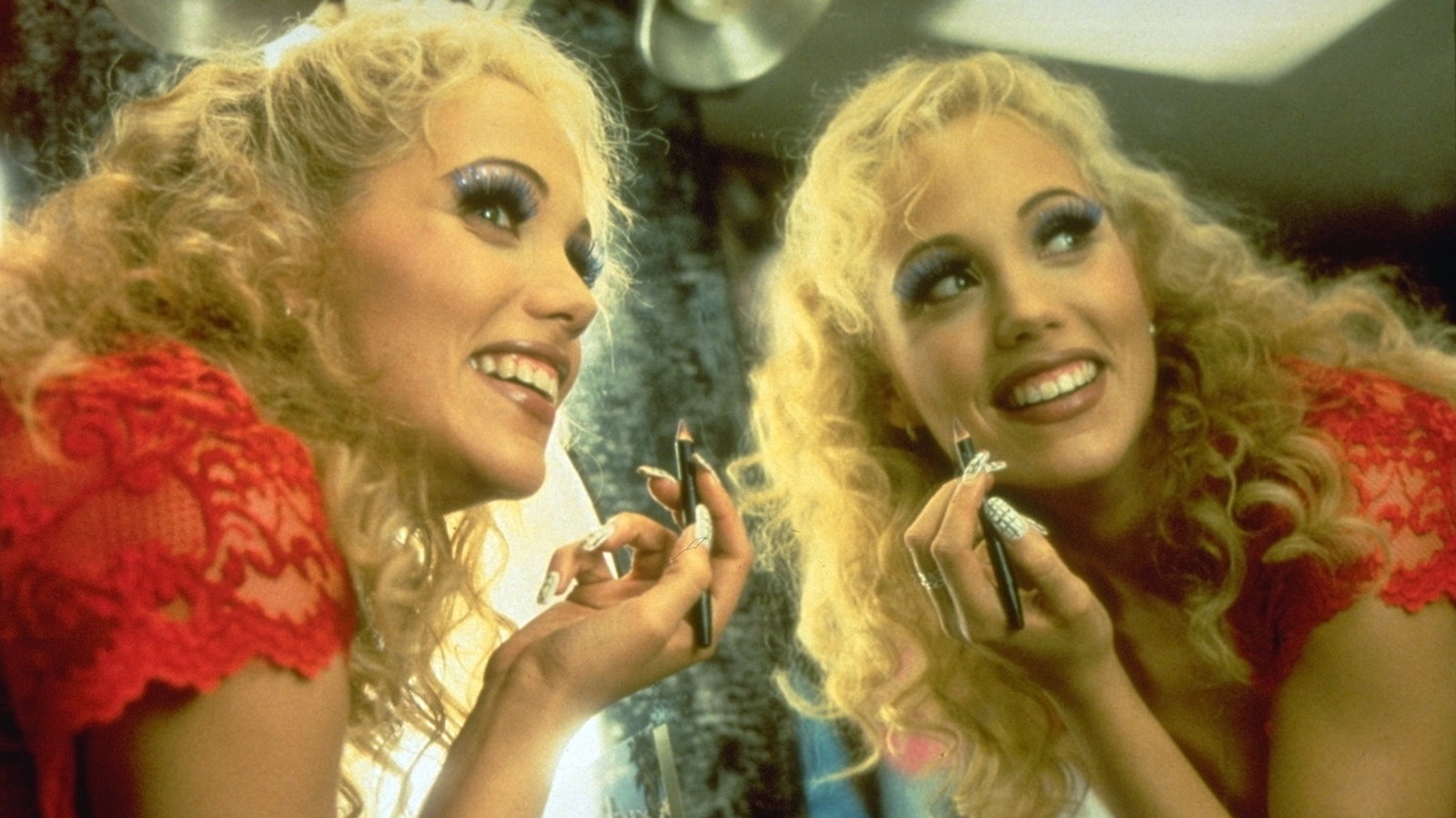
In “Showgirls,” Shannon Elizabeth stars as Nomi Malone, an aspiring dancer who arrives in Las Vegas with little more than the clothes on her back. She quickly finds work at a seedy strip club to make ends meet. Determined to break into the big leagues, Nomi befriends Molly Abrams, played by Gina Ravera, who works as a costumer at the Stardust Resort and Casino. Through Molly, Nomi meets Cristal Connors, portrayed by Gina Gershon, the star of the casino’s dance show. Despite Cristal’s dismissive comparison of Nomi’s job to prostitution, Cristal and her boyfriend, Zack Carey, played by Kyle MacLachlan, take an interest in her, helping her join the chorus line. As Nomi climbs the ladder to fame, she learns that success comes at a price.
Upon its 1995 release, “Showgirls” was widely derided, even earning a Razzie Award, with critics calling it ugly, sexist, and absurd. Kenneth Turan of the Los Angeles Times described it as a film of “thunderous oafishness.” Despite initially failing to recoup its $45 million budget, the film has since attracted a cult following. Viewers have come to appreciate director Paul Verhoeven’s satirical take on the material, especially in the wake of the #MeToo movement, which has highlighted issues of sexual exploitation in the industry.
Showgirls
Aspiring dancer Nomi Malone (Shannon Elizabeth) arrives in Las Vegas with nothing but the clothes on her back, and she quickly sheds those when she takes a job in a seedy strip club to pay the bills. Desperate to make her way into the big leagues, she quickly befriends Molly Abrams (Gina Ravera), who works backstage as a costumer at the Stardust Resort and Casino. Nomi uses her connection to meet the star of the casino’s nightly dance revue, Cristal Connors (Gina Gershon), who likens her job at the strip club to prostitution. Yet Cristal and her boyfriend, entertainment director Zack Carey (Kyle MacLachlan), take a liking to Nomi, and find a place for her in the chorus line. Before long, Nomi is ascending the rungs of the ladder, but she quickly realizes there’s a price to fame.
Few movies were as thoroughly scorned upon their release as “Showgirls” (1995), a Razzie Award-winner that’s actually worth watching if ever there was one. Directed by Paul Verhoeven and written by Joe Eszterhas, it’s an NC-17 showbiz parable that was called ugly, sexist, and just plain silly by the majority of critics. “A film of thunderous oafishness that gives adult subject matter the kind of bad name it does not need or deserve” proclaimed Kenneth Turan (Los Angeles Times) of the box office bomb that made back less than half of its $45 million budget. Yet in the decades since, it’s gained a cult following from viewers who identified the satirical bent Verhoeven brings to the outlandish material, especially in a post-Weinstein world where sexual exploitation is no longer accepted (or swept under the rug) so readily.
Event Horizon
In the year 2047, a distress signal is intercepted from the Event Horizon, a spacecraft that has been missing for seven years. The ships designer, Dr. William Weir (Sam Neill in one of his best movies), hops aboard the Lewis and Clark, a rescue vessel led by Captain S.J. Miller (Laurence Fishburne) that’s been dispatched to search for survivors. What they discover instead is a sinister force that has taken over the ship during its time in a black hole. Like the characters in a haunted house movie, the crew of the Lewis and Clark starts getting picked off one by one. Dr. Weir’s eccentric behavior calls into question his true motives, leading Captain Miller to take drastic action.
Directed by Paul W. S. Anderson (the man behind the best “Resident Evil” movies, not the Oscar-winning filmmaker of “One Battle After Another”), “Event Horizon” (1997) was the victim of massive studio interference by Paramount Pictures. Rushed into theaters to fill the summer season gap left from the numerous “Titanic” (1997) delays and severely edited for its violence, the film was dismissed by critics and failed at the box office. “Despite game efforts from a first-rate cast and acres of impressive production values, ‘Event Horizon’ remains a muddled and curiously uninvolving [sic] sci-fi horror show,” opined Joe Leydon (Variety). Although the fabled 130 minute director’s cut has yet to emerge from the black hole it disappeared into, the version that does exist is as frightening and unsettling as sci-fi horror gets, truly leaning into its cosmic horror elements that have left audiences chilled and wanting more.
Armageddon
When several major cities experience deadly meteor showers, NASA honcho Dan Truman (Billy Bob Thornton) discovers an asteroid the size of Texas hurtling towards Earth. Desperate to explode the asteroid before it reaches the atmosphere, he devises a plan to drill a hole into it and plant a nuclear bomb inside. Rather than train astronauts how to drill, Truman recruits oil driller Harry Stamper (Bruce Willis) and gives him and his team of roughnecks a crash course in space travel. One of the drillers is A.J. Frost (Ben Affleck), who’s secretly dating Harry’s daughter, Grace (Liv Tyler). With the fate of the world resting on their shoulders, Harry and his men launch towards the stars.
Although it’s now considered one of the best disaster movies of all time, Michael Bay’s “Armageddon” (1998) was treated as just a regular disaster by critics despite being a massive commercial success. “Here it is at last, the first 150-minute trailer,” wrote Roger Ebert (Chicago Sun-Times). “The movie is an assault on the eyes, the ears, the brain, common sense and the human desire to be entertained,” he added, and indeed, few films are as big, loud, and overblown as this one is. Yet it didn’t take long for the critical worm to turn on “Armageddon,” as evidenced by how quickly it joined the esteemed Criterion Collection on DVD complete with a famous Ben Affleck commentary track. The film might be dumb, chaotic, and a bit tough on the ears, but that’s all apart of what makes it so much fun.
Big Daddy

Sony Pictures Releasing
Sonny Koufax (Adam Sandler), a 32-year-old slacker, is desperate to prove he’s capable of being a grown-up when his girlfriend (Kristy Swanson) dumps him. He gets his chance when five-year-old Julian (Cole Sprouse and Dylan Sprouse) shows up at his doorstep. The long-lost son of Sonny’s roommate, Kevin (Jon Stewart), Julian needs a place to stay after his mom dies of cancer. With Kevin away on business, Sonny agrees to look after Julian, teaching him how to pee in public and trip skaters in Central Park. When he learns the kid might get put into foster care, Sonny decides to step it up for the first time. In so doing, he finds a new love with Corrine (Joey Lauren Adams), a lawyer and older sister of Kevin’s fiancée (Leslie Mann).
Although popular with audiences, Adam Sandler’s particular brand of humor wasn’t always the critics’ cup of tea, especially in the ’90s. One of Sandler’s worst reviewed films, the Dennis Dugan-helmed “Big Daddy” (1999) won him his first Razzie as worst actor. “A flimsy sentimental comedy with more product plugs and fewer laughs than might have been hoped for,” wrote Janet Maslin (The New York Times) of the film, which attempted to mix Sandler’s surrealistic comedy with the sentimentality of Charlie Chaplin’s “The Kid” (1921). Yet the box office smash is now considered one of the 15 best Adam Sandler movies, and counts among its fans Paul Thomas Anderson, who cast the Sandman in “Punch-Drunk Love” (2002) shortly after its release.


