
Share this @internewscast.com
“Star Trek” stands as a cultural cornerstone, with its imagery and symbols, along with its characters and futuristic gadgets, woven into the fabric of society. From Captain Kirk to the starship Enterprise, phrases like “beam me up, Scotty,” and concepts like warp engines are instantly recognizable. This familiarity extends to its notable alien species such as Vulcans, Ferengi, and Tribbles. These extraterrestrial characters became iconic as they regularly appeared throughout the franchise, turning into memes long before the term became mainstream.
Throughout its history, some “Star Trek” species have been featured consistently across various series and films. However, it may surprise fans to learn that many of these familiar aliens have undergone significant transformations since their initial appearances. These changes span visual redesigns and narrative adjustments, evolving from one series to another, and occasionally even from one episode to the next. In some cases, the transformations have been so profound that the aliens are almost unrecognizable. These alterations often result from advancements in makeup and special effects or efforts by writers seeking to inject fresh intrigue into established alien races. Here are five “Star Trek” alien species that underwent drastic changes without any in-universe explanations.
When discussing “Star Trek” alien races that have been dramatically altered without explanation, the Klingons are a prime example. Introduced in the original series, they initially served as allegories for the Soviet Union during the Cold War, depicted as fierce warriors on par with Starfleet and perpetually on the brink of war with the Federation. Their original appearance featured bronze skin, gold and black uniforms, and Fu Manchu-style facial hair.
A decade later, in “Star Trek: The Motion Picture,” the Klingons were transformed into almost unrecognizable characters. They appeared in silver body armor, with brown skin, long hair, prominent forehead ridges, and large fangs. By the time “The Next Generation” aired, Klingons were reimagined from a mere warrior race to a culture deeply rooted in honor, a portrayal that has endured. These changes occurred without any narrative explanation, leaving fans to conclude they were simple retcons.
Klingons have been radically altered more than once
Years later, “Star Trek: Discovery” introduced further controversial changes to the Klingons’ appearance. However, possibly due to fan backlash, “Strange New Worlds” reverted to the Klingon design seen in the 90s. This decision also contradicted the storyline in “Star Trek: Enterprise,” which had attempted to explain the initial transformation. Confused yet?
Following the Klingons, the Romulans were another significant adversary to the Federation in the original series. Their first appearance in the episode “Balance of Terror” was pivotal, marking the first time Starfleet personnel saw Romulans face-to-face, revealing their striking resemblance to Vulcans. They too shared the signature bowl-cut hairstyles, pointed ears, and angled eyebrows of their Vulcan counterparts, a crucial plot element in their introduction.
Decades later, controversial changes were made once more to the Klingons in “Star Trek: Discovery.” There, they received another drastic visual update. But, possibly due to the outcry from fans, the subsequent series “Strange New Worlds” reverted to the 90s-style Klingon look. Yet, even this retcons a plotline in the prequel “Star Trek: Enterprise,” which itself retconned the in-universe explanation for the first change. Confused yet?
The Romulans got a facelift for The Next Generation
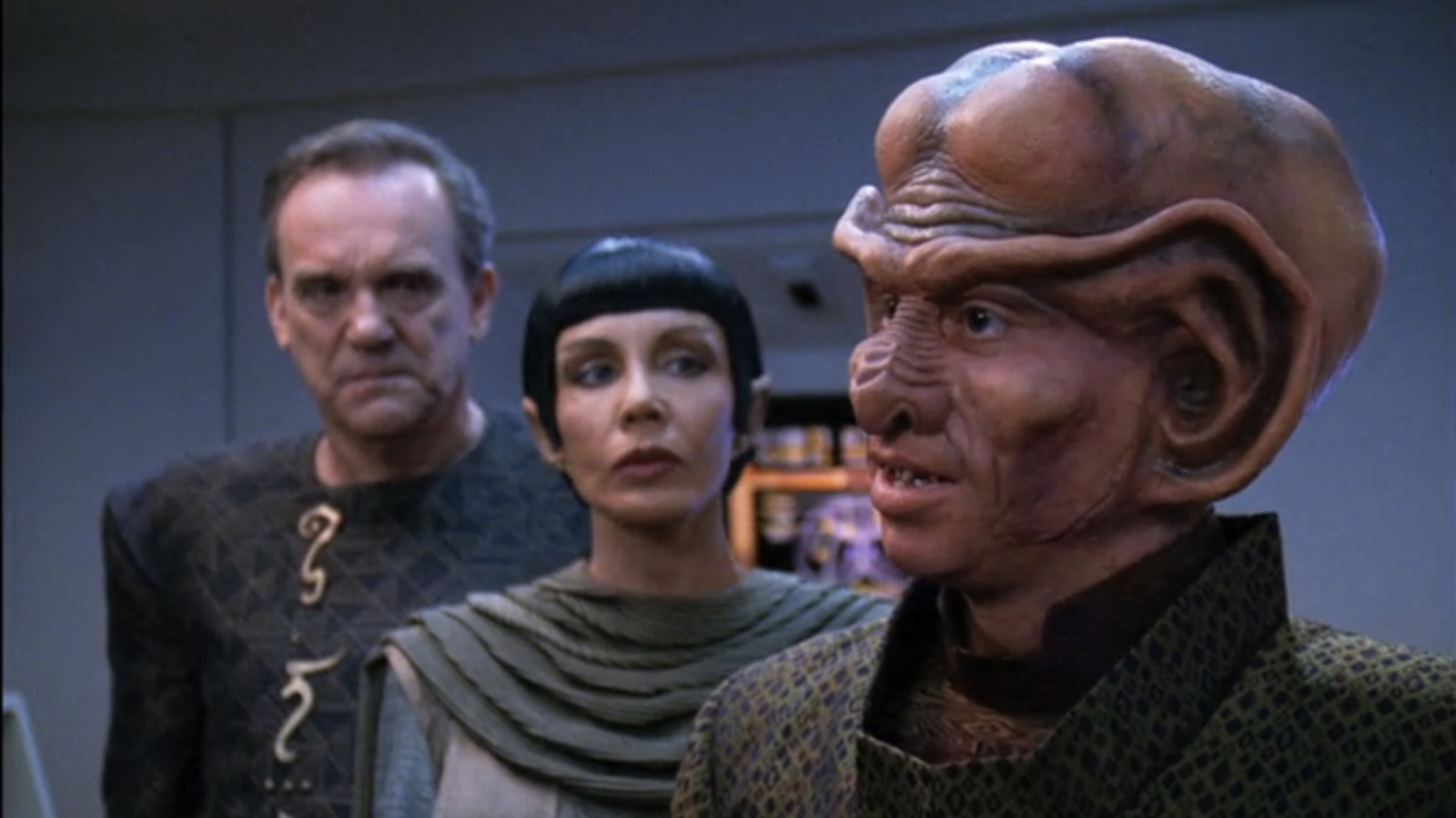
Next to the Klingons, Star Trek’s Romulans were the next greatest interstellar rivals to the Federation in the original series. When they first show up on screen, in the iconic installment “Balance of Terror,” we learn that this is the first time anyone in Starfleet has ever seen a Romulan face-to-face. And we’re shocked to learn that they look identical to Vulcans, a key plot point in the story. Like Vulcans, Romulans have bowl cut hairdos, pointy ears, and slanted eyebrows.
Two decades later, in Season 1 of “Star Trek: The Next Generation,” we meet the Romulans again, but this time, they have one big physical feature added since we last saw them: a bulbous, V-shaped ridge on their forehead. Like the visual update to the Klingons, audiences are left to assume that this was a simple visual retcon, and Romulans remained with this look through the ’90s and into the 2000s in “Star Trek: Nemesis.” The look was even used for “Star Trek: Enterprise,” set before the original “Star Trek,” suggesting they’d always looked this way — but there was never an explanation for the change on-screen.
Decades later, 2009’s “Star Trek” reboot featured a Romulan villain, Nero, who inexplicably was depicted as one of the ridgeless Romulans. Again, no explanation. But “Star Trek: Picard,” a few years later, retconned them all when it included Romulans with and without ridges, suggesting that the ridges are simply a feature of some Romulans and not others.
The Borg went from robots to zombies
The Borg might be the most well-known “Star Trek” villain that originated from “The Next Generation.” They were the adversaries faced by the crew of the Enterprise in one of the greatest season-ending cliffhangers in TV history, “The Best of Both Worlds.” They were also the villains in the best “Trek” film starring the “TNG” crew, and were persistent enemies of Captain Janeway in “Star Trek: Voyager.” But they’ve been radically changed more than once over the years.
Some casual Trekkies may forget, but in their first appearance, in the episode “Q Who?”, the Borg are said to be genderless and born in breeding chambers aboard their strange, cube-shaped ships. They are said to have a collective consciousness and no defined leader, but years later, we learned that the Borg aren’t bred, but “assimilated” into their collective. This is done through the use of nanites that infect a person’s blood and quickly transform them into a member of the Borg collective.
The film “Star Trek: First Contact” changed them again, turning them from mere cyborgs into zombie-like monsters with tendrils that attack a victim like a vampire. That film also retcons the entire concept of the collective, introducing the Borg Queen (Alice Krige). Later episodes of “Voyager” seem to suggest there is more than one Queen, and perhaps multiple “hives.”
The Trill were overhauled because of one actor
“Star Trek: Deep Space Nine” introduced fans to numerous new alien races, including the Changelings, the Jem’Hadar, and the Breen. The Trill are also given the spotlight thanks to the character of Lieutenant Dax (Terry Farrell). The Trill are a species with some members who are exceptionally long-lived, symbiotic beings: Their true self is a worm-like creature that is placed into a host body, and is transferred to a new host when that body dies. Dax, in fact, is on her eighth host body and has lived for hundreds of years.
What some may forget, however, is that the Trill weren’t new to “Deep Space Nine.” They’d first been introduced in the “Next Generation” episode “The Host.” There, we meet Ambassador Odan (Franc Luz), a Trill diplomat who falls in love with Dr. Beverly Crusher (Gates McFadden). He’s a solemn, serious, but charming man, and his alien nature is seen through a roughly M-shaped ridge on the forehead.
But over on “Deep Space Nine,” no Trills seem to have anything on their foreheads at all, and instead have spots like an animal that go down the sides of their body — a design also used for a different alien species, the Kriosians, in the “TNG” episode “The Perfect Mate.” These changes are never once addressed on-screen, but the real reason for them is that the bulbous forehead makeup just didn’t look good on actress Terry Farrell during early screen tests, so producers simply altered the design of the Trill.
The Gorn got more terrifying in the 21st century
Paramount+
There are few episodes of “Star Trek” more famous than the legendary 1967 episode “Arena.” It’s famous for a message of understanding and tolerance, but also for its iconic villain, the Gorn, a humanoid reptile-like creature that gets trapped on a barren planet with Captain Kirk (William Shatner). They’re forced to fight to the death, with Kirk realizing in the end that he may, in fact, be the one in the wrong.
The Gorn are depicted through a pretty cheesy rubber costume, and for that reason, we argue it could stand a modern remake. But as famous as the Gorn were for that episode, they disappeared from “Star Trek” for decades — returning only in a 2005 episode of “Star Trek: Enterprise,” where they looked unrecognizable. There, the Gorn character is depicted as animalistic, barely bipedal, and with a much more lizard-like appearance. He was also entirely created with the wonders of CGI. But that’s not even the biggest change the Gorn saw.
In 2022, “Star Trek: Strange New Worlds” debuted on Paramount+, and the Gorn were a major villain. Here they’re reimagined from the ground up, with cutting-edge VFX making them look better than ever. But they are even more animalistic, seemingly driven by instinct and using humans as breeding sacks for their young. As you might expect, this has been a controversial change for fans, but with two seasons still remaining, there’s clearly more to the story, as their use of starships suggests they might not be the animals they appear to be.