
Share this @internewscast.com
We may earn a commission from purchases made through links in this article.
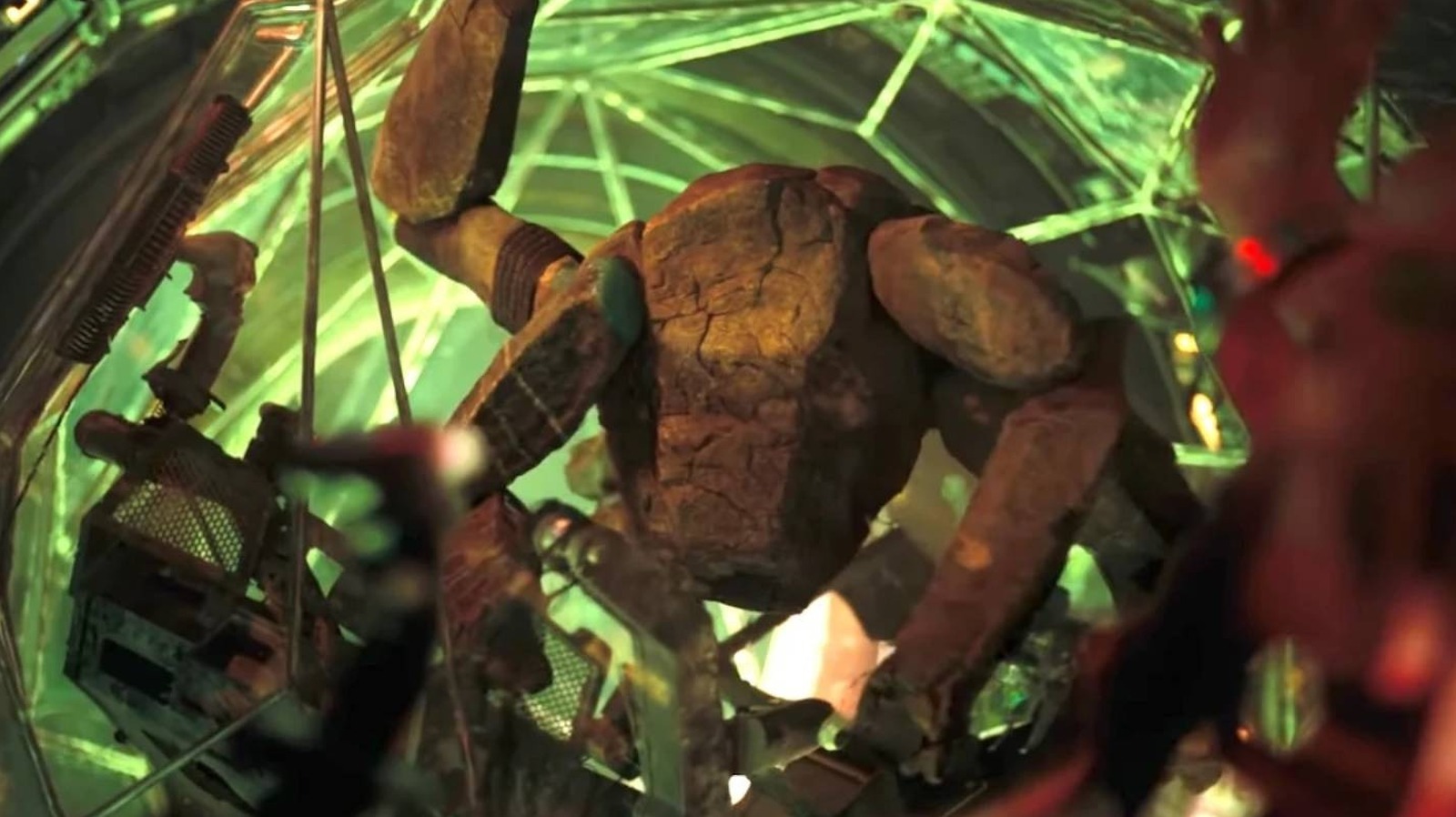
With the introduction of the intriguing creature named Rocky, “Project Hail Mary” has firmly secured its place among the great alien-themed films. Looper has commended the movie as a “stunning space adventure,” and audiences are already familiar with Ryland Grace (portrayed by Ryan Gosling) as he teams up with his extraterrestrial ally to find a solution to Earth’s impending doom. While the film effectively delves into Rocky’s character, viewers seeking a concise summary can find a helpful video recap on Looper.
Rocky originates from the planet Erid, located in the 40 Eridani star system. His planet faces a dire threat as its star is being consumed by the astrophage organism, endangering his civilization’s existence. Both Rocky and Grace embark on a mission to Tau Ceti, a star seemingly resistant to the astrophage, to uncover the reason behind its immunity. Their first challenge is overcoming the language barrier, as Rocky communicates through musical tones. Grace begins by recording these tones, associating them with numbers and concepts to establish a basic understanding of Rocky’s language.
The differences between the two characters extend beyond language. Rocky’s composition is akin to rock-like matter, a detail explored extensively in the “Project Hail Mary” novel. On Erid, the surface pressure is 29 times greater than on Earth, with an atmosphere predominantly composed of ammonia, necessitating protective measures for Rocky aboard Grace’s oxygen-filled spacecraft.
Grace quickly discovers that Rocky and his fellow Eridians lag behind humans in some scientific knowledge. Notably, Rocky is initially unaware of relativity and radiation, which might seem peculiar for a species capable of space travel. Albert Einstein’s theory of relativity posits that time and space are relative, changing based on the observer’s perspective. Given that Eridians lack eyesight and do not perceive light, their difficulty in comprehending these concepts becomes understandable.
The oversight regarding radiation proves to be significant, as it leads to the demise of Rocky’s entire crew before reaching Tau Ceti. Rocky survives only because his quarters are adjacent to the astrophage. The astrophage, which consumes energy from stars, also absorbs other forms of radiation, providing Rocky with an inadvertent safeguard during his journey.
Rocky is smart in some ways and behind in others

Amazon MGM Studios
Grace soon learns that Rocky and all Eridians lag behind humans in certain areas. Initially, Rocky has no idea about relativity and radiation, which would seem odd at first for a space-faring species. Albert Einstein’s theory of relativity suggests that time and space are not fixed concepts but instead change based on one’s frame of reference. It’s heavily reliant on light, and since Eridians don’t have eyes and don’t perceive light, it’s understandable why they might not be able to grasp these ideas.
Radiation is also a pretty massive oversight — it’s responsible for all of Rocky’s crew dying before reaching Tau Ceti. Rocky only survives because his quarters are close to the astrophage. Since the astrophage eats energy from stars, it makes sense that it could consume other types of radiation to keep Rocky safe.
Despite these gaps in knowledge, Rocky is an outstanding engineer who immediately proves why he was a great pick for the Eridian mission. Not only does he make his little hamster ball to traverse Grace’s ship, but he constructs models to communicate with Grace originally. He also creates a lengthy chain so that they can go “fishing” for whatever’s eating the astrophage on the planet they dub “Adrian.” Although Rocky is a completely new type of alien compared to what we’ve seen in other movies, making him part of some of the more confusing moments in “Project Hail Mary,” everything gets explained pretty easily. If you have more questions, refer back to our video at the top.