Share this @internewscast.com
Rod Serling’s groundbreaking television series, “The Twilight Zone,” managed to be both ahead of its time and a brilliant reflection of the era in which it was created. Serling had a bold vision for his anthology series, using it as a platform to delve into pressing social issues that America was grappling with in the post-World War II era. As the turbulent 1960s began, the show embarked on a sci-fi-laden journey into realms where individuals were compelled to face their primal instincts and, ideally, aspire for a better world. Among that initial wave of episodes, there were timeless classics that resonate just as strongly today. However, there were also episodes that missed the mark, veering into a realm that felt out of sync with the show’s intent.
Serling’s ambitions were often commendable. The episodes highlighted in this discussion tackle themes such as racism, xenophobia, misogyny, colonialism, and divorce, frequently through a progressive lens. While “The Twilight Zone” generally served as an engaging medium for exploring these social themes, there were occasions when certain episodes faltered. Sometimes, Serling’s quest for transcendence resulted in missteps, with episodes teetering on the delicate line between sincerity and kitsch.
So, as you venture further into this analysis, imagine crossing into a realm of both shadows and substance—of ideas that didn’t quite hit the mark, and those that utterly missed it. Welcome to the exploration of The 10 Worst Episodes of “The Twilight Zone.”
Take “The Jungle,” for instance, an episode that seemed poised for success. It offers a progressive narrative tackling the serious issue of an American businessman imposing on foreign lands, disrupting local traditions and harming indigenous people for profit’s sake. John Dehner portrays Alan, a man who has just returned from Africa with plans for a hydroelectric plant, much to the displeasure of the local populace. His wife Doris, played by Emily McLaughlin, returns with small objects given by a shaman for protection, which Alan dismissively burns—potentially bringing a curse upon himself.
The episode occasionally captures an eerie atmosphere with its desolate nighttime cityscapes, effectively juxtaposing the African jungles with New York City’s concrete jungle. As Alan roams the streets, haunted by imagined animal sounds, there are fleeting moments where the episode’s concept seems on point.
10. The Jungle (Season 3, Episode 12)
Yet, the narrative ultimately fails to evolve. Once the viewer grasps that Alan is haunted by the culture he plans to obliterate, the episode offers little additional depth. With the passage of time, the storyline also falls prey to clichéd depictions of African mysticism. Particularly problematic is a scene where Alan is startled by a mannequin dressed as a tribal hunter, highlighting the episode’s reliance on outdated stereotypes.
The episode’s eerie, empty, nighttime city scenes are occasionally unsettling. “The Jungle” thrives on the tension between the jungles of Africa and the concrete jungle of New York City. As Alan wanders the streets and hallucinates frightening animal sounds, there are a few moments where the episode’s conceit seems to be working.
Ultimately, however, the episode doesn’t really go anywhere. Once you’ve caught on to what the episode’s doing — that this man is haunted by the sounds of the culture he’s soon to destroy — there aren’t really any additional shades layered on top of the story. A few decades on, the episode also seems to have dipped too far into stereotypical tropes about dark magic coming out of Africa. Especially egregious is the scene where Alan is frightened by a storefront mannequin dressed like a tribal hunter.
9. Cavender is Coming (Season 3, Episode 36)
As “The Twilight Zone” stretched on, it began to spin its wheels. An early episode called “Mr. Bevis” was about a guardian angel trying to help a hapless man. In Season 3, the show revisited the concept, once again trying to craft a backdoor pilot that could’ve supported its own show. Once again, it failed, hard.
“Cavender is Coming” was broadcast with a laugh track, evidently in an attempt to clue audiences in to the fact that Cavender (Jesse White) might someday get a sitcom. He didn’t, because “Cavender is Coming” is somehow a worse version of “Mr. Bevis,” which already isn’t the show’s strongest episode. This time, the guardian angel is paired opposite Carol Burnett, one of the funniest women who’s ever lived. She doesn’t really get a chance to show it off here, however; mostly making goofy facial expressions as she stumbles through a story about how wealth doesn’t actually make people happier. It’s not a particularly novel observation, which would be forgivable if the episode were funnier, but it isn’t.
Rod Serling was reportedly a huge fan of Burnett, and after the episode aired he sent her a letter of apology. His daughter Anne told HuffPost, “[He wrote] saying how sorry he was that the show was so bad, and he would buy her a pastrami sandwich. She said something like, ‘Oh, it wasn’t so bad, but I don’t like pastrami.’”
8. Young Man’s Fancy (Season 3, Episode 34)
Thanks to frequent holiday-related “The Twilight Zone” marathons, plenty of people who grew up long after its initial airing still feel a certain amount of childhood nostalgia for the show. The show itself was concerned with nostalgia, offering up several episodes about people returning to the place where they grew up while learning important lessons about the dangers of romanticizing the past. Some of those episodes, like “A Stop At Willoughby,” are stone-cold classics.
And then there’s “Young Man’s Fancy,” an episode about a man named Alex (Alex Nichol) who returns to his childhood home after the death of his mother (Helen Brown). Alex is a newlywed and his wife Virginia (Phyllis Thaxter) is disturbed by just how much her husband misses mommy. The house itself seems out of time, as though it’s regressing to what it looked like when Alex was a child. Soon, Alex himself regresses, so full of longing for a time when his mother cared for him that he becomes a kid again.
In addition to centering around a theme we’ve seen before on this show, “Young Man’s Fancy” is mostly a Freudian soup of confusing psychosexual resentment. It becomes increasingly uncomfortable to watch Virginia compete with her husband’s dead mother for his affection. By the time the credits roll, we’re glad to flee that strange relationship right along with her.
7. The Whole Truth (Season 2, Episode 14)
“The Whole Truth” seems like it was created using a Mad-Libs generator. It’s about a sleazy man named Hunnicut (Jack Carson) who buys a used car and realizes that he’s no longer able to lie. It’s sort of an early take on the plot that would later be used in the Jim Carrey film “Liar Liar,” but it doesn’t have the benefit of Carrey’s elastic acting. Instead, everyone involved seems desperate to sell a concept that isn’t all that interesting to begin with.
There are a few other things about “The Whole Truth” that make it a major misstep in “The Twilight Zone” canon. In the show’s second season, several episodes were shot on video, which would’ve been cheaper than film. In “The Whole Truth,” you can tell. The episode was clearly shot on a soundstage, and the switched-up filming style isn’t kind to the actors, the sets, or the dialogue.
“The Whole Truth” is also one of the few episodes of “The Twilight Zone” pegged to a specific event. The episode aired the same day as President John F. Kennedy’s inauguration, and it ends with Hunnicut on the phone asking the operator to connect him to Jack Kennedy so he can pass on important information he’s learned about Kruschev. This show was never above gimmicks, but this is a gimmick aimed at making the show timely rather than timeless, and it just doesn’t land.
6. The Bewitchin’ Pool (Season 5, Episode 36)
You won’t find “The Twilight Zone” on our list of the 10 worst series finales of all time, but it certainly could’ve been included. “The Bewitchin’ Pool” was the final episode aired during the show’s initial run, and it’s one of the worst episodes they ever produced. It’s about kids named Sport (Mary Badham) and Jeb (Jeffrey Byron), two normal children who are in denial about the fact their parents’ marriage is falling apart. When they swim down to the bottom of a swimming pool in protest, the kids discover a portal to an idyllic forest home overseen by the folksy Aunt T (Georgia Simmons).
There’s no other way to put it: This episode is cloying. “The Twilight Zone” was always earnest, reflecting Rod Serling’s steadfast belief in the power of storytelling to effect change in the world. Unfortunately, “The Bewitchin’ Pool” is so sugary-sweet that it’s almost unbearable. It’s wrapped up in a neat moral about how some parents don’t deserve their children, but Aunt T and her commune of runaways come off as creepy rather than comforting.
“The Bewitchin’ Pool” fails on a technical level, too. The outdoor scenes feature distracting dialogue clearly recorded after-the-fact. Mouths often don’t match the words being said, which is confusing. Sport was even dubbed over by June Foray, an adult woman who voiced everyone from Rocky the Flying Squirrel to Magica DeSpell on “DuckTales.” Bewitchin’, it ain’t.
5. Jess-Belle (Season 4, Episode 7)
“Forbidden Planet” beauty Anne Francis starred in two episodes of “The Twilight Zone.” The first, “The After Hours,” finds her trapped in a department store where the mannequins come alive at night. It’s a strange, eerie episode, which Looper named as one of the 30 best “Twilight Zone” episodes.
“Jess-Belle,” on the other hand, is a joke. Francis plays the titular character, a Southern twist on the Biblical Jezebel. She’s madly in love with a man named Billy-Ben (James Best), and to get him to love her back, Jess-Belle turns to witchcraft. Unfortunately, the curse backfires, and Jess-Belle becomes a leopard every night. The fourth season of “The Twilight Zone” expanded to fill an hour, and the storytelling suffered for it. This is already a thin concept explored better elsewhere — there are shades of much better material in something like “Cat People” – and stretching it out to an hour makes its weaknesses even more apparent. There’s just not enough there, there.
Those weaknesses stand out in even sharper relief, in fact, if you compare “Jess-Belle” to “Cat People.” Whereas the Jacques Tourneur film builds to a climactic transformation sequence made indelible through its simplicity, “Jess-Belle” doesn’t bother. When she transforms, the episode is content to overlay some mist and some stock footage of a leopard. It’s a bore.
4. The Incredible World of Horace Ford (Season 4, Episode 15)
“The Incredible World of Horace Ford” is another hourlong Season 4 episode, and it’s even worse than “Jess-Belle.” Whereas there’s some camp factor to be found in that one — Anne Francis is always watchable, even when the episode around her is bad — this one is just an unpleasant watch. Further, this hourlong episode is another one of those episodes about how your idyllic childhood may not have been as idyllic as you remember, so we get to watch the show spin its wheels for even longer than normal.
Pat Hingle plays the titular Horace Ford, a toymaker who thinks he’s honoring his wonderful upbringing with the trinkets he makes for kids. He views the past as a carefree time, but when he realizes he can travel back to his hometown as it existed then, Horace comes to believe there might have been more going on around the edges than he was aware of as a child.
This is an episode about fun, but there’s not much fun to be had. We’re all used to the way these nostalgic “Twilight Zone” stories go at this point in the show’s run; it’s clear that Horace is going to learn a lesson about living. By the time Horace realizes he should be fine with the fact that he’s now an adult, it feels like we’re the ones who have aged.
3. Four O’Clock (Season 3, Episode 29)
There’s a subgenre of “The Twilight Zone” episodes that’s all about power fantasies. Several great episodes revolve around meek, misunderstood people finally getting revenge, finding themselves able to right a wrong that’s bugged them for a long time … only to realize that revenge isn’t all it’s cracked up to be. “Four O’Clock” is about a nerdy scientist named Oliver Crangle, which is a great character name. Unfortunately, that’s one of the only high points. Crangle is plotting something against all the evil people of the world, retribution that he claims will fall upon them when the clock strikes four.
In the popular imagination, “The Twilight Zone” was a show that relied on twist endings, on pulling the rug out from under viewers in the last few moments of an episode. That wasn’t always the case; the show was often high-concept, but those twist endings weren’t always the point. In “Four O’Clock,” though, the twist is not only predictable, it’s executed with all the subtlety of a sledgehammer.
Crangle, we learn, is himself evil. We learn this when the clock strikes four and he is shrunk down with the rest of them; not even coming up to the windowsill anymore. The parrot he’s been bickering with looks hungry, and we’re left with the impression that he might be the bird’s next snack. It’s not one of the best twist endings in “Twilight Zone” history, to put it mildly, and it muddies the moral about holding powerful people to account.
2. The Gift (Season 3, Episode 32)
The truth about “The Twilight Zone” is that even the worst episodes are usually worth watching. There’s something so charming about the show’s belief in the power of mankind, the power of storytelling, and the power of science fiction to break down barriers. This is a show all about how people should learn to get along. Even when Rod Serling and his team of talented writers came up with a stinker, it was usually still a thinker.
Not so with “The Gift.” The Season 3 episode plays like a parody of the show’s worst instincts, taking a nuanced issue like xenophobia and twisting it so far that it comes back around to being offensive. This episode takes place in a Mexican village visited by a humanoid alien (Geoffrey Horne), who is white-coded. The residents of the village include a young boy named Pedro (Edmund Vargas) who befriends the visitor, but everyone else is murderously suspicious of this strange man who’s entered their small town.
In the final moments of the episode, mob violence ends in the alien lying dead while the gift he’d brought them set ablaze. They are just able to make out an explanation in the ashes: This was a cure for cancer. Their suspicion of outsiders destroyed their ability to save untold millions of lives. Oops! Unlike the best “Twilight Zone” twists, this one isn’t shocking so much as groan-worthy; surely we could’ve come up with something more subtle?
1. The Bard (Season 4, Episode 18)
CBS
It’s tempting to call “The Bard” so bad it’s good. After all, you’ve got Burt Reynolds playing a character named Rocky Rhodes, a mumbling, sneering take on the Marlon Brando style of acting that had taken Hollywood by storm the decade before. Reynolds is quite good at the slouching persona, pointing toward a different style of career he might’ve enjoyed, had he gone down a different path than leading the cast of “Smokey and the Bandit.”
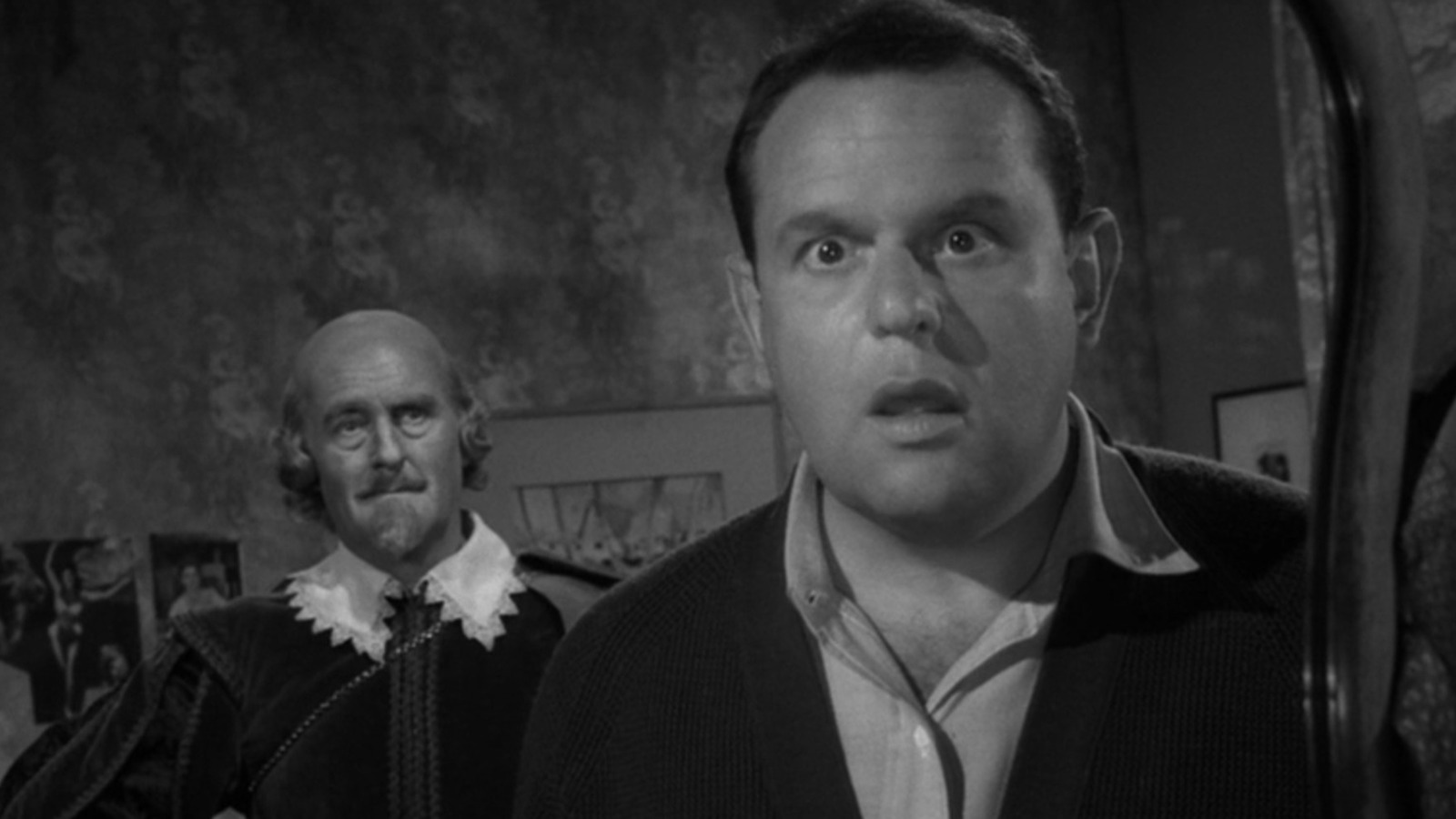
Unfortunately, this episode also has John Williams as William Shakespeare. Thanks to some black magic, a terrible screenwriter named Moomer (Jack Weston) brings the Bard to the present-day, enlisting his help writing scripts for television. It’s ostensibly a comedy, but almost none of the jokes land. This is also an hourlong episode, which mostly means that it plays variations on the same theme endlessly. That is: Oh boy, writing sure is different today than it was in Shakespeare’s time, isn’t it?
These days, “The Bard” is perhaps best-remembered as a TV Easter egg. The episode is briefly visible airing on television in the series finale of “The Sopranos.” Creator David Chase explained at a panel (via Entertainment Weekly) that despite its reputation as one of the worst episodes of the entire “Twilight Zone” run, the episode works. He insisted, “It was a critique and a slam of network television, and it was very funny.” Whatever you say, David!