
Share this @internewscast.com
Vin Diesel may be synonymous with the adrenaline-fueled “Fast and Furious” saga today, but in the early 2000s, he made his mark in the science fiction genre with the cult classic “Pitch Black.” This film introduced audiences to the enigmatic character of Riddick, a role Diesel would reprise in several sequels. However, the Riddick series isn’t Diesel’s only foray into sci-fi. His 2008 film “Babylon A.D.” had all the makings of a sci-fi hit, though it ultimately fell flat.
20th Century Fox
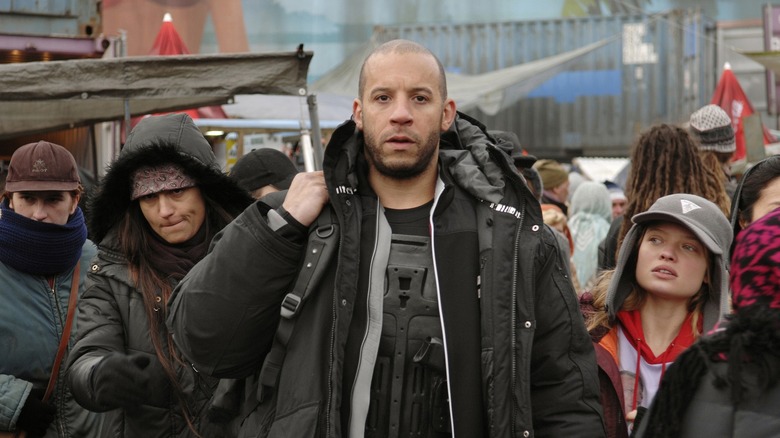
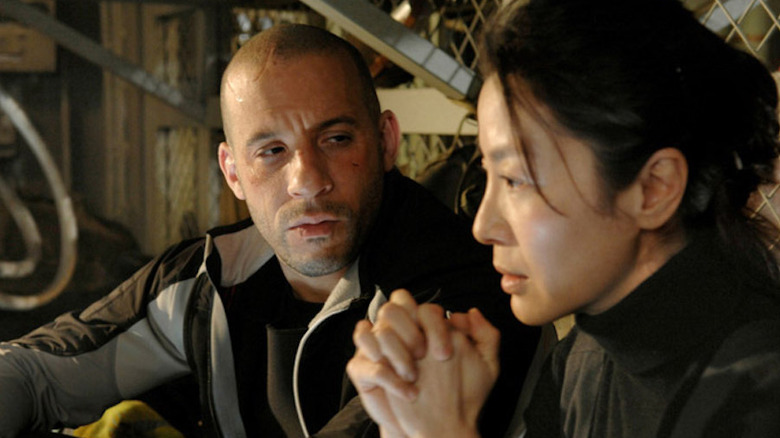
Set in a dystopian future dominated by mega-corporations and rampant crime, “Babylon A.D.” hit theaters in 2008, nestled between “Fast & Furious: Tokyo Drift” and “Fast & Furious.” The film stars Diesel as Hugo Toorop, a hardened mercenary tasked with escorting Aurora, a mysterious young girl played by Mélanie Thierry, to New York City. Accompanied by Aurora’s guardian, Sister Rebekah, portrayed by Michelle Yeoh, they soon discover Aurora’s extraordinary abilities, attracting the attention of sinister forces.
Despite its promising cast and stunning visuals, “Babylon A.D.” struggled to deliver on its potential. The film aspired to be a thought-provoking sci-fi epic but failed to hit the mark, resulting in plans for a series being scrapped following poor reviews. While the film’s action scenes and Diesel’s performance had potential, they could not salvage the overall execution, which was criticized for being chaotic and ineffective.
Adapted from Maurice G. Dantec’s novel “Babylon Babies,” the film was rife with high-concept ideas. Still, director Mathieu Kassovitz found himself at odds with the production process. In a candid 2008 interview with AMC, Kassovitz lamented the film’s troubled journey, blaming poor production decisions and lack of creative control for the final outcome. “The script wasn’t respected,” he admitted, citing “bad producers” and “bad partners” as contributing factors to the film’s failure.
Kassovitz was initially drawn to the project by the novel’s profound social commentary. “The scope of the original book was quite amazing,” he remarked, noting the author’s foresight into the evolution of warfare as driven by financial and political motives rather than territorial disputes. However, rampant studio interference and legal entanglements overshadowed these themes, compromising the film’s intended impact.
The director of Babylon AD admits it was terrible
20th Century Fox
The director envisioned “Babylon A.D.” as a narrative about the significance of educating future generations for the planet’s salvation. Yet, the chaotic production quashed these aspirations. “All the action scenes had a goal,” Kassovitz explained, “They were supposed to be driven by either a metaphysical point of view or experience for the characters.” Instead, the film devolved into something resembling a lackluster episode of “24,” a disappointment even for cast member Michelle Yeoh, who would later gain acclaim in the “Avatar” franchise.
Kassovitz explained that he was originally drawn to the story because of its important social messaging. “The scope of the original book was quite amazing,” he insisted. “The author … saw that as wars evolve, it won’t be just about territories anymore, but money-driven politics.” Sadly, however, the entire production was plagued with problems, including studio meddling and interference from lawyers and executives who didn’t seem interested in making a good film.
“The movie is supposed to teach us that the education of our children will mean the future of our planet,” Kassovitz said. While the action he’d planned was supposed to be in service of that message, he acknowledges that the production problems derailed it. “All the action scenes had a goal: They were supposed to be driven by either a metaphysical point of view or experience for the characters… instead, parts of the movie are like a bad episode of ’24.’” In the end, it’s one of the films Michelle Yeoh, a future star of the “Avatar” movies, would like you to forget about.