Share this @internewscast.com
For countless enthusiasts of Stephen King’s work, “The Dark Tower” stands as his crowning achievement. As someone deeply appreciative of King’s storytelling, I see it as essential for grasping the breadth of his creativity and the heights popular literature can reach. This saga is monumental, and if anyone is equipped to bring it to the screen, it’s Mike Flanagan.
Flanagan, already known for adapting King’s “Doctor Sleep” and “Gerald’s Game” into films, seems an ideal choice for tackling “The Dark Tower.” However, such a project isn’t without its challenges. The narrative is long, filled with unexpected twists, particularly in “The Dark Tower IV: Wizard and Glass.” This installment is unique, even compared to its series counterparts, with its beautifully crafted Western romance that delves into the backstory of Roland the Gunslinger, enriching the overarching tale.
The challenge lies in “Wizard and Glass” momentarily stalling the series’ momentum. The narrative comes to a near standstill, making a direct adaptation difficult. Fortunately, Flanagan’s proficiency in nonlinear storytelling, paired with King’s intricate narrative, offers a creative pathway to seamlessly integrate “Wizard and Glass” into a TV adaptation of “The Dark Tower,” provided he has the creative latitude necessary.
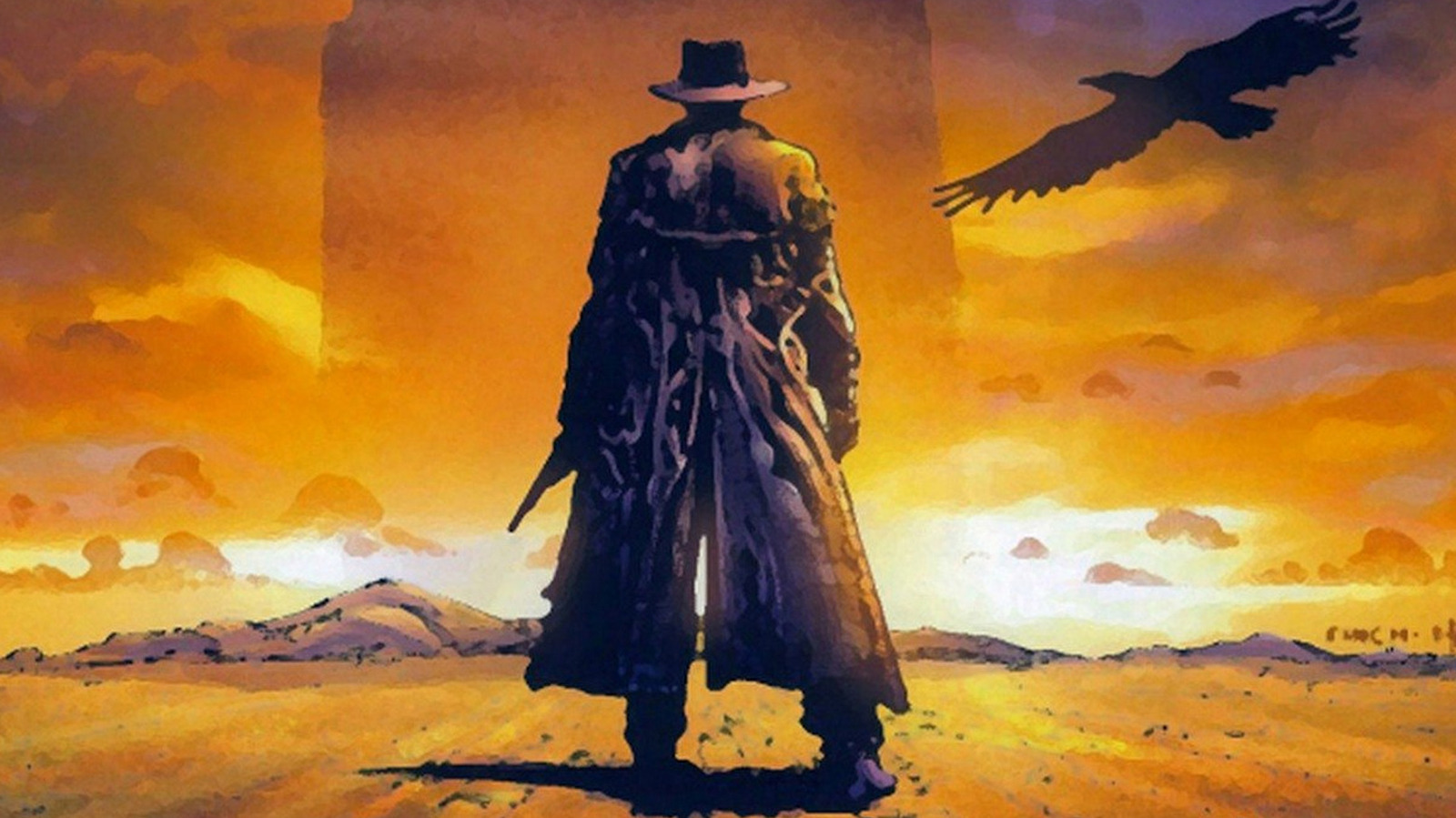
At its core, “The Dark Tower” chronicles the journey of Roland of Gilead, the last of a legendary group of knight-like figures called “Gunslingers,” as he seeks the enigmatic Dark Tower. His journey, along with the allies and adversaries encountered, forms the backbone of the story, yet it’s not the sole focus.
Originally the fourth book in the series, “The Dark Tower IV: Wizard and Glass” shifts the narrative back in time, showcasing Roland’s youth as a Gunslinger sent by his father to address issues in Mejis. There, Roland falls for Susan Delgado, a romance destined for tragedy, which profoundly influences his future.
Wizard and Glass is essential, but it also creates a problem for any adaptation
“Wizard and Glass” is a beloved favorite among fans, myself included. Its lyrical prose, idyllic setting, and deep dive into Roland’s often-guarded psyche captivate many. It’s an indispensable part of the “Dark Tower” saga, crucial for conveying the full depth of King’s epic tale.
“The Dark Tower IV: Wizard and Glass” arrives fourth in the series’ original publication order, but it actually takes the action back many years, to show us Roland as a young Gunslinger dispatched by his father to handle an issue in a fiefdom known as Mejis. There, he meets a beautiful young woman named Susan Delgado, and begins a doomed romance that will shape who he is for the rest of his days.
I love “Wizard and Glass,” and I know I’m not alone. Virtually every “Dark Tower” fan I’ve ever spoken to is in love with its language, its pastoral beauty, and its insights into the often-stony Roland’s inner life. You can’t truly tell the entire “Dark Tower” story without it.
The problem is that the book arrives just as a major cliffhanger from the previous book, “The Dark Tower III: The Waste Lands,” is resolved. After a major piece of the present-day story wraps up, Roland simply sits down and tells his friends a story about his youth. It’s a great story, to be sure, but it also stops all momentum in the main narrative, and when it comes to TV, that’s a problem. Think of all the times one of your favorite shows has devoted an episode, or an entire subplot, to spinning one character off from the rest of the ensemble. The material in “Wizard and Glass” constitutes at least an entire season of that kind of storytelling, which in the era of prestige TV, creates a stumbling block that can’t be ignored.
Wizard and Glass can still work (alongside the rest of The Dark Tower prequel material)
So, how do we fix the “The Dark Tower IV: Wizard and Glass” stumbling block issue? One school of thought is to simply throw the entire story out and devise a new way for Roland to let his friends know about his past, but I think that’s both clumsy storytelling and something that’ll have devoted fans absolutely furious. “Wizard and Glass” is a beautiful narrative, and its story deserves a place in the larger “Dark Tower” saga.
The real solution: tell the story, but dose it out in pieces alongside key moments from the present-day story. When Stephen King wrote “The Dark Tower,” he was usually finding the story as he went along. He didn’t necessarily plan for “Wizard and Glass” to appear this way, but he did know that Roland’s past was an essential part of the story, and I know that because the book isn’t the only prequel material King has written.
The first book in the series, “The Dark Tower: The Gunslinger,” includes an extended flashback explaining how Roland became a Gunslinger in the first place, and two other major works — the novelette “The Little Sisters of Eluria” and the interquel novel “The Dark Tower: The Wind Through the Keyhole” — also offer extended peeks into Roland’s past. These peeks are vital for a number of reasons. They tell us why Roland has trouble trusting people, why he’s afraid that journeying with him is a death sentence, and why he’s so determined to reach the Tower in the first place. And they can all work as nonlinear segments of story intercut with present-day events, so the past and the present inform and often even mirror each other in the larger story arc.
Mike Flanagan is a master of nonlinear storytelling
I understand if the prospect of breaking “The Dark Tower IV: Wizard and Glass” into chunks distributed throughout a “Dark Tower” series makes you nervous. It makes me nervous too, because I remember how it felt to experience that story for the first time — to feel transported to a time when things were different in Stephen King’s Mid-World universe. It’s a daunting prospect, but fortunately for us, this “Dark Tower” project is in the hands of Mike Flanagan.
For years now, Flanagan has proven himself a master of the nonlinear narrative. Through films like “Oculus” and shows like “The Haunting of Hill House,” he’s woven past and present together in elegant tapestries of terror and high emotion. He knows exactly how to make each segment of the past mirror something in the present (in “Oculus” he did that very literally) for maximum impact, and with a wealth of “Dark Tower” prequel material to choose from, he can do that with “Wizard and Glass” and other key moments throughout the entire narrative. Roland’s past shapes not just his story, but the entire overarching “Dark Tower” epic, and Flanagan can marshal all of that into a more immediate, gripping TV version.
Plus, Flanagan’s not just another Stephen King fan. He reveres King, and his own storytelling style was clearly shaped by King’s writing. For proof, just look at the three feature films he’s directed based on King’s work, often with the author’s blessing and involvement. Flanagan is not one to discard and rearrange King’s work lightly, and I for one trust him to make it all work in one grand narrative on the screen.
The Dark Tower saga will change onscreen, but it’s in good hands
Mathew Tsang/Getty Images
There’s a lot of trepidation surrounding this new adaptation of “The Dark Tower,” and I’m certainly not excused from feeling it. I remember all too well how strange, disjointed, and just plain frustrating it was to watch the 2017 film adaptation of the story, despite Idris Elba’s solid performance as Roland, and the thought of rearranging the lore again is frightening.
But that’s what adaptation is. Books and television do not function in the same way. They dispense information, reveal character, and structure major reveals in very different forms, and that means some things have to move around to make a series of books function as a live-action series. It’s scary, and there are plenty of examples in Stephen King’s bibliography alone (remember “The Mist” TV show?) in which adaptations don’t work.
But we’re talking about Mike Flanagan here, a filmmaker so successful at adapting King that he’s approaching Rob Reiner and Frank Darabont levels of love among the King faithful. I certainly have faith in him, and I believe that if we are patient, and if we allow Flanagan to tell the story his way, we’ll get “The Dark Tower” adaptation we deserve, “The Dark Tower IV: Wizard and Glass” and all.