
Share this @internewscast.com
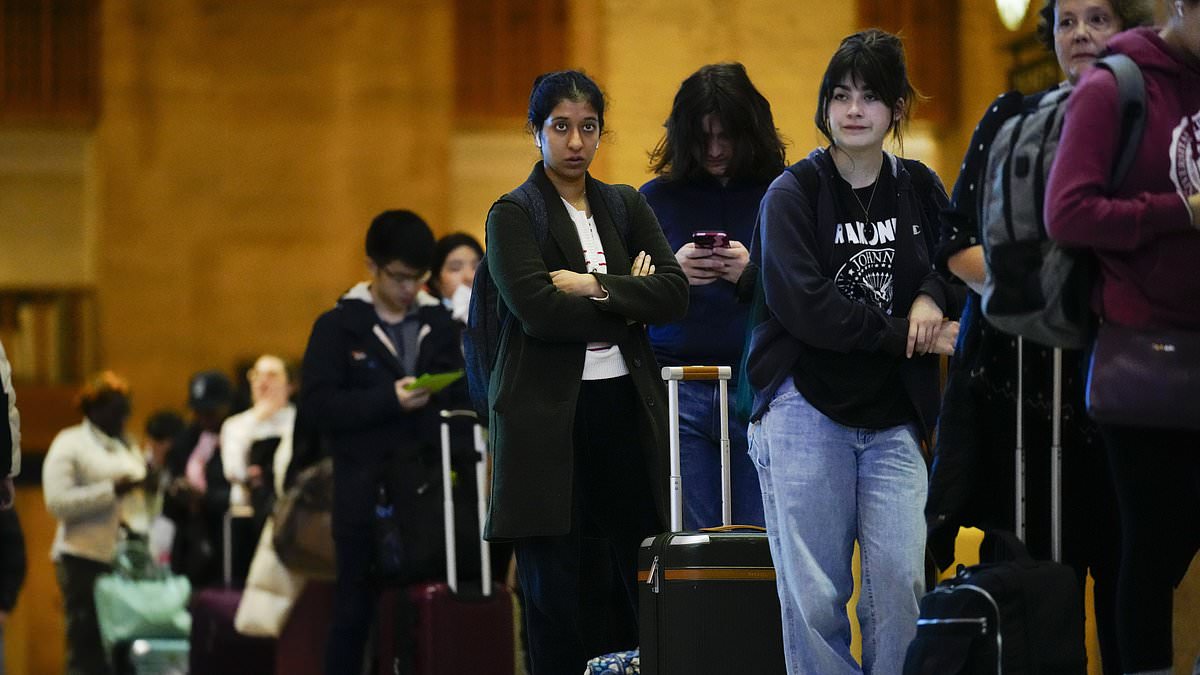
Amtrak has issued a cautionary alert to its passengers due to a potential measles exposure incident. This follows an announcement by health authorities about a passenger infected with measles who traveled from Philadelphia to Baltimore-Washington International Airport on a packed train between January 7 and January 8.
Health officials in Maryland have identified multiple locations as potential exposure points linked to this traveler. These include Philadelphia International Airport’s Terminal A East between 7:50 PM and 11 PM on January 7, an Amtrak journey from Philadelphia’s 30th Street Station to Washington, DC, from 9 PM to 11:30 PM the same evening, the Amtrak shuttle to BWI Airport between 10:45 PM and 1:30 AM, and the BWI long-term parking shuttle from 11 PM to 2 AM on January 8.
The health authorities have not confirmed whether the infected individual exhibited symptoms such as fever or rash during the journey, nor have they clarified if the person was in the highly contagious stage of the disease. It remains unknown whether the traveler had received the measles vaccination.
Health experts recommend that those who are unvaccinated reach out to their healthcare providers or local health departments and remain vigilant for early signs of measles for up to 21 days. Key symptoms to watch out for include a fever exceeding 101 degrees Fahrenheit, a cough, runny nose, and red, watery eyes.
Typically, measles symptoms appear 10 to 14 days after exposure, with a rash that initially forms on the face and then progresses downward over a period of one to four days. The virus can be spread from four days before the rash becomes visible to four days after.
Recognized as the most infectious disease globally, measles poses a significant risk, with a 90 percent infection chance for unvaccinated individuals who share airspace with an infected person, even hours later. The disease results in fatalities for about three out of every 1,000 infected individuals.
This potential exposure event occurs as the US faces a significant resurgence of measles. Last year saw 2,144 confirmed cases, the highest annual total since the disease was declared eliminated in 2000 and the most in over three decades.
Several states have emerged as viral hotspots for measles. In Utah, officials confirmed 20 new cases this week, raising the state’s 2025-2026 total to 176. Meanwhile, in the Southeast, North Carolina has reported five cases since late December, including one in 2026, and South Carolina has added 99 new infections, bringing its statewide total to 310.
![A person infected with measles traveled on an Amtrak train from Philadelphia's 30th Street Station [pictured] to BWI Airport in Maryland on January 7](https://i.dailymail.co.uk/1s/2026/01/12/21/105450919-15456997-A_person_infected_with_measles_traveled_on_an_Amtrak_train_from_-a-21_1768254444517.jpg)
A person infected with measles traveled on an Amtrak train from Philadelphia’s 30th Street Station [pictured] to BWI Airport in Maryland on January 7
Meg Sullivan, the Maryland Department of Health’s deputy secretary for Public Health Services, said: ‘Vaccination remains essential to protecting ourselves, our families, and our communities against measles and other infectious diseases.
‘These types of situations underscore the importance of knowing your vaccination status and ensuring you are up to date with all recommended vaccines.’
According to the CDC, 93 percent of measles cases are in unvaccinated people or those with an unknown vaccine status. Three percent have received one dose of the MMR vaccine and four percent have received both doses.
The odds of a vaccinated person becoming infected is very low, about three percent.
Even if infection occurs, symptoms are typically far milder and the risk of severe complications or transmission is drastically reduced.
According to national data, 11 percent, or 240 people infected, have been hospitalized and three people have died in the current outbreak.
Nearly 20 percent of children under five infected during the current outbreak have required hospitalization.
The US formally eliminated measles in 2000, meaning there had been no community spread in 12 months, thanks to widespread uptake of the measles, mumps and rubella (MMR) vaccine.
But the level of population-wide immunity needed to stave off outbreaks and protect vulnerable populations, about 95 percent, has sunk to less than 93 percent, suggesting the cases documented in 2026 are just the beginning.
Enclosed train cars and airports are extremely risky locations for disease transmission. The measles virus spreads via airborne droplets when an infected person coughs or sneezes.
Measles first invades the respiratory system, then spreads to the lymph nodes and throughout the body. As a result, the virus can affect the lungs, brain and central nervous system.
While measles sometimes causes milder symptoms, including diarrhea, sore throat and achiness, it leads to pneumonia in roughly six percent of otherwise healthy children, and more often in malnourished children.
While the brain swelling that measles can trigger is rare, occurring in about 1 in 1,000 cases, it is deadly in roughly 15 to 20 percent of those who develop it, while about 20 percent are left with permanent neurological damage such as brain damage, deafness or intellectual disability.
It also severely damages a child’s immune system, making them susceptible to other potentially devastating bacterial and viral infections they were previously protected against.
A significant measles outbreak that started last year in West Texas, primarily within a largely unvaccinated religious community, quickly spread across state lines to the rest of the country. Texas officials have recorded more than 760 cases since January 2025.
Before MMR vaccines became available in the 1960s, measles caused epidemics with up to 2.6 million global deaths every year. By 2023, that number had fallen to roughly 107,000 deaths.
The World Health Organization estimates that measles vaccination prevented 60 million deaths between 2000 and 2023.
Robert F Kennedy, Jr, in his capacity both as current head of the Department of Health and Human Services and as co-founder of the nonprofit Children’s Health Defense, has consistently cast doubt on the safety and efficacy of well-studied vaccines such as the MMR shots.
After the death of an eight-year-old girl in Texas, Kennedy acknowledged the MMR vaccine is the most effective way to prevent measles, while at the same time promoting vitamin A as an effective treatment, which is believed to have contributed to several small children being hospitalized with an overdose.
High-dose vitamin A is a standard, evidence-based treatment for measles, proven to reduce the risk of death and severe complications like pneumonia. Its life-saving effect is most pronounced in individuals with pre-existing vitamin A deficiency.