
Share this @internewscast.com
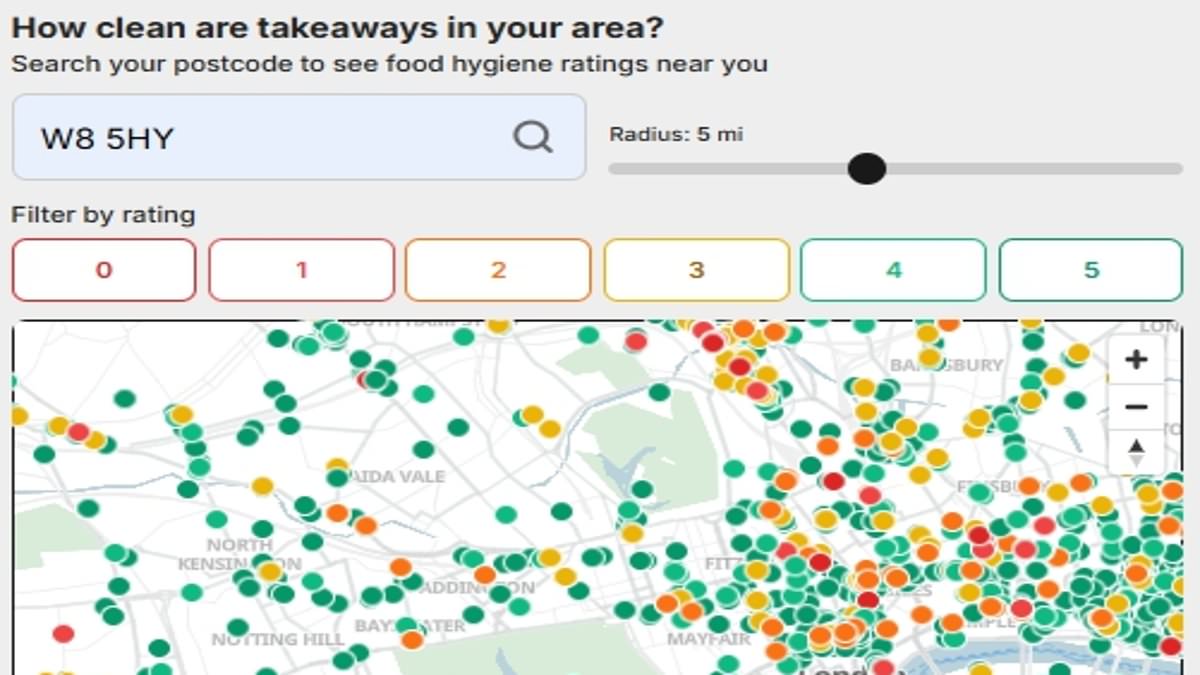
An eye-opening interactive map has exposed the dirtiest takeaways across Britain, highlighting establishments that have fallen short of hygiene standards.
A thorough investigation by the Daily Mail into the Food Standards Agency (FSA) hygiene ratings has uncovered that 3,600 eateries failed their inspections due to poor sanitary conditions.
On a national scale, this means that approximately one in every 17 takeaways and sandwich shops does not meet the basic hygiene requirements.
An alarming 175 of these establishments received the lowest possible score of zero, including various Indian and Chinese restaurants, kebab shops, pizza places, burger joints, and fish and chip shops. These venues have been instructed that they need to make urgent improvements.
Inspectors have reported finding decomposing food, rodent droppings, and insect infestations at some of the most egregious offenders. Additionally, certain premises have been reprimanded for the unsafe storage of raw chicken.
To discover how your local takeaways measure up, simply enter your postcode in the tool provided below.
In England, Wales and Northern Ireland, all venues serving food are judged on a scale between zero and five.
Scores of two or below are counted as a fail.
The Mail’s probe discovered 1,560 had a rating of two, with the FSA warning them that ‘some improvement is necessary’.
Another 1,240 scored one – meaning major improvement is necessary.
Out of a total of 63,500 outlets nationwide, it means 5.7% failed.
FSA research found it is twice as likely for foodborne illness outbreaks to occur in zero, one or two rated businesses than in those that are rated three, four or five.
Venues in Scotland are graded on a binary pass/fail basis.
Mail analysis found 660 businesses were slapped with an ‘Improvement Required’ label.
In the most serious cases, officers can close a business until improvements are made and can also recommend that a firm be prosecuted for breaching food standards regulations.
Broken down by local authorities, the worst offender was the Scottish Borders with 26% of takeaways failing inspection, followed by Aberdeen (25%) and Pendle (20%).
However, at the other end of the filthy scale, 31 councils didn’t have a single outlet that failed a hygiene rating.

Favourite Chicken in Brent, west London, was given a zero rating at an October inspection
An inspection fail can devastate businesses, damaging their reputation permanently overnight.
Some delivery platforms, such as JustEat, require a minimum rating of three to register. And if the rating drops to a zero, they are immediately removed from the app.
Consumers are now far more aware of food hygiene ratings than ever before, Food Safety Consultancy UK.
A spokesman told the Daily Mail that more people are now regularly checking ratings online, and local community Facebook groups can highlight poor scores very quickly.
‘If a rating isn’t displayed, that in itself should raise questions’, they added.
But even though everyone should be conscious of the cleanliness of where they are eating, the experts stressed that customers with allergies should be the most careful.
A Food Safety Consultancy UK spokesperson said: ‘Getting this wrong can have life-threatening consequences and has been a key factor in major prosecutions.
‘Other ongoing challenges include pest control, staff training, record-keeping, and maintaining standards during busy periods.’
Some businesses still take shortcuts – for example, not having a proper pest control contract in place, inadequate cleaning regimes, or incomplete due-diligence records.
Staff shortages and high turnover also mean training often falls behind, which directly impacts standards.
And although a lower inspection score does not necessarily mean food is unsafe at that moment, customers should definitely be wary of what they are walking into.
Ian Andrews, of the Chartered Institute of Environmental Health, said: ‘Food hygiene standards depend on a range of factors, from the training of staff and good cleaning regimes, to things like the age of the building.
‘However, when food safety controls fail, illness can result, which ties up really valuable NHS resources.
‘Environmental Health Practitioners will investigate what went wrong and look for ways to prevent it happening again. They will also take enforcement action where required to prevent illness spreading in the community.’

Pizza Experts in Kingston Upon Hull was given a zero at a June inspection
But although it is now easier than ever to find the results of a hygiene inspection online, businesses are still not required by law to display them in England – with only 72% choosing to do so.
And perhaps unsurprisingly, the likelihood of displaying it is linked to a higher rating, with 79% of five stars showing it off compared to 38% of those rated three.
Only establishments in Wales and Northern Ireland are required by law to have it displayed, but campaigners such as Which? and the FSA want to change England and Scotland’s law to be the same.
The FSA was set up in the late 1990s, in the wake of the mad cow disease crisis and the 1996 e-coli outbreak in Lanarkshire which killed 20 people.
Since then, the UK’s framework has been become well-established and viewed as generally effective.
The system works by local authorities inspecting businesses in their area at least once every two years, before passing on the results to the FSA or Food Standards Scotland (FSS).
But questions are being raised regarding if it is able to meet the demand, as many council environmental health departments have been struggling to recruit sufficient qualified staff in recent years.
Over the past decade, the number of food standards inspectors employed by local councils has fallen by 45%.
The FSA and Food Standards Scotland (FSS) have previously warned that staff shortages and cuts are ‘putting unsustainable pressure on existing local authority teams and may increase the risk of important food safety issues being missed’.
There are currently 5,495 takeaways serving food have never been inspected.

Broadway Kebab House in Handsworth, Birmingham, was given a zero rating in January 2025
Farrelly Mitchell, the co-founder and managing director of international food consultancy firm Farrelly Mitchell, told the Daily Mail outcomes can vary depending on a local authority’s resources.
He said: ‘Inspection capacity remains uneven across the country, particularly in peripheral areas or areas with a high concentration of food outlets.
‘This can lead to longer gaps between inspections and delays in re-rating.
‘Mandatory display of food hygiene ratings in England would likely help address this by increasing transparency and encouraging operators to prioritise compliance.
‘Evidence from parts of the UK where display is already mandatory suggests it drives improvements and raises overall standards.’
A spokesman for the Local Government Association, which represents councils, said they ‘know their local areas best’ and target their reduced resources at the riskiest businesses.
But it said ‘ultimately it is the responsibility of food businesses to ensure the products they produce comply fully with food safety law and pose no risk’, although it stressed councils will do all they can to maintain checks ‘despite severe budgetary pressures’.
Sue Davies, head of food policy at Which?, said it supports the FSA ensuring that more complex businesses operating nationally comply with food law, which enables local authorities to focus on high risk businesses in their areas.
The FSA claims the inspection is a ‘snapshot’ of the standards of food hygiene.
Its ratings do not cover issues such as the quality of food, customer service, culinary skill, presentation or comfort, instead concentrating on how the food is stored and prepared.
The Mail’s data was extracted from the FSA website and is correct as of December 16, 2025.
The results of every inspection is available on the FSA website, which is subjected to constant daily daily updates as more inspections roll in.
FSA chiefs recommend businesses are inspected depending on risk, ranging from once every six months to two years.
Some extremely low-risk premises – such as newsagents, market stalls and cricket clubs – may have even longer intervals between check-ups.
Businesses that fail can book a retest once they have rectified the issues in the initial report.
A FSA spokesman said: ‘The fact that premises with poor hygiene standards are being identified and scored appropriately demonstrates that local authority food officers are doing their job in protecting consumers.
‘Food hygiene standards across the UK are very high. Almost 97% of establishments achieve a rating of “generally satisfactory” or better
‘Ratings are displayed online even if a business does not display their sticker.’